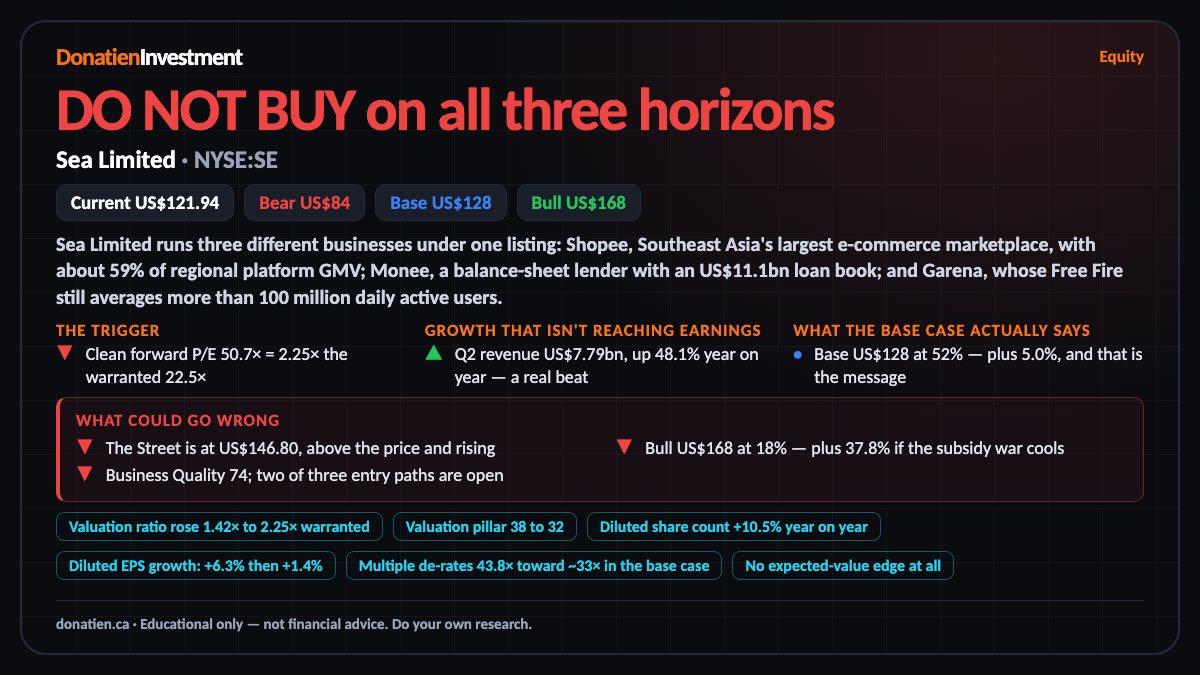
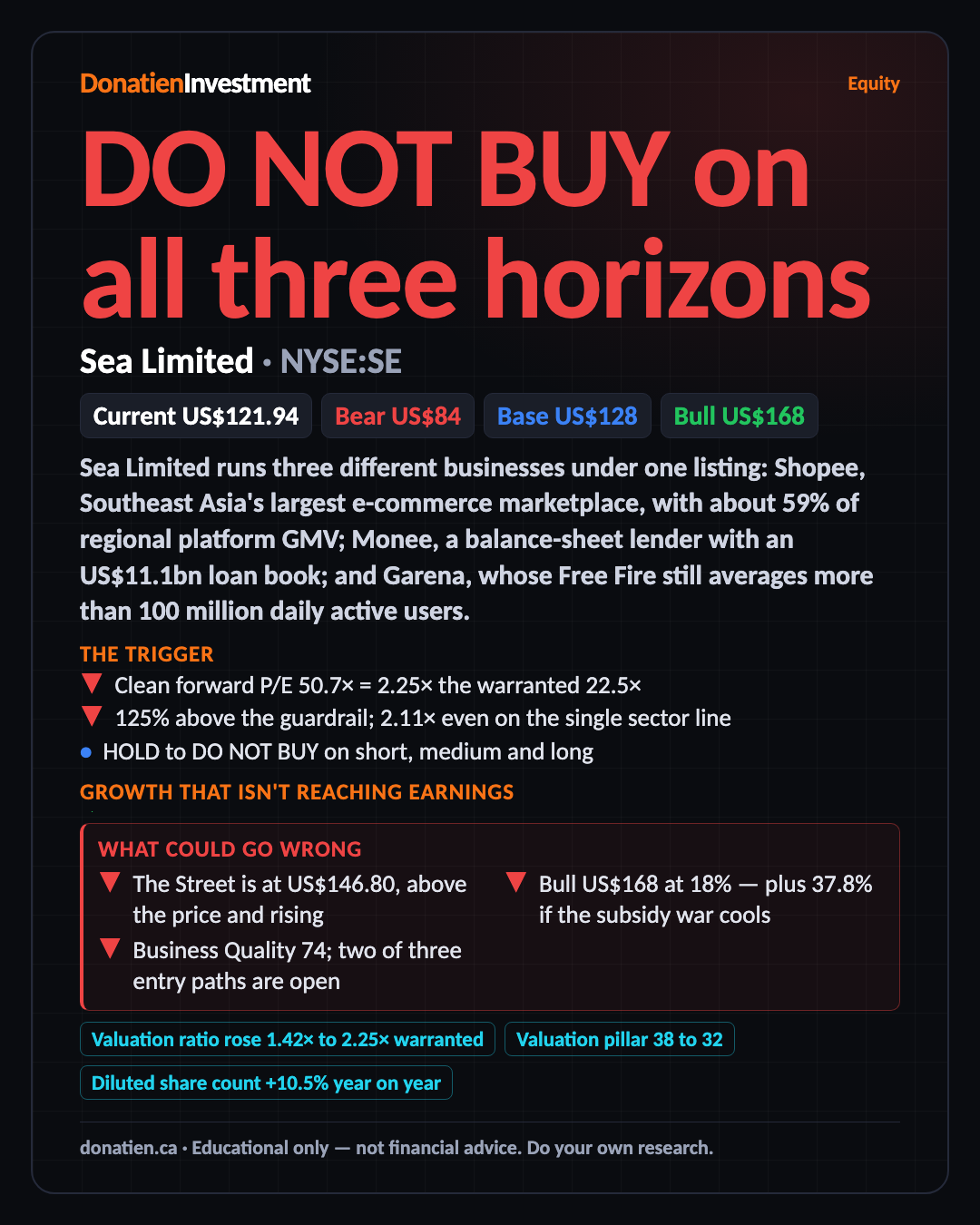
Sea Limited (NYSE:SE) DO NOT BUY on all three horizons
Clean forward P/E of 50.7× is 2.25× the warranted 22.5×, while diluted earnings per share grew 1.4% on revenue up 48.1%.
Sea Limited runs three different businesses under one listing: Shopee, Southeast Asia's largest e-commerce marketplace, with about 59% of regional platform GMV; Monee, a balance-sheet lender with an US$11.1bn loan book; and Garena, whose Free Fire still averages more than 100 million daily active users. This is a judgement about the price, not the business — Business Quality still scores 74.
The trigger
The rule that fires is Do-Not-Buy trigger two, the absolute valuation arm. On the clean basis the framework requires, Sea trades at fifty point seven times forward earnings against a warranted twenty-two and a half — a ratio of two point two five, where the trigger's limb sits at two. The trigger carries a growth exception, and it does not hold here, because the growth is not reaching the earnings line the multiple prices. Note what most of the move was not: only about zero point one three of the rise from one point four two came from the higher share price. The rest is corrected method. The multiple is now the clean forward figure of fifty point seven times, not the reported forty-three point eight. And the conclusion does not depend on this report's bespoke guardrail — on the framework's own published Consumer Discretionary line of twenty-four times, the ratio is still two point one one, still above the trigger's limb.
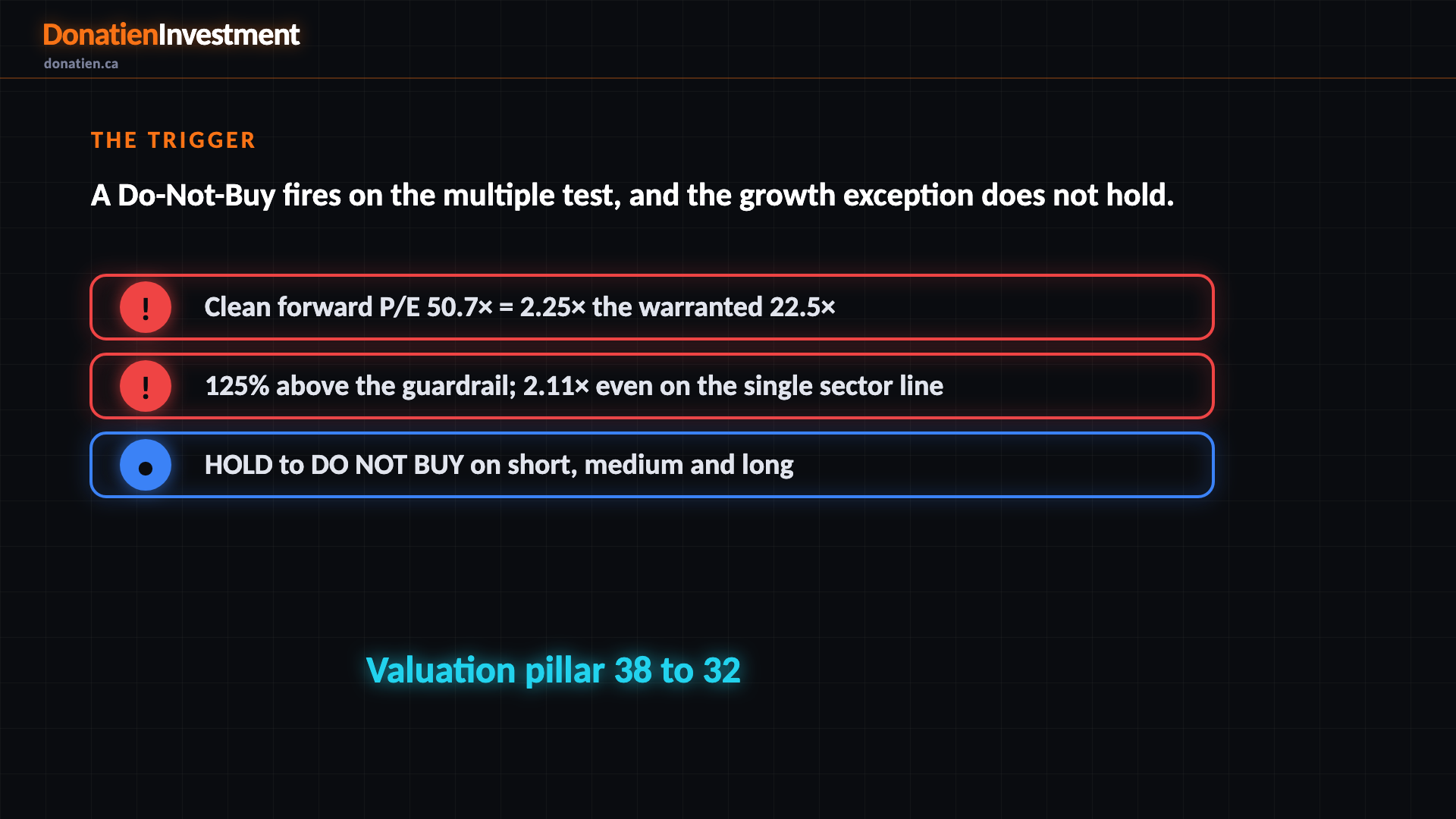
Valuation ratio rose 1.42× to 2.25× warranted · Valuation pillar 38 to 32
Growth that isn't reaching earnings
The second quarter, filed on the eleventh of August, was a genuine beat. Revenue rose forty-eight point one percent year on year to seven point seven nine billion dollars. But over the same quarter diluted earnings per share grew one point four percent, adjusted profit before interest, tax and depreciation grew ten point six percent, and all three segment margins compressed. The quarter before that, per-share earnings grew six point three percent. So the deceleration is a sequence, not a single print, and part of it is mechanical: the diluted share count rose ten and a half percent year on year as the convertible notes entered it. Revenue growth is exceptional, proven and durable. Revenue is not the stream a price-to-earnings multiple capitalises.
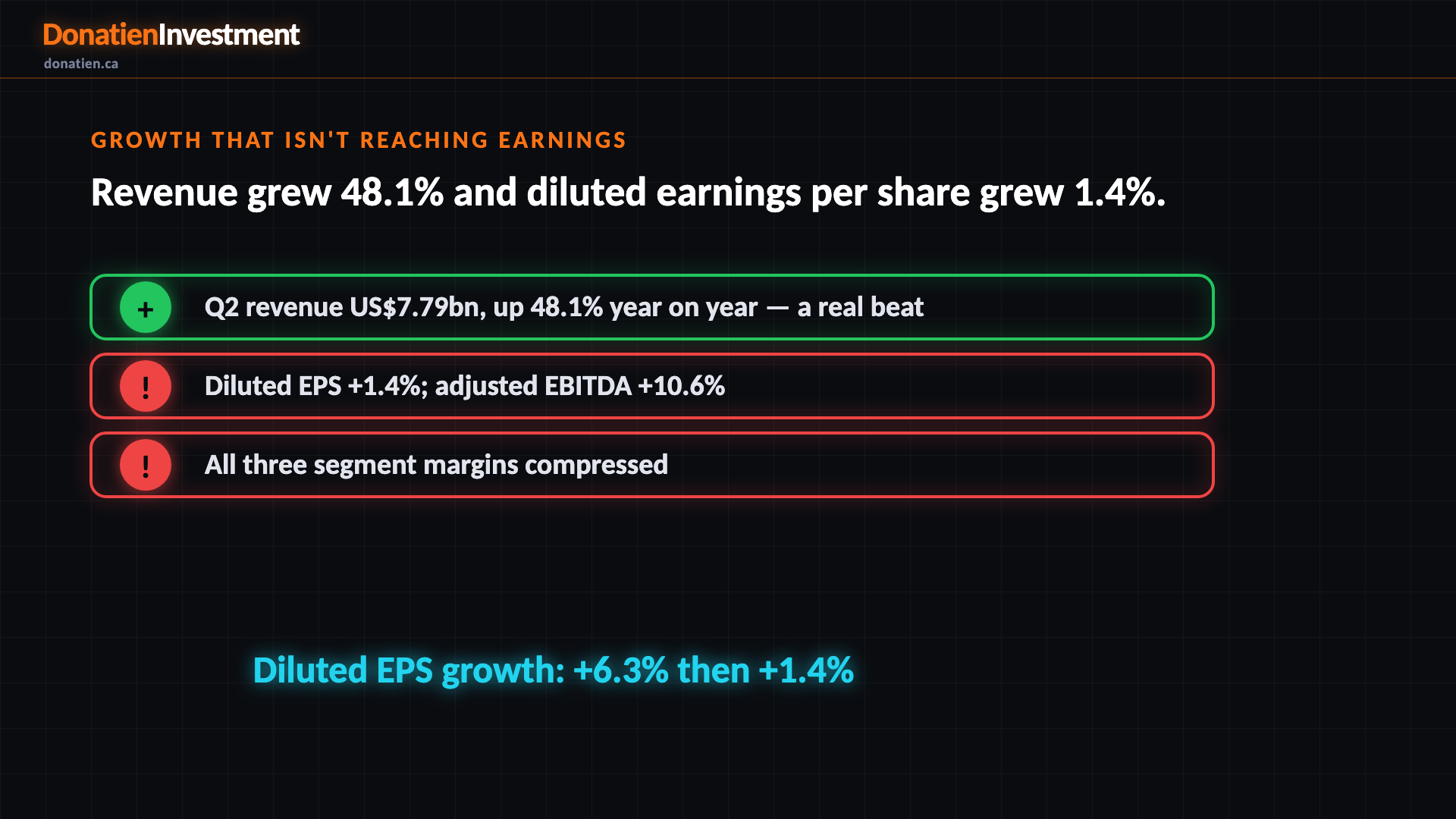
Diluted share count +10.5% year on year · Diluted EPS growth: +6.3% then +1.4%
What the base case actually says
Read the central case carefully, because it is not a bad-outcome case. It assumes Sea executes: Shopee compounding merchandise value in the mid-twenties with take rate still climbing and hitting its one-billion-dollar milestone, Monee's book growing toward fifteen billion with bad loans near one percent, Garena growing bookings high-single to low-teens. On that path per-share earnings reach about three dollars eighty-seven, up thirty-nine percent. And the total return is still about five percent, because the multiple de-rates from forty-three point eight toward thirty-three on the way. Thirty-nine percent earnings growth delivering a five percent return is the argument of the whole report. Across all three scenarios the probability-weighted value is one hundred and twenty-two dollars against a price of one hundred and twenty-one ninety-four. There is no edge.
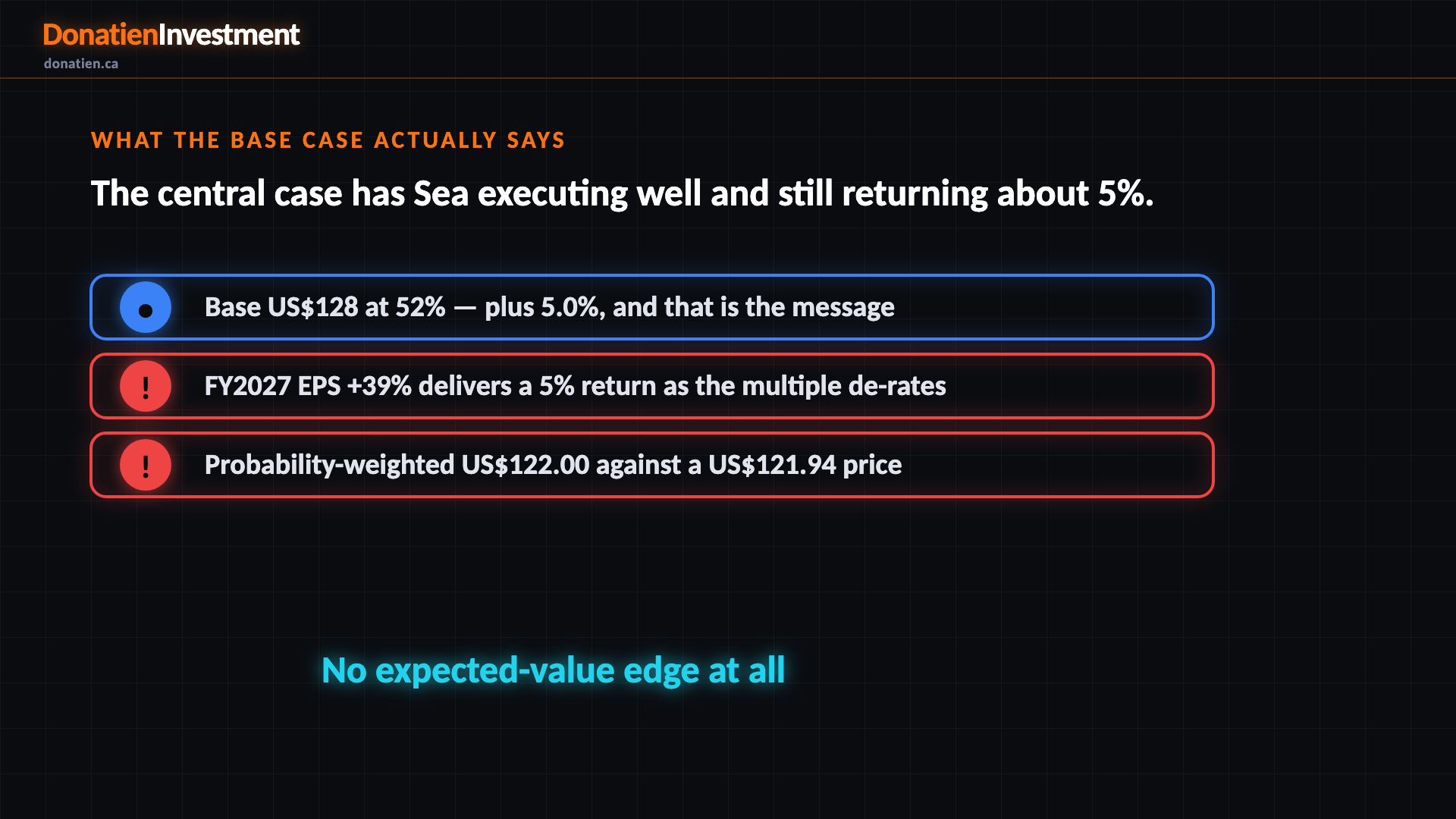
Multiple de-rates 43.8× toward ~33× in the base case · No expected-value edge at all
Three things we got wrong
Three corrections to the previous report, stated plainly. First, that run recorded non-operating income as zero percent of net income and a clean multiple identical to the reported one — the mandatory earnings-quality decomposition returned nothing when it should have found nineteen point one percent. Second, the multiple was struck off a consensus earnings figure that is not on a reported diluted basis; it is restated here using a realisation factor measured on the prior year's actuals. Third, the guardrail was a single sector line, and for a three-business group it is now weighted across the segments. None of those flatters the stock. We also restated total debt from one point two two billion to two point two two billion, because nine hundred and eight million of non-current borrowings had been left out. And this report failed its own first independent audit and was corrected in six further places before publication, including the omission that caused the Do-Not-Buy test to be mis-run.
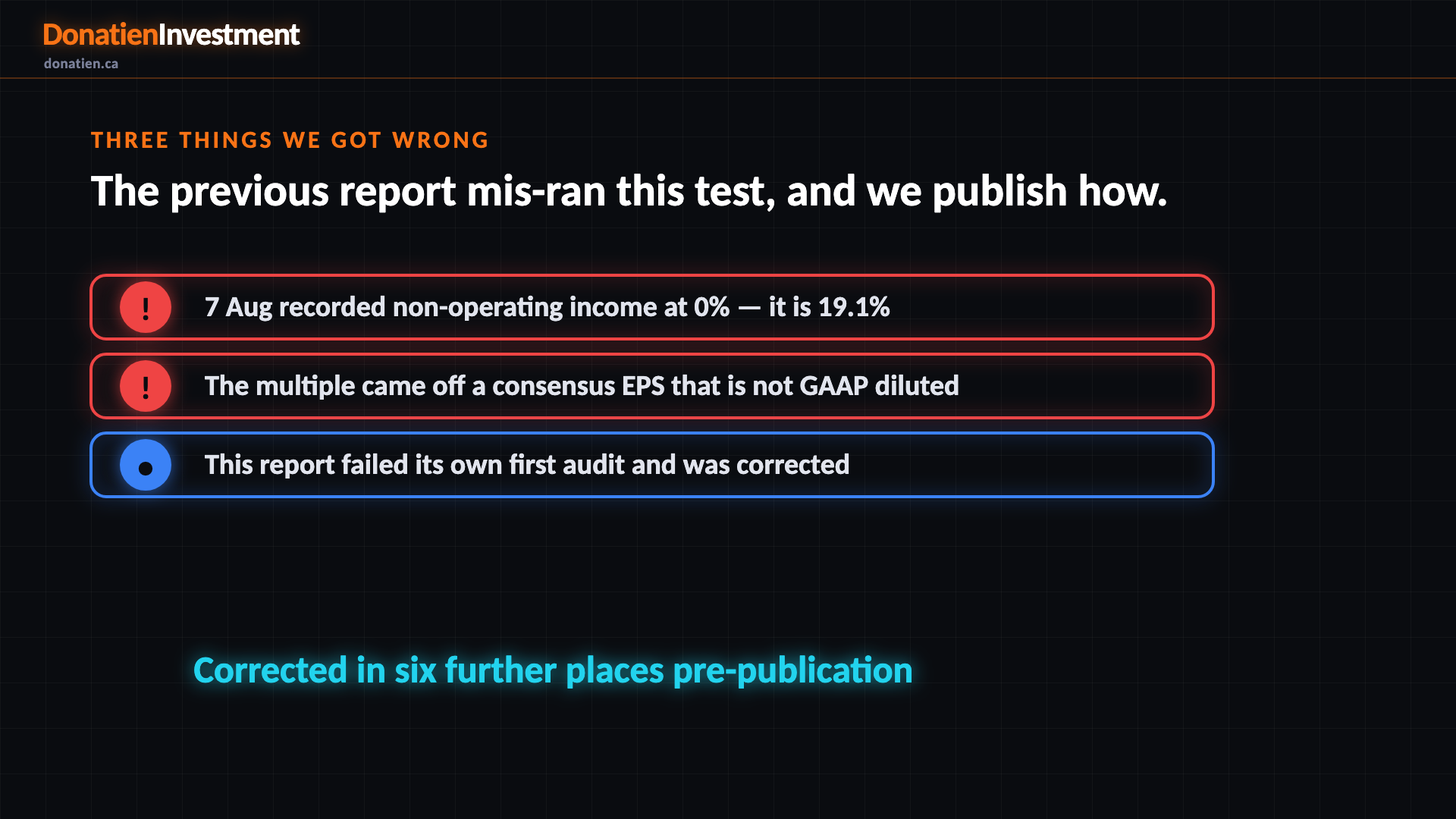
Total debt restated US$1.22bn to US$2.22bn · Corrected in six further places pre-publication
What could go wrong
The case against this call is strong and worth stating loudly. Analysts raised their consensus target from one hundred and thirty-three sixty to one hundred and forty-six eighty after the print, with zero rating changes in thirty days — so the Street looked at the same quarter and became more positive, not less. The bull case is one hundred and sixty-eight dollars, plus thirty-seven point eight percent, and it needs only two things: the subsidy war cooling as TikTok Shop rationalises spending, and Monee's provisioning decelerating below book growth. Business quality still scores seventy-four, timing improved from fifty-two to sixty on the post-results breakout, and two of the three entry paths are mechanically open. The one that is shut is price against value, and that is the single path this signal turns on. If the market keeps paying above warranted value — and it has for years — a Do-Not-Buy will look like a missed rally rather than avoided risk. We would rather be early and say so than pay fifty times earnings for one point four percent earnings growth.
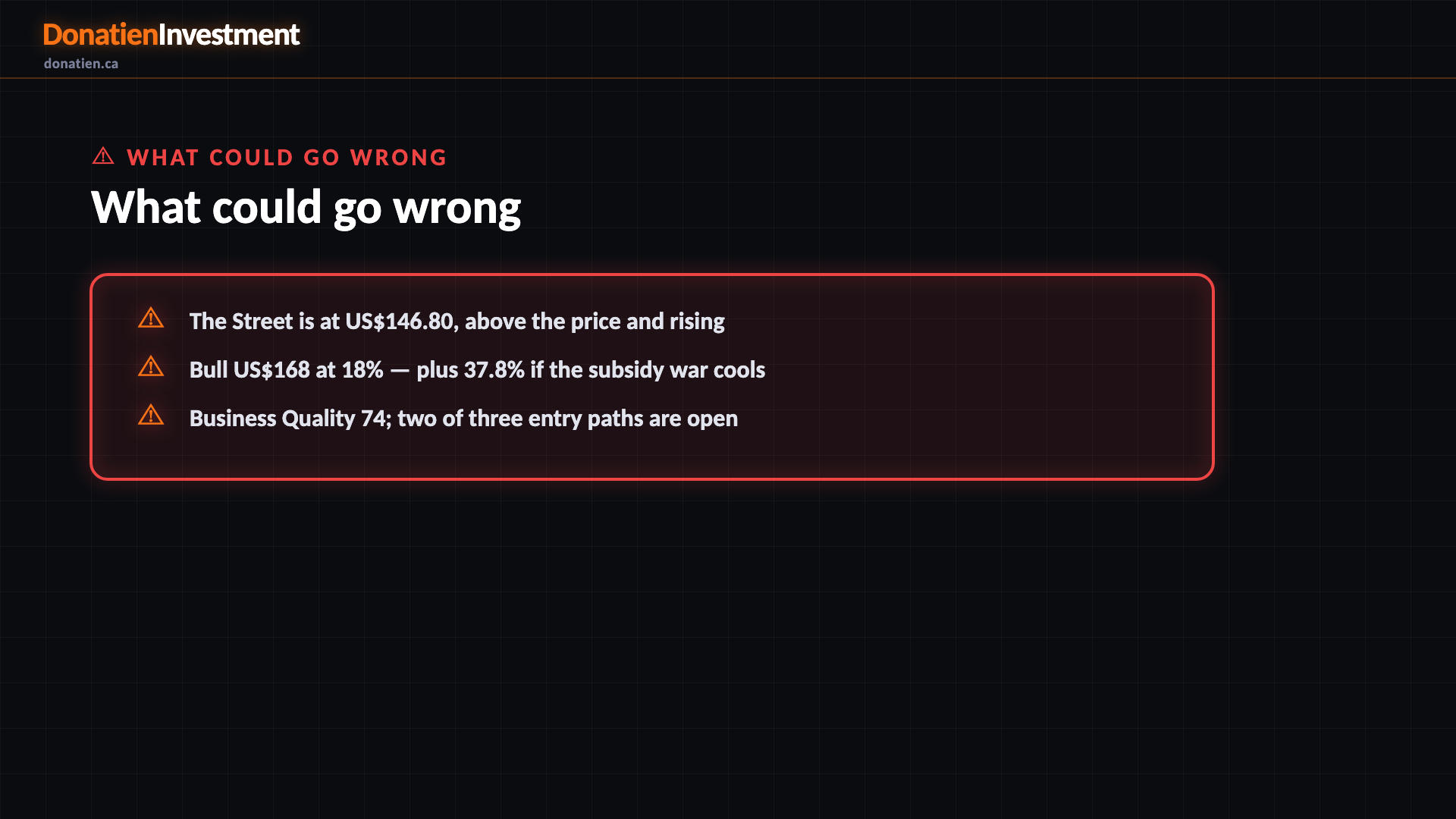
Risk vs Reward
Bull one hundred and sixty-eight at eighteen percent, plus thirty-seven point eight percent — and note it still assumes the multiple stays well above warranted, so it is a bet on execution and on continued generosity. Base one hundred and twenty-eight at fifty-two percent, plus five percent. Bear eighty-four at thirty percent, minus thirty-one point one percent, and the trigger is specific: Monee's ninety-day bad-loan ratio normalising from one percent toward two and a half to three as the fast-written 2026 vintages season, while Shopee's margin compresses under another round of subsidy. The bear is weighted at one point six seven times the bull. That asymmetry, and a probability-weighted value that lands within a tenth of a percent of the current price, is the arithmetic behind the call.
The verdict
Do not buy, on all three horizons. That is not a forecast that the shares fall — the central case has them modestly higher. It is a statement that the price already contains the growth, so a buyer is paid about five percent for taking the execution risk and the credit-cycle risk of an eleven-billion-dollar loan book whose provisions are growing faster than the book. The conviction ladder reads full-size and is void: it answers how much if you may, never whether you may. If you own it, this is a price judgement and the stop has been raised from eighty-three dollars to one hundred and seven.
This report is refreshed on the thirty-first of August; the next earnings are on the tenth of November. It is a quantitative framework for educational purposes only, and it is not financial advice. Always do your own research.
Read the full report on donatien.ca →