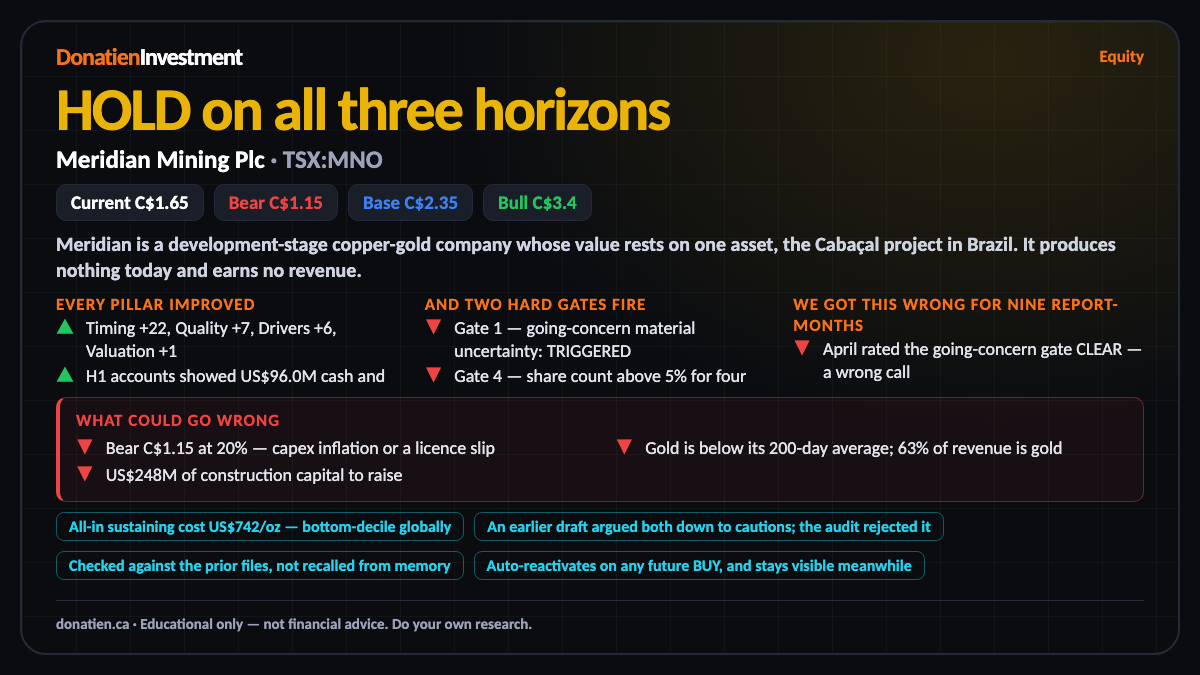
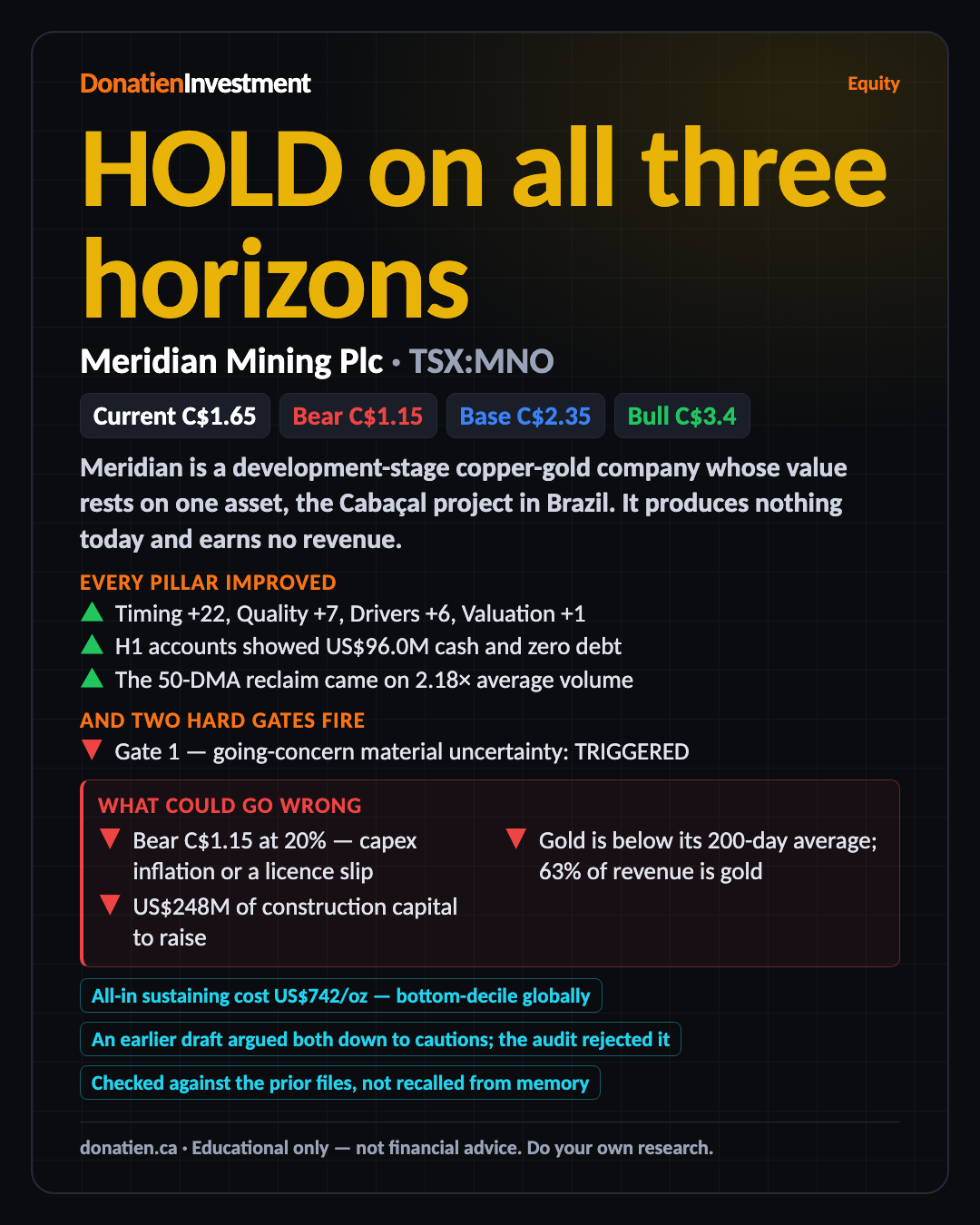
Meridian Mining Plc (TSX:MNO) HOLD on all three horizons
Gate 1 fires on a going-concern material uncertainty and Gate 4 on share count above 5% for four consecutive years, capping medium and long from STRONG BUY to HOLD.
Meridian is a development-stage copper-gold company whose value rests on one asset, the Cabaçal project in Brazil. It produces nothing today and earns no revenue.
Every pillar improved
Take the good news first, because there is a lot of it. Every pillar score rose or held: timing up twenty-two points, quality up seven, drivers up six, valuation up one. The technical trigger the last report named — a reclaim of the twenty and fifty-day averages on volume — was met on the seventh of August at one dollar seventy on more than twice the twenty-day average volume, and price has held above the fifty-day since. In August the company reported stacked metal layers below one of its deposits. And the half-year accounts showed ninety-six million US dollars of cash and no debt — materially more than this desk had been carrying, worth about twelve Canadian cents a share.
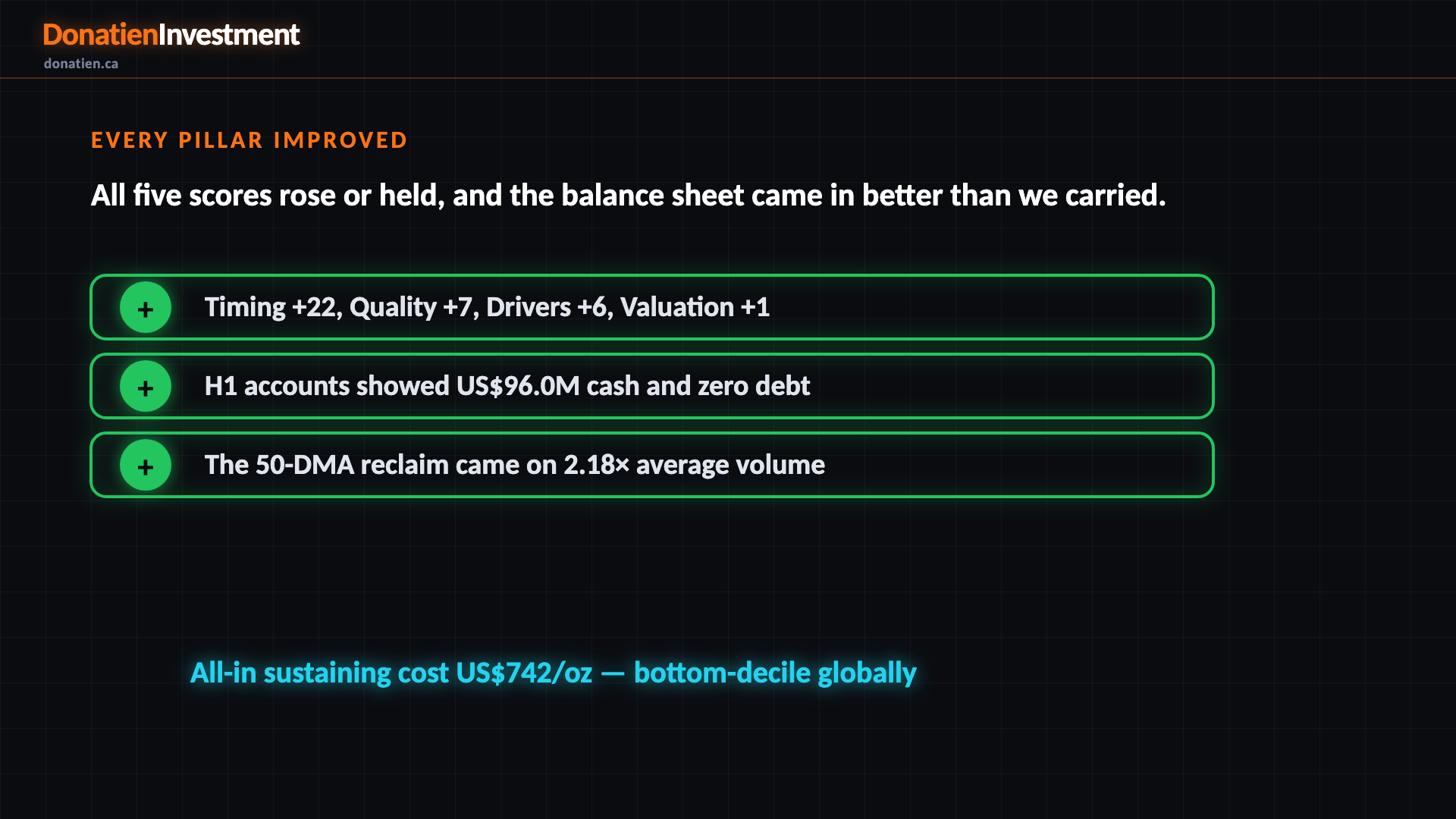
All-in sustaining cost US$742/oz — bottom-decile globally
And two hard gates fire
The same accounts that carried the cash also carried a going-concern material uncertainty, which is a stated trigger of the financial-distress gate. And the share count has grown by more than five percent for four consecutive years, which is a stated trigger of the dilution gate. An earlier draft of this report recorded both as cautions — arguing that the going-concern language is standing rather than new, and that the placings were struck at a fair price so no value moved away from holders. An independent audit rejected both arguments, and it was right to. Neither gate contains a newness test or a fair-price test. Where this framework wants an exemption it writes one explicitly, and it wrote none into these two. Those arguments were authored, not framework, and they are withdrawn.
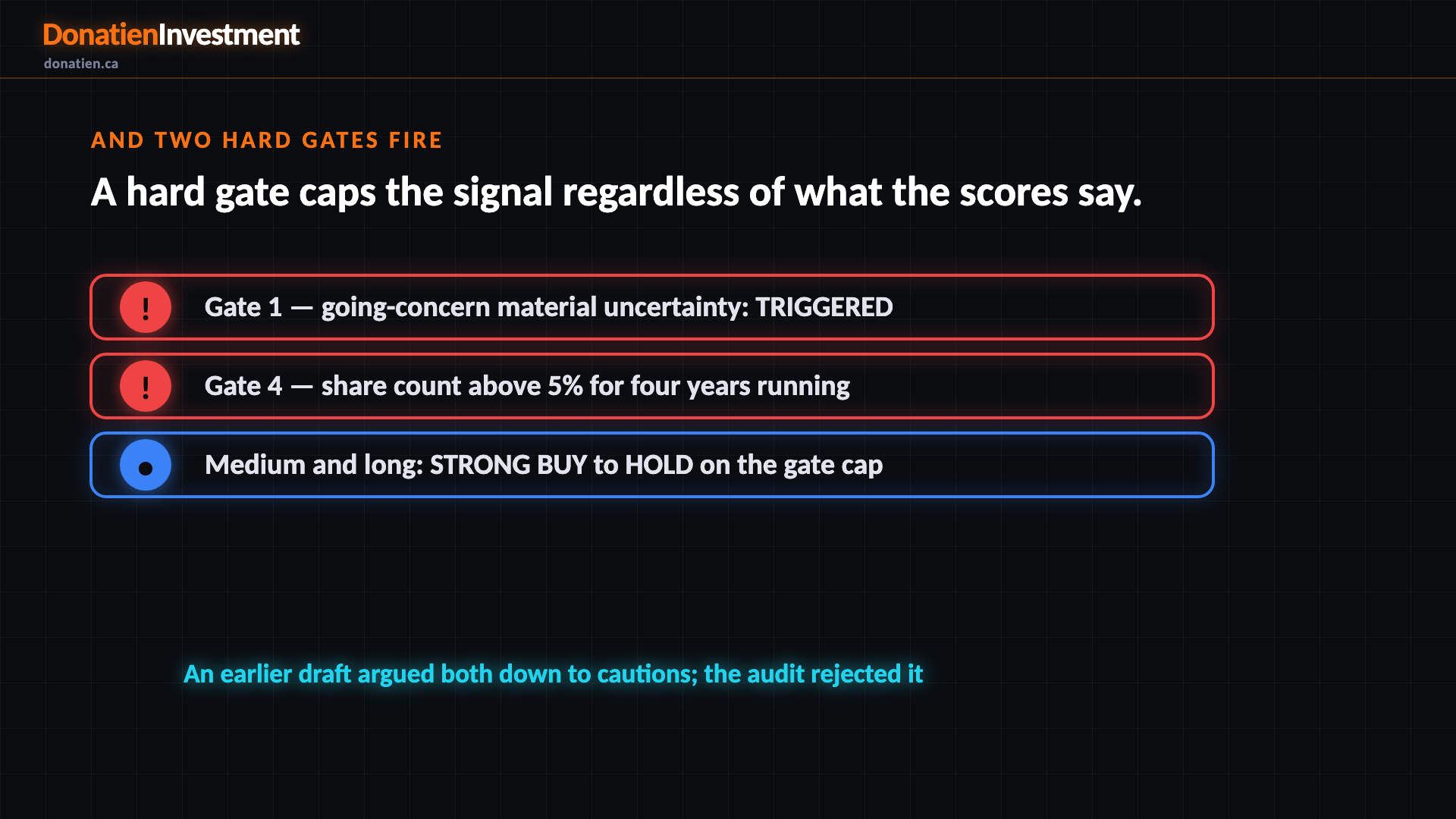
An earlier draft argued both down to cautions; the audit rejected it
We got this wrong for nine report-months
Now our own record, and we checked it against the files rather than recalling it. The two April reports each carried a going-concern gate row and rated it clear, describing a clean balance sheet. That is an affirmative wrong call, not an omission — though both predate the board's approval of the full-year accounts. The five reports from mid-June to the end of July did not mention the gate at all, and those are the genuine omissions. Add them up and nine prior report-months carried a buy-or-better signal that these gates should have capped. We would rather publish that count than let it sit quietly in an archive.
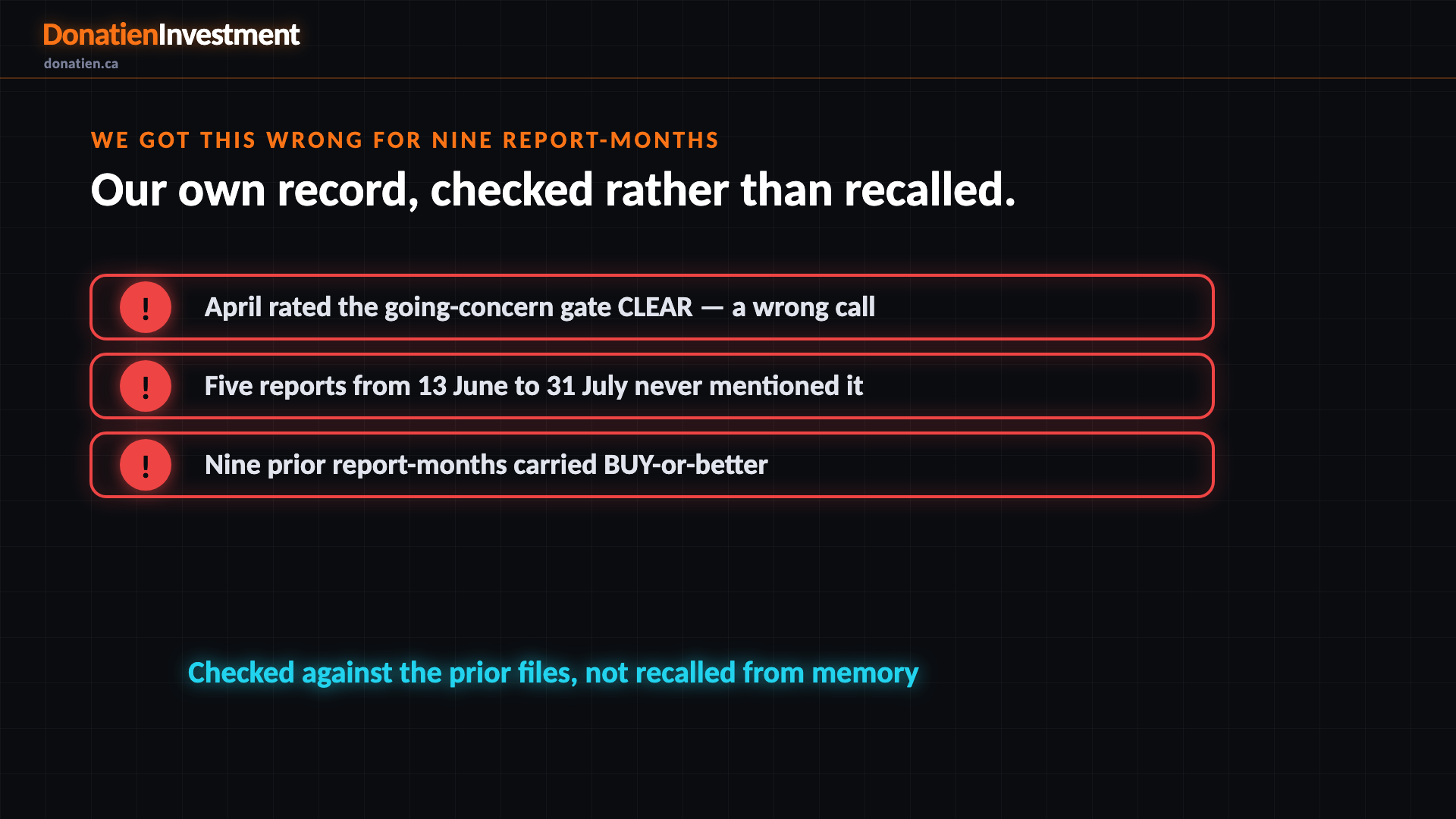
Checked against the prior files, not recalled from memory
The uncomfortable part
Here is the tension, stated rather than smoothed. The probability-weighted fair value across the three paths is two dollars forty-three Canadian, about forty-seven percent above today's price, and the signal is still hold. That is what a hard gate does: it caps the signal regardless of how attractive the arithmetic underneath looks. The conviction ladder actually improved to full-size — but the ladder sizes an entry, it does not authorise one, and the gates have withdrawn the authorisation. With no buy at any horizon the Donatien Pick moves to stopped. It stays visible on the watchlist rather than being quietly removed, and it reactivates automatically the moment a later report produces a buy anywhere.
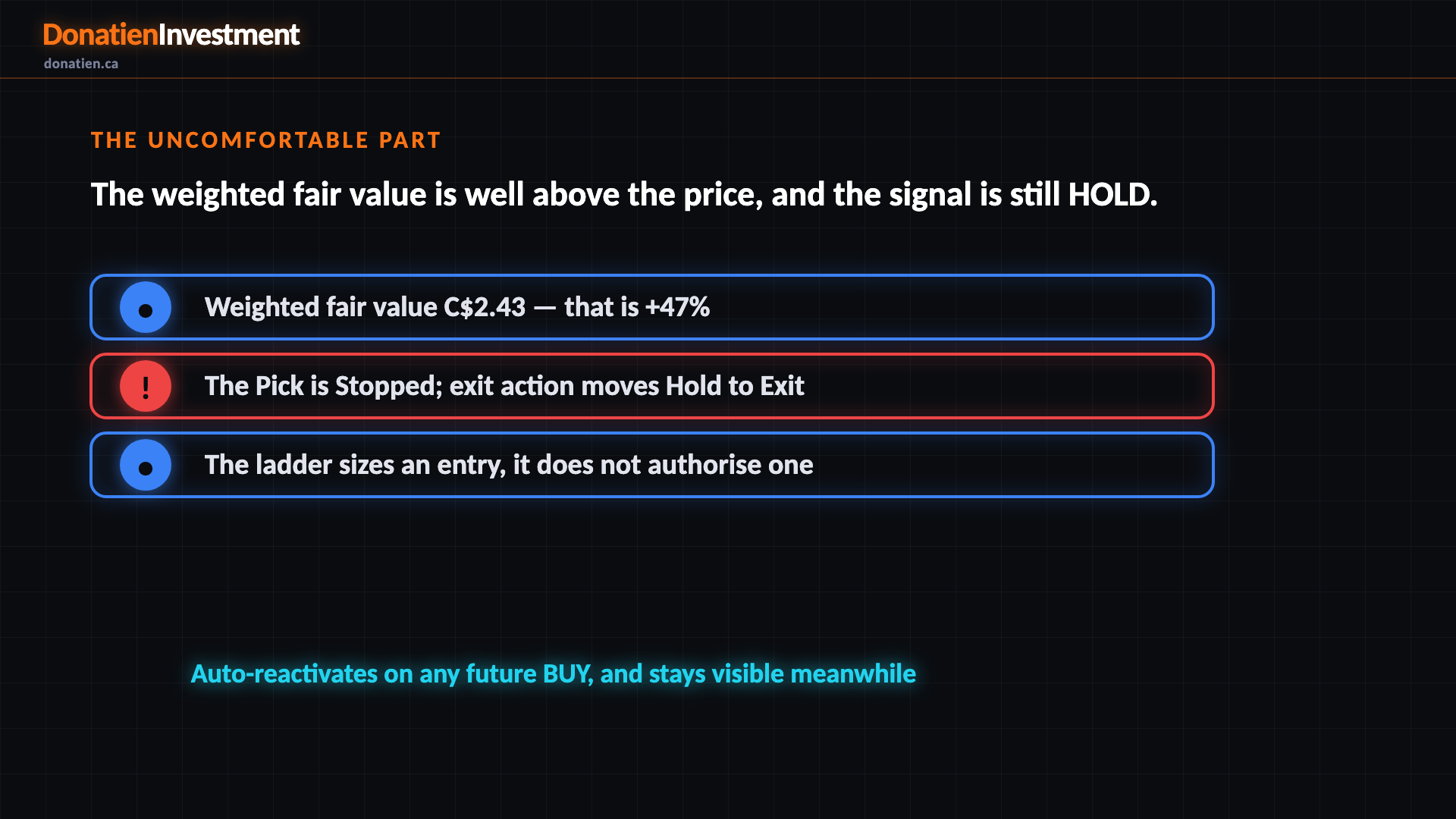
Auto-reactivates on any future BUY, and stays visible meanwhile
What could go wrong
The downside on a pre-production developer is not symmetrical with the upside, and it deserves the loud half of this report. The bear path is one dollar fifteen at twenty percent, and it needs any two of: the definitive study printing capex well above the study figure, the installation licence slipping or returning with conditions, construction equity raised at a depressed price so dilution lands nearer forty percent than twenty, or the gold leg breaking — and gold is already below its two-hundred-day average while roughly sixty-three percent of this project's revenue is gold. That last one is a live near-term risk rather than a distant tail. Behind all of it sits the funding requirement: this company must raise around two hundred and forty-eight million US dollars of construction capital, and if credit conditions tighten the going-concern uncertainty hardens rather than clears. A holder following the exit rules would already be out at the stop of one thirty, well above the bear target.
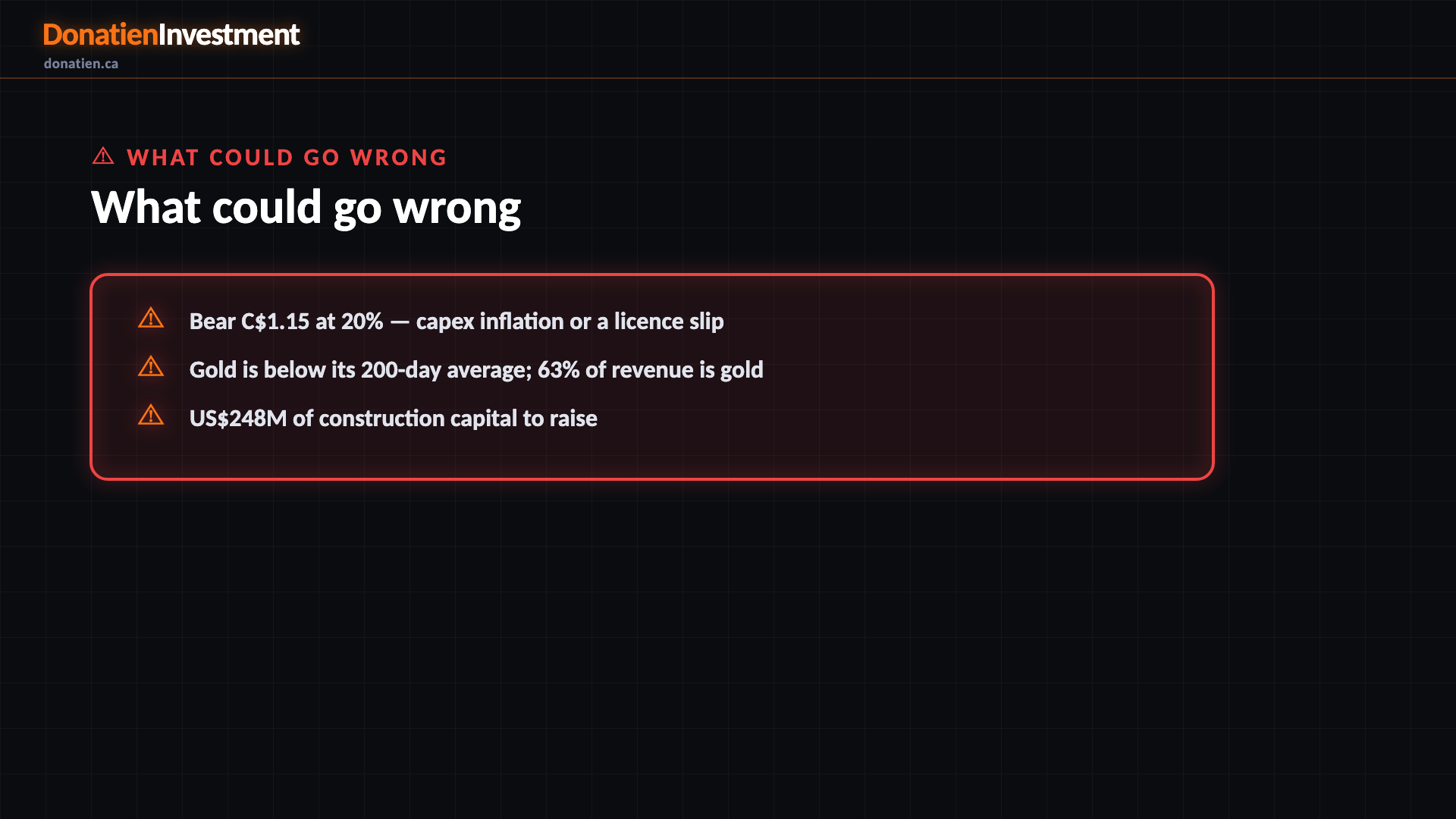
Risk vs Reward
Bull three dollars forty at thirty percent, more than double today, if the licence is granted, the definitive study holds capex near the study figure, and construction is financed in a way that minimises equity issuance. Base two thirty-five at fifty percent, up forty-two point four percent, on the study broadly confirming at a higher price deck with roughly twenty percent dilution. Bear one fifteen at twenty percent. The weighted fair value is two forty-three, forty-seven percent above today — which is exactly why the gate cap is the uncomfortable part of this report rather than an easy call.
The verdict
Hold, on all three horizons, and the Donatien Pick is stopped. This is not a verdict on the orebody — the asset came through an independent audit intact, the cost curve is bottom-decile, and every pillar score went up. It is what happens when two hard gates fire on their literal text and the framework refuses to write itself an exemption it never provided for. The exit action moves from hold to exit, because a triggered hard gate is listed as a catastrophic thesis-invalidation item. If a later report produces a buy at any horizon, the Pick reactivates automatically.
It is a quantitative framework for educational purposes only, and it is not financial advice. Always do your own research.
Read the full report on donatien.ca →