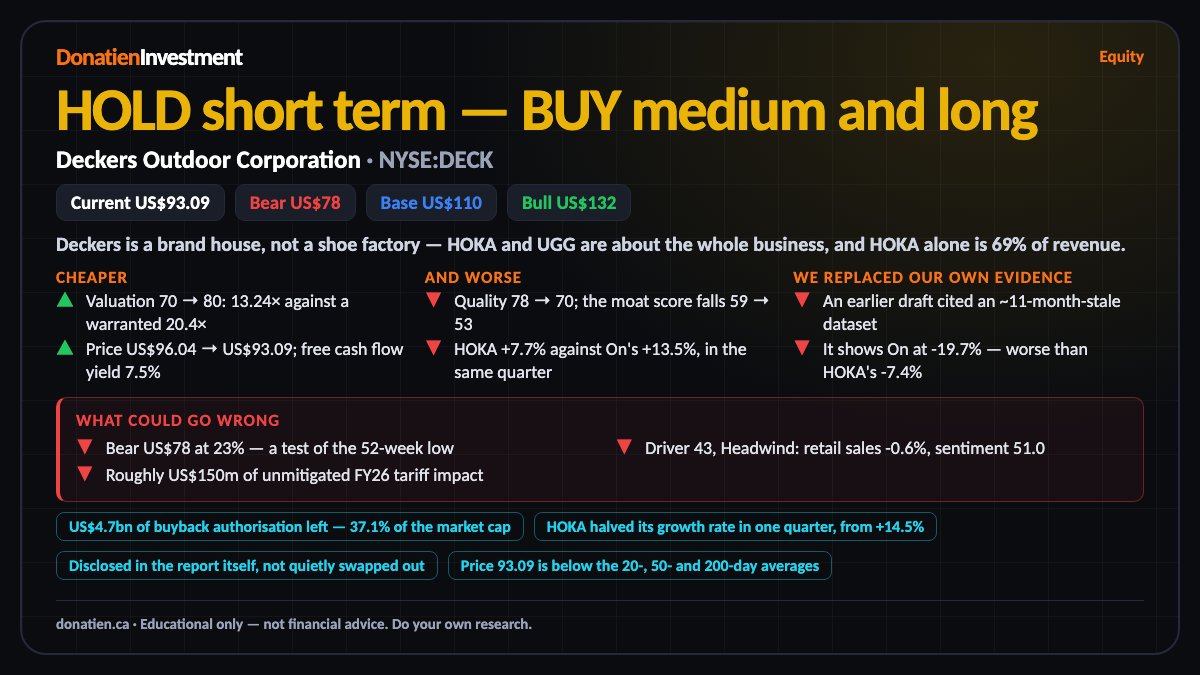
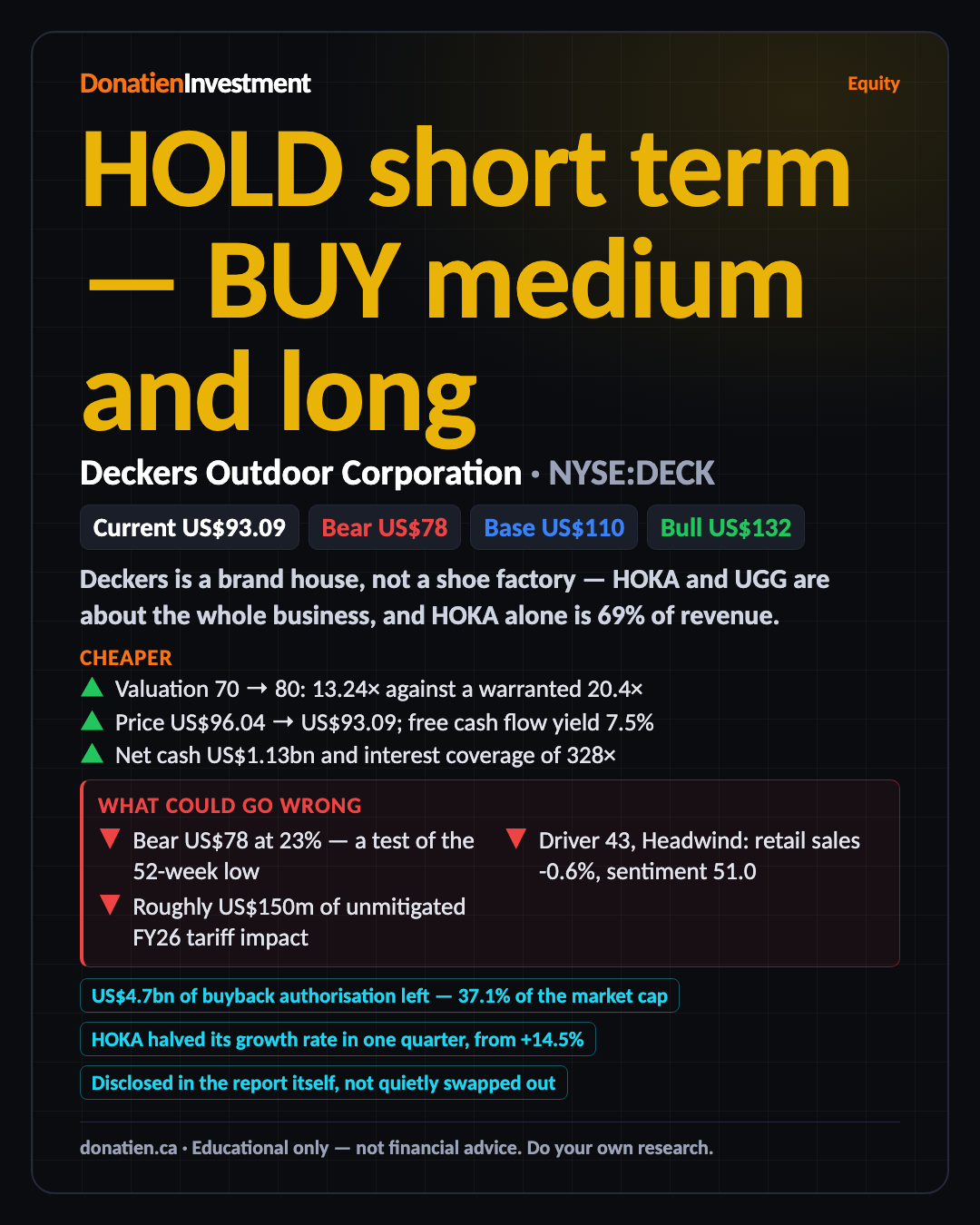
Deckers Outdoor (Deckers Brands, NYSE:DECK) HOLD short term — BUY medium and long
The base short signal is BUY, capped by the technical-confirmation rule: monthly, weekly and daily are all confirmed downtrends and no entry path is open.
Deckers is a brand house, not a shoe factory — HOKA and UGG are about the whole business, and HOKA alone is 69% of revenue.
Cheaper
Take the two directions in turn. On price, this got cheaper: down another three point one percent to ninety-three oh nine, against a warranted multiple that barely moved. Thirteen point two four times trailing earnings against a warranted twenty point four is a ratio of zero point six five, from zero point six nine last time, and the valuation score rises ten points to eighty. The balance sheet is genuinely strong — one point one three billion dollars of net cash, interest cover of three hundred and twenty-eight times, and a free cash flow yield of seven and a half percent on enterprise value. There is four point seven billion of buyback authorisation outstanding, thirty-seven percent of the market capitalisation.
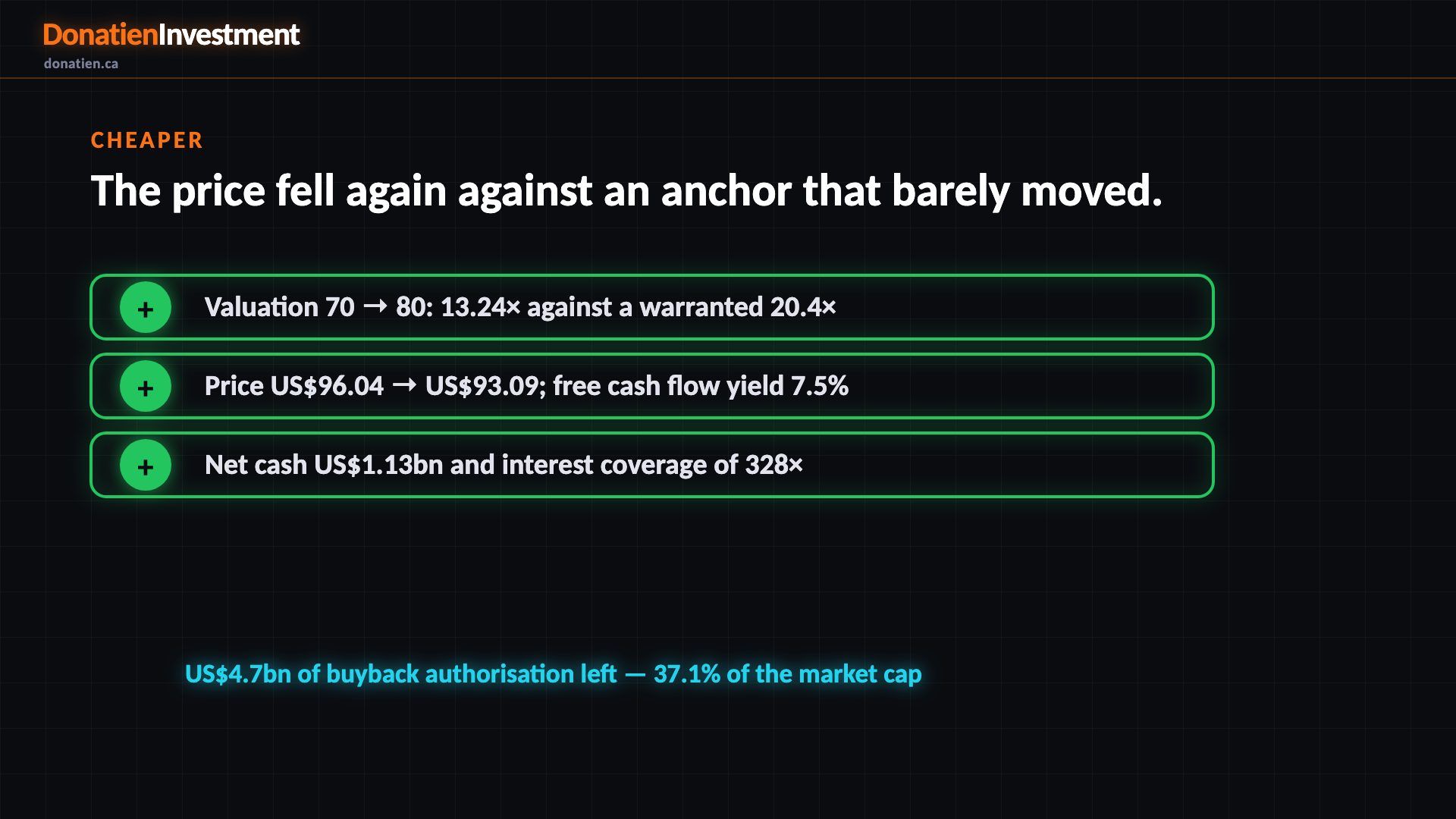
US$4.7bn of buyback authorisation left — 37.1% of the market cap
And worse
Against that, the business read got worse, and the fall is attributable rather than drift. In the identical quarter ended the thirtieth of June, HOKA grew seven point seven percent while On Holding grew thirteen point five percent as reported and twenty-one point six in constant currency, and Nike's running category grew more than twenty percent. HOKA had halved its own growth rate in a single quarter. Switching costs and cost advantage inside the moat scorecard were both cut on that evidence, taking the moat from fifty-nine to fifty-three and business quality from seventy-eight to seventy. Gross margin steps down to about fifty-six and a half percent for the coming year, from fifty-seven point seven.
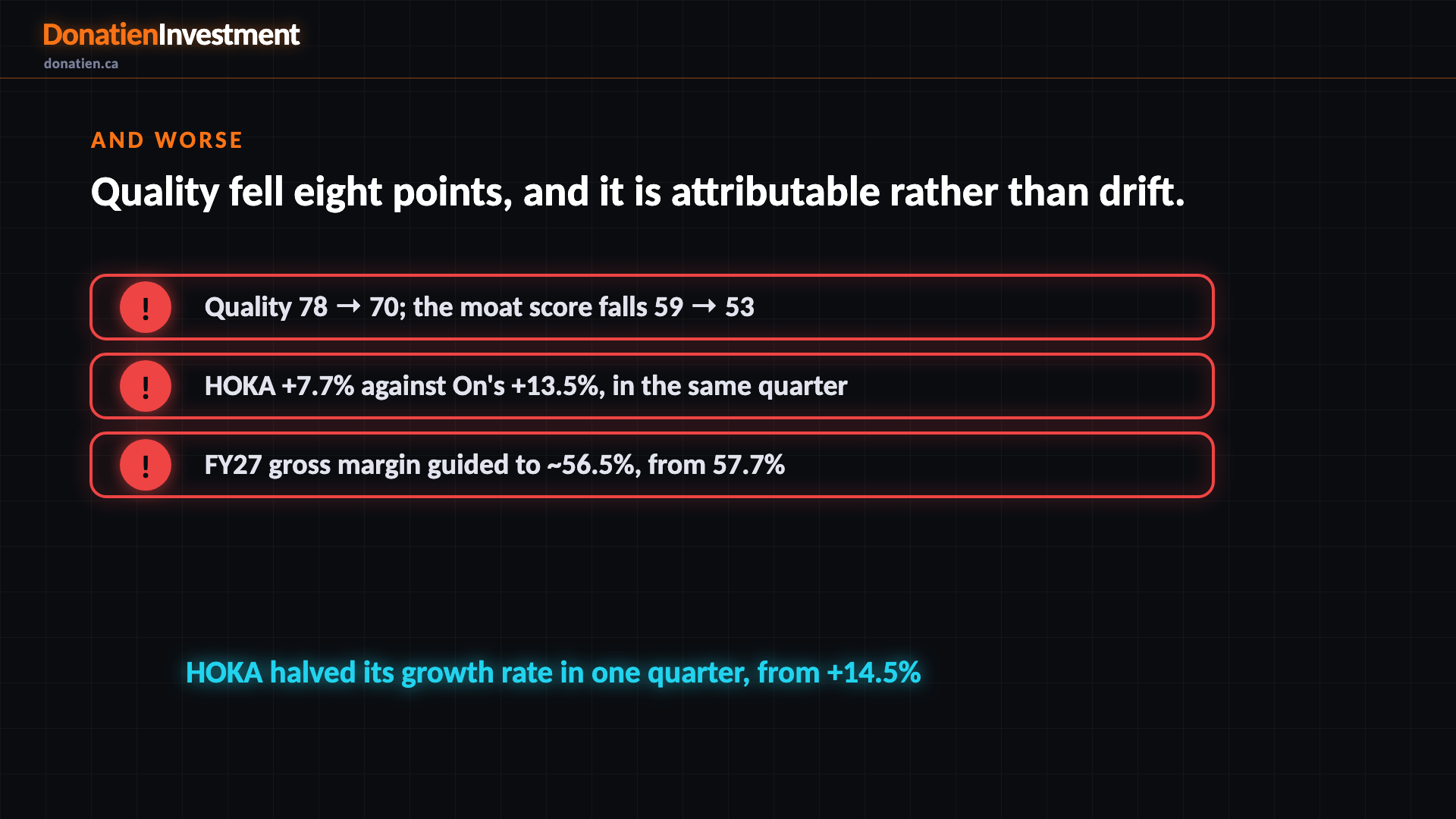
HOKA halved its growth rate in one quarter, from +14.5%
We replaced our own evidence
One correction, disclosed rather than quietly swapped out. An earlier draft of this report cited a run-specialty channel dataset as evidence that On was taking share from HOKA. That dataset was published in December, covers the twelve months to September the year before, and is roughly eleven months stale — and it actually shows On at minus nineteen point seven percent, worse than HOKA's minus seven point four. It says the opposite of what we used it for. An independent audit caught it as a blocker. The finding has been re-derived from period-matched company reporting for both companies. The trajectory conclusion survives and the scores are unchanged, but the evidence for it has been replaced, and the stale figures now appear only as disclosed counter-evidence.
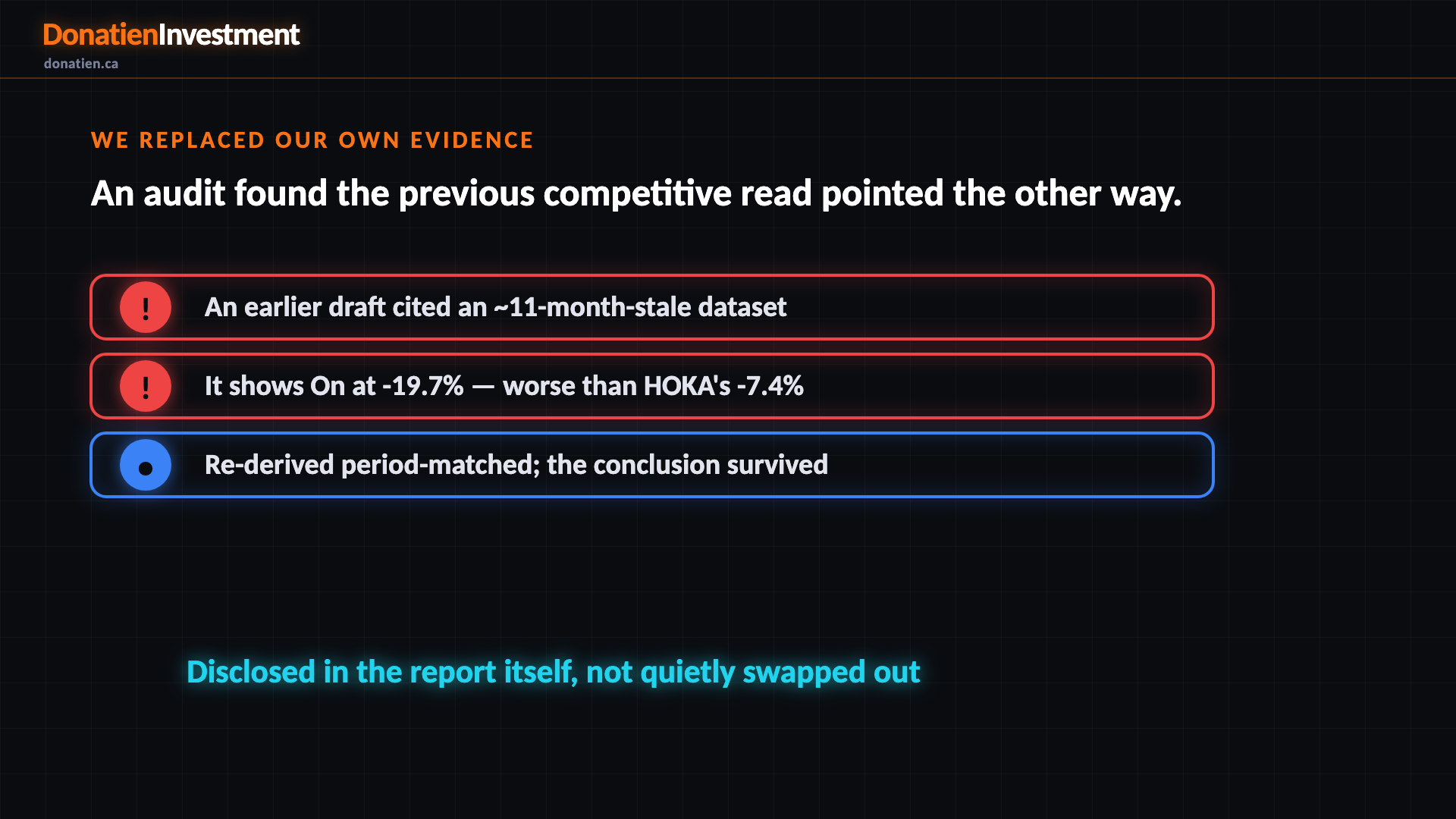
Disclosed in the report itself, not quietly swapped out
Why the short stays capped
The short horizon needs explaining, because the underlying scores actually produce a buy. High quality and an attractive valuation is a buy row. What caps it is the technical-confirmation rule — a rule this desk wrote after losing money on this very name — which says a short-term buy needs the technical or catalyst entry path open, and neither is. All three timeframes are confirmed downtrends with an active support breakdown, and price sits below the twenty, fifty and two-hundred-day averages. Separately, the driver score crossing below fifty closed the fundamental path too, so the conviction ladder falls from half-size to wait, with none of the three groups open. That is the honest answer rather than a downgrade of the thesis.
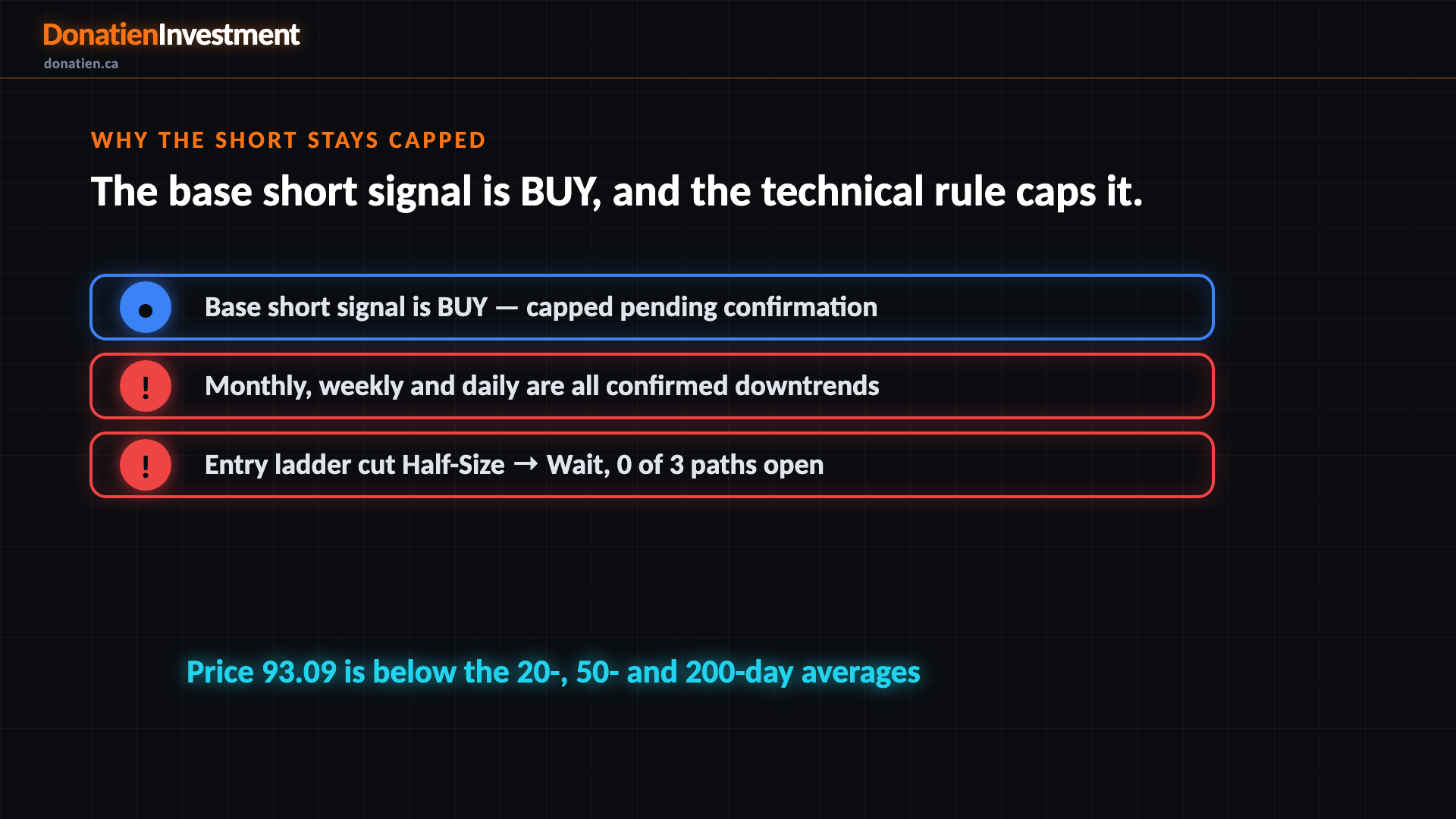
Price 93.09 is below the 20-, 50- and 200-day averages
What could go wrong
The bear needs two correlated things rather than two independent ones, and the report should say so. The competitive leg: On and a resurgent Nike squeeze HOKA from both ends and its growth decays from seven point seven percent toward flat — and HOKA is sixty-nine percent of this company's revenue. The consumer leg: July's minus zero point six percent retail sales and a sentiment reading of fifty-one turn out to be the start rather than a wobble, direct-to-consumer growth compresses, and a hundred and twenty-six days of inventory becomes markdown risk. That takes gross margin below the guide. Seventy-eight dollars is minus sixteen percent and a test of the fifty-two week low. Behind it sits about a hundred and fifty million dollars of unmitigated tariff impact, quantified from the company's own guidance rather than carried forward as a headline.
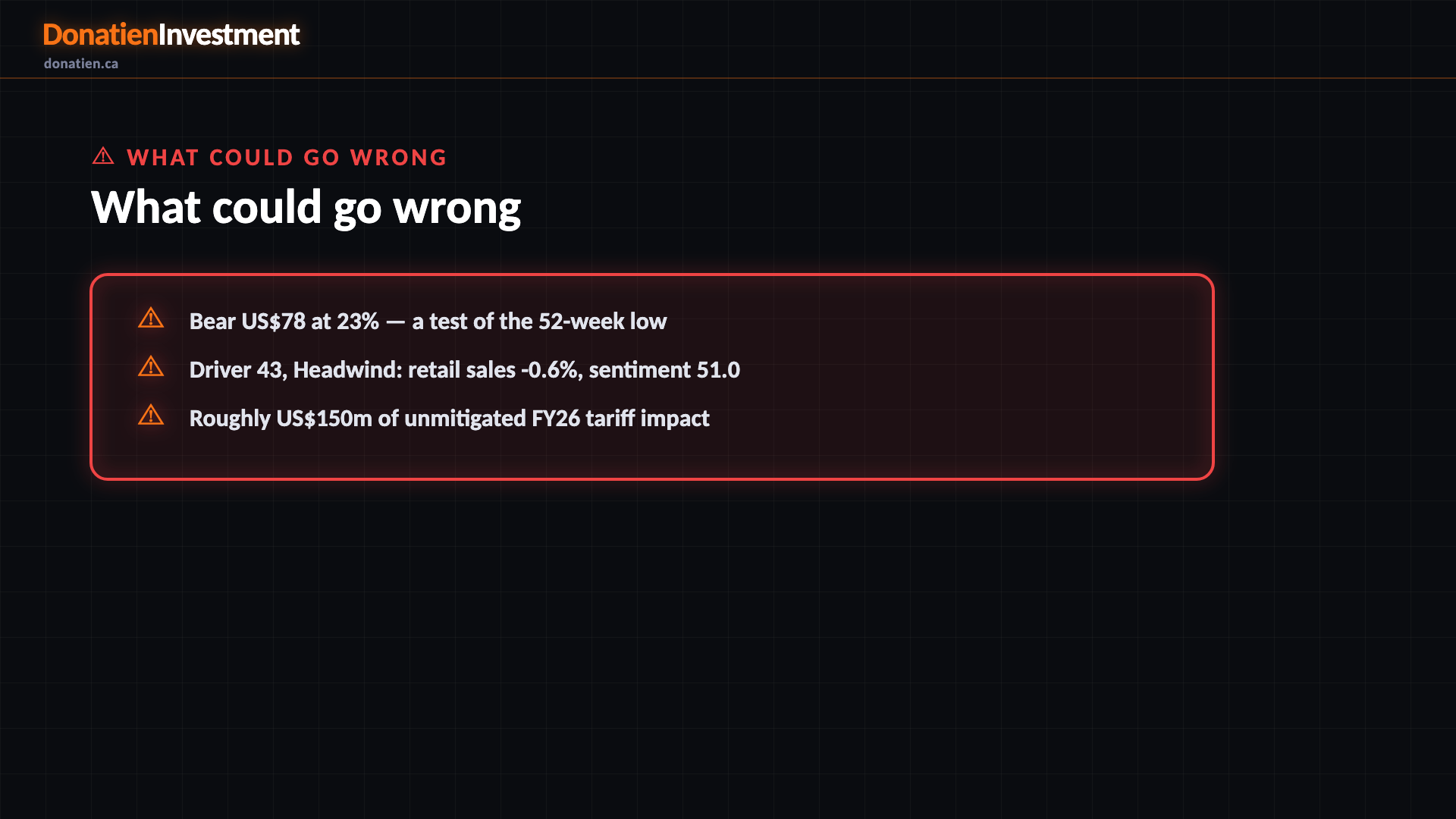
Risk vs Reward
Bull a hundred and thirty-two at twenty-two percent, plus forty-one point eight percent, and note that even there the stock would still trade below the twenty point four times its own fundamentals warrant — a re-rating to fair, not to expensive. Base a hundred and ten at fifty-five percent, plus eighteen point two: the company simply delivers the guidance it has already given, the multiple does nothing, and the return comes from earnings and the share count shrinking. Bear seventy-eight at twenty-three percent, minus sixteen point two. Probability-weighted, that is a hundred and seven fifty.
The verdict
Hold on the short horizon, buy on the medium and the long, unchanged. Net of everything: a cheaper stock and a weaker customer, which roughly cancel at the signal level and leave the short-term entry with no open path. This is a genuinely good business — forty-two percent return on equity, a twenty-two point seven percent operating margin, net cash — losing relative ground in premium running at the same moment its customer's confidence broke down. The medium and long-term case rests on the gap between thirteen times earnings and a warranted twenty, and that gap is wider than it was three weeks ago. The next report is due the thirty-first of August.
It is a quantitative framework for educational purposes only, and it is not financial advice. Always do your own research.
Read the full report on donatien.ca →