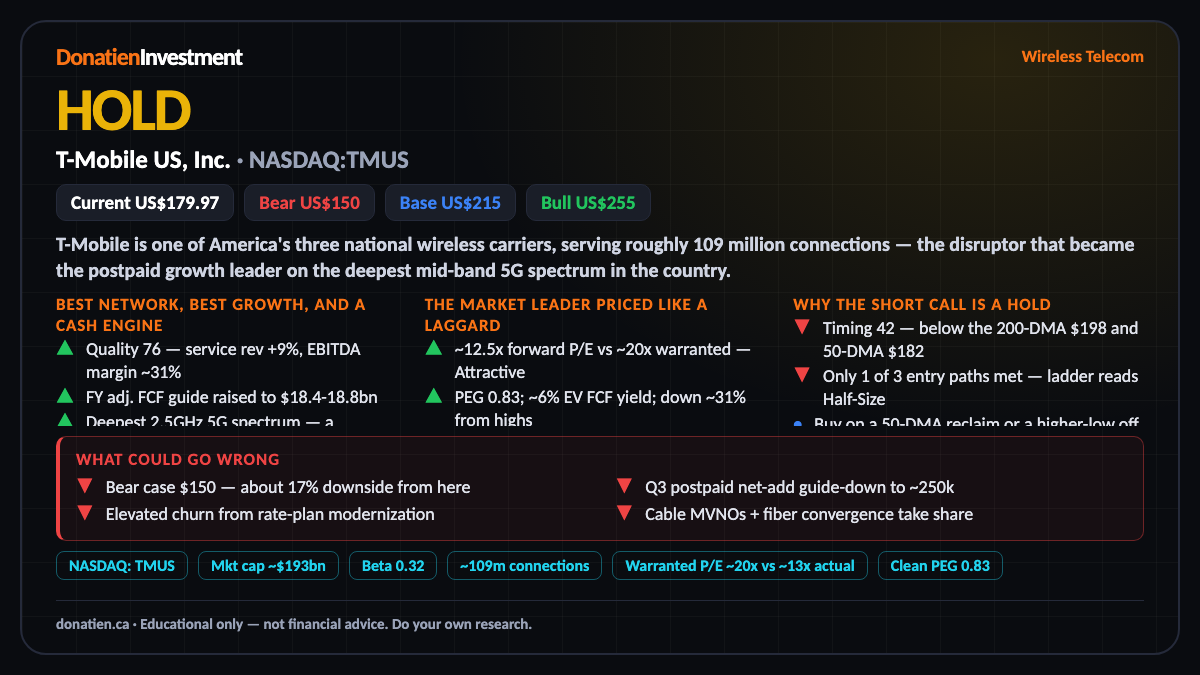
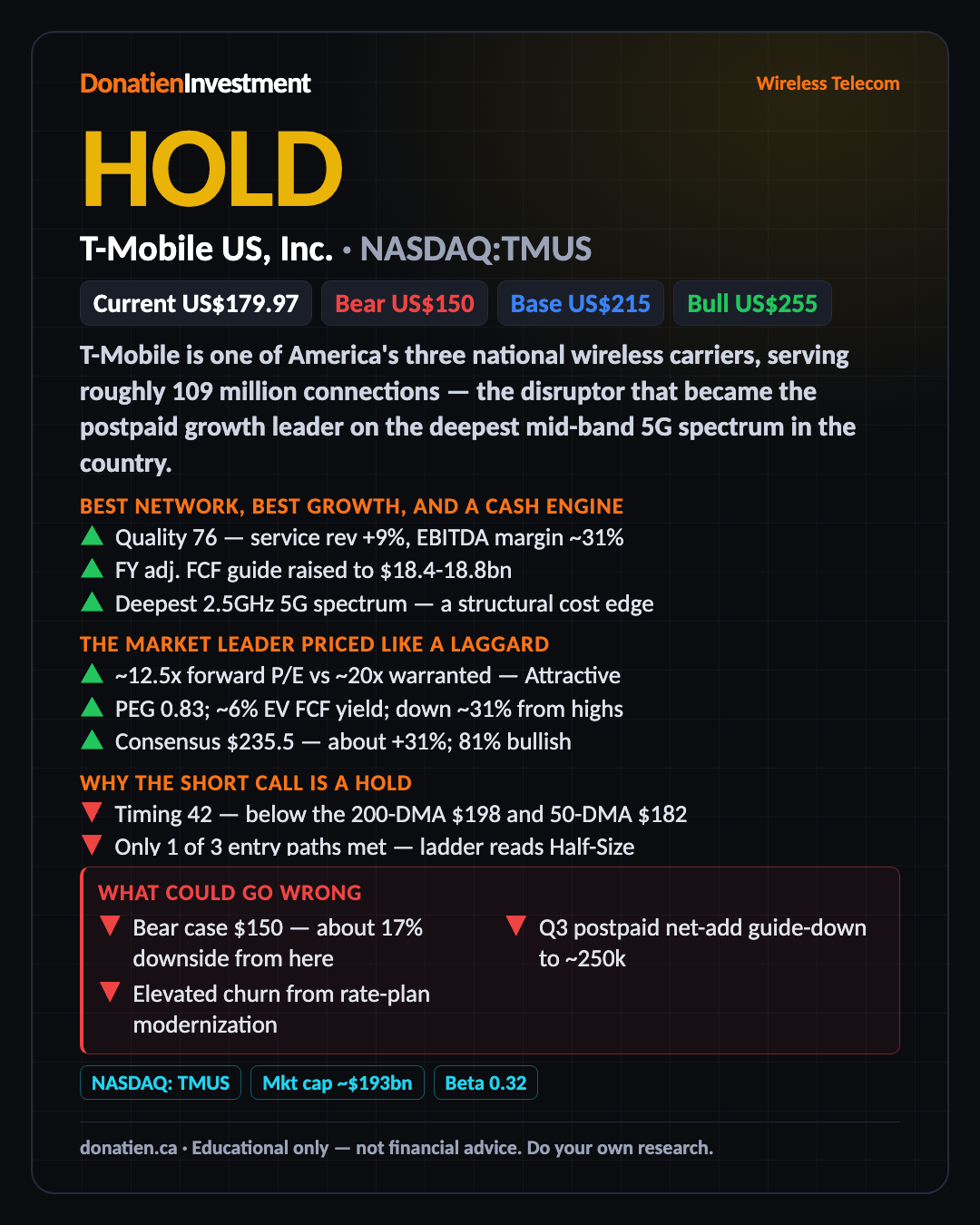
T-Mobile US, Inc. (NASDAQ:TMUS) HOLD
The US wireless growth leader at about 12.5x forward earnings, roughly two-thirds of its warranted multiple after a ~31% de-rate from its high — so the medium and long calls are both BUY. Short-term it is a HOLD: the primary trend is still down, below the 200-day and 50-day averages, with no confirmed technical entry yet. Buy on confirmation; accumulate on weakness.
T-Mobile is one of America's three national wireless carriers, serving roughly 109 million connections — the disruptor that became the postpaid growth leader on the deepest mid-band 5G spectrum in the country. The report rates it HOLD short-term, BUY medium and BUY long, at a share price of 179.97 dollars, as of the 7th of August, 2026. It has fallen about 31 percent from its high even as earnings held — so the whole case turns on one question: is this a broken business, or a cheap one waiting for its tape to turn.
Best network, best growth, and a cash engine
The quality here is genuine, if capped by a heavy balance sheet. T-Mobile runs the best network economics of the big three, built on the deepest mid-band 5G spectrum in the country from the Sprint merger and the twenty twenty-five UScellular deal — a real structural cost edge over Verizon and AT&T. Second-quarter revenue rose almost eight percent to twenty-two-point-eight billion dollars, with service revenue up nine percent, EBITDA margins near thirty-one percent, and return on equity around eighteen percent. That converts into serious cash: the full-year adjusted free-cash-flow guide was raised to eighteen-point-four to eighteen-point-eight billion dollars, funding buybacks that cut the share count from about one-point-one-four billion to one-point-zero-eight billion in a year, plus a dividend just raised sixteen percent. The one clear weakness is leverage — a hundred and twenty billion dollars of gross debt.
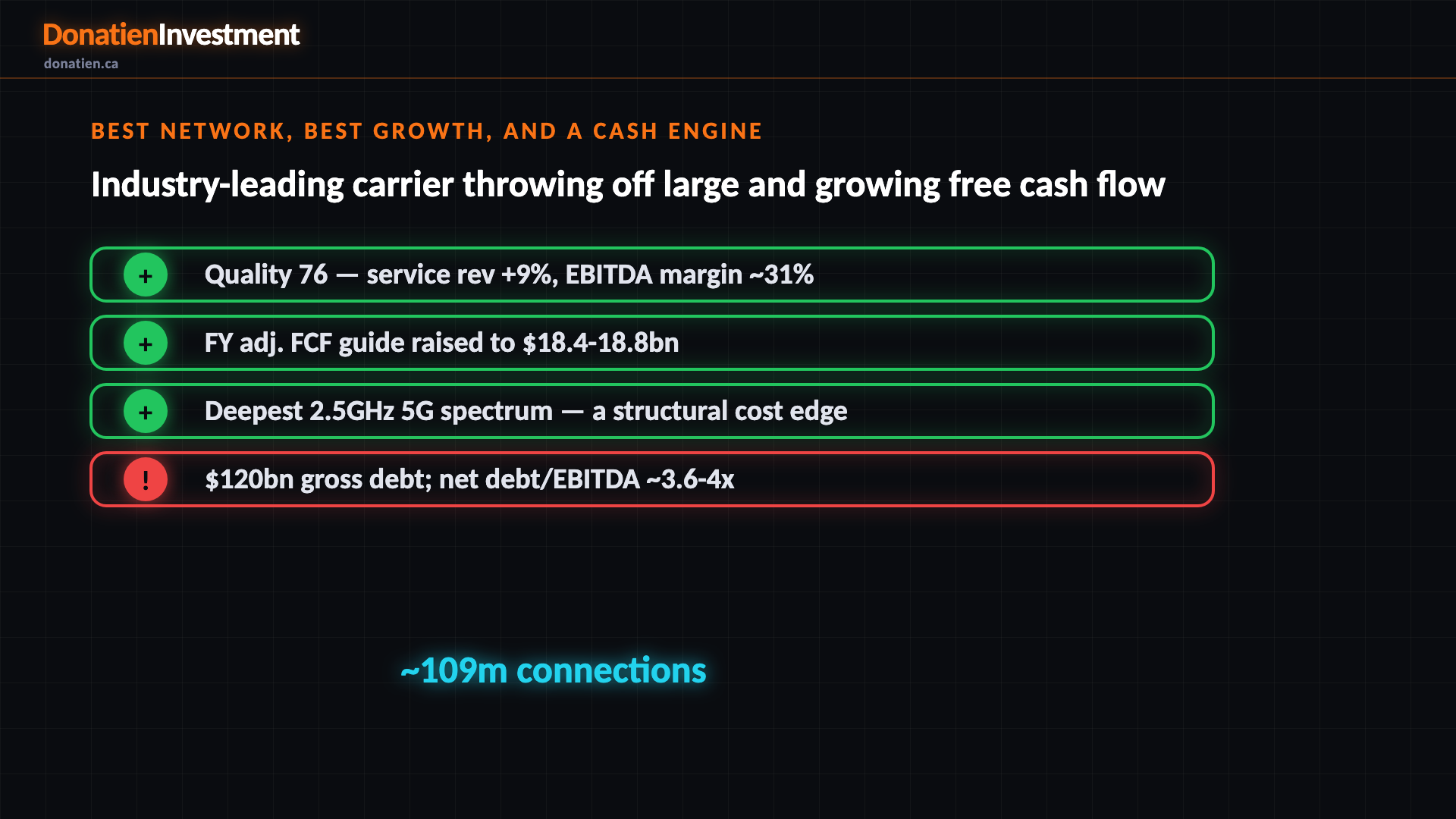
NASDAQ: TMUS · Mkt cap ~$193bn · Beta 0.32 · ~109m connections
The market leader priced like a laggard
On valuation the leader is priced like a straggler. The stock has de-rated about thirty-one percent, from a fifty-two-week high of two hundred sixty-one dollars to one hundred eighty, even as forward earnings estimates held — pushing the forward multiple to roughly twelve-and-a-half times, near the bottom of its own five-year range. Against a warranted multiple of about twenty times, that clean thirteen-times reading is a ratio of zero-point-six-five — squarely in the attractive band. The growth-adjusted PEG is zero-point-eight-three, the EV free-cash-flow yield around six percent, and the dividend yields about two-point-three-five percent and rising. At today's price the market embeds only three to four percent long-run earnings growth against a franchise compounding high-single-digits. The consensus target is two hundred thirty-five dollars and fifty cents — about thirty-one percent above spot — with eighty-one percent of a well-covered analyst panel bullish.
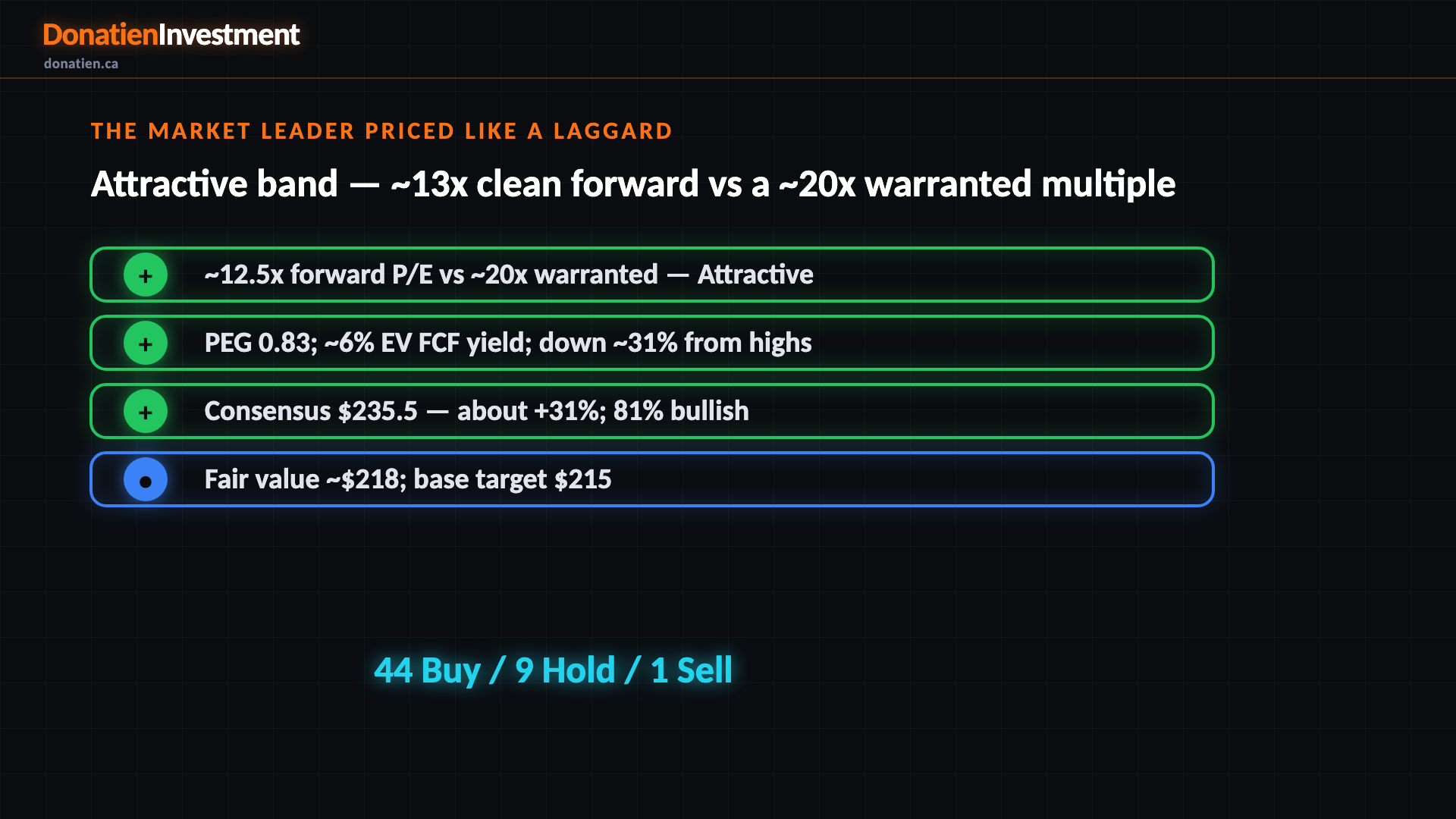
Warranted P/E ~20x vs ~13x actual · Clean PEG 0.83 · 44 Buy / 9 Hold / 1 Sell
Why the short call is a HOLD
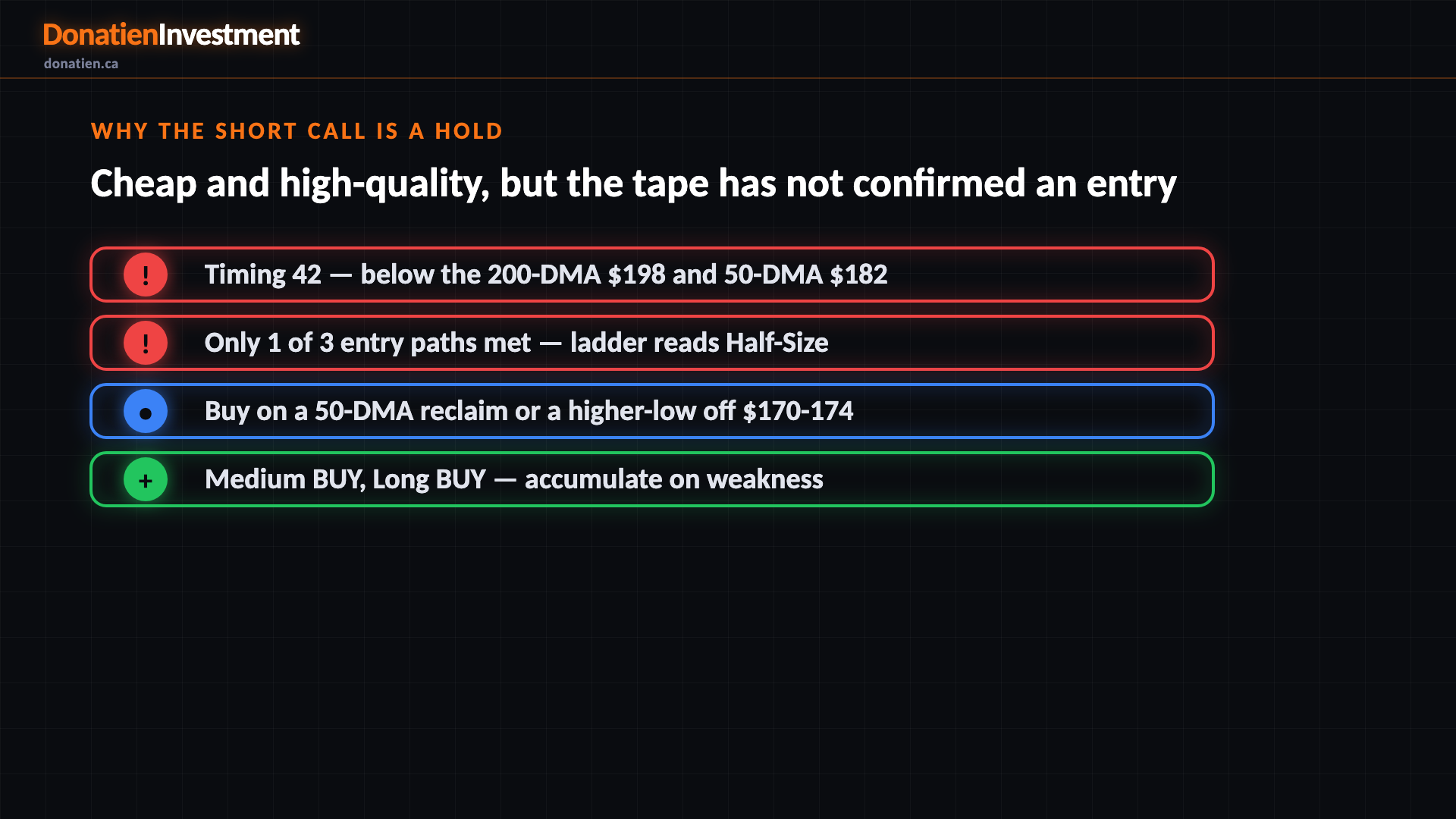
So why not buy today. The reason is timing, not the business. The primary trend is still down — the stock sits below both the two-hundred-day average near one hundred ninety-eight and the fifty-day near one hundred eighty-two, with the monthly, weekly and daily timeframes all in downtrends. The good news is the knife has stopped falling: after the post-second-quarter crash to about one hundred seventy and a late-June low of one hundred sixty-six, the daily RSI has neutralised and price is bouncing, up almost four percent in the last session. But that is a counter-trend rally inside a broken downtrend. Only the fundamental entry path is met — neither the technical nor the catalyst path is — so the ladder reads half-size. The plan is to buy on confirmation: a volume-backed reclaim of the fifty-day average, or a tested higher-low bounce off the one-seventy to one-seventy-four base.
What could go wrong
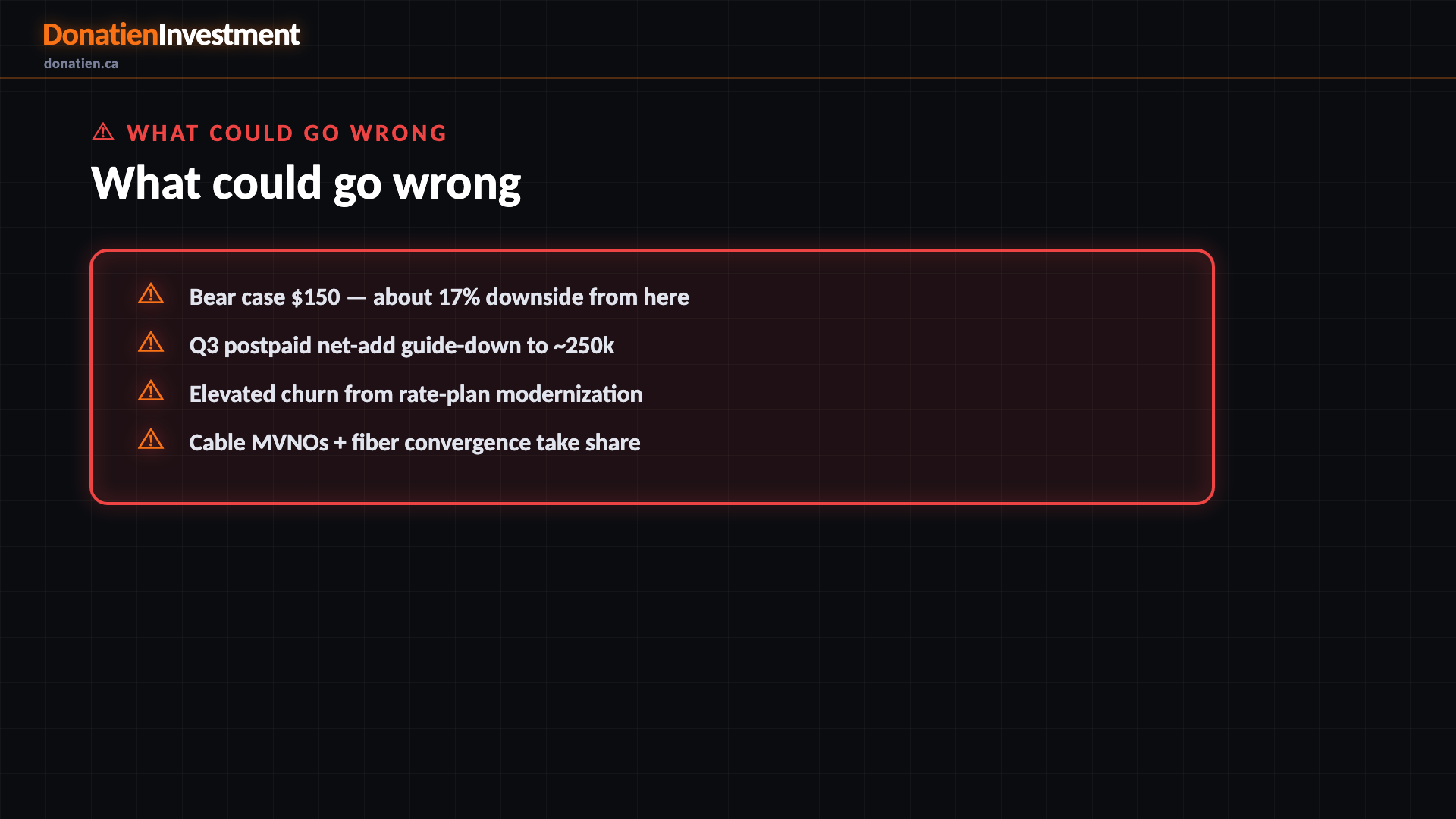
The risks are real, and they are why the bear case exists. That bear sees the shares fall to about one hundred fifty dollars, roughly seventeen percent below today. The core threat is subscriber momentum: T-Mobile guided third-quarter postpaid net adds down to around two hundred fifty thousand, and warned of temporarily elevated churn as it modernises rate plans — the first cracks in years of industry-leading growth. Underneath that, the battleground is shifting to convergence, where T-Mobile is less advantaged: AT&T and Verizon bundle fiber with wireless to lock in households, while cable operators like Comcast and Charter run low-cost mobile plans that pressure the value tier and ARPU. The heavy balance sheet compounds it — a hundred and twenty billion dollars of debt means a higher-for-longer ten-year yield weighs directly on the valuation and the dividend. If net adds turn negative or churn stays elevated past the third quarter, the growth-leader thesis breaks.
Risk vs Reward
The base case is two hundred fifteen dollars at fifty-five percent — net adds stabilise, ARPA grows two-and-a-half to three percent, adjusted free cash flow of about eighteen-and-a-half billion funds the buyback and the rising dividend, and the multiple drifts from twelve-and-a-half toward fourteen or fifteen times as post-print fear fades. That is about nineteen percent above today. The bull case is two hundred fifty-five at twenty-five percent, roughly forty-two percent up, if net adds re-accelerate, the churn proves temporary, convergence gains traction, and buybacks compound at a low multiple. The bear case is one hundred fifty at twenty percent, about seventeen percent down, if competitive intensity worsens and net adds turn negative. The probability-weighted fair value is about two hundred twelve dollars — a favourably skewed distribution anchored by a cheap multiple, with the bear gated by the same competitive intensity that already knocked the stock down.
The verdict
The honest read is a hold now, a buy for the longer run. T-Mobile is the best-in-class US wireless franchise — best network economics, best subscriber growth, a growing river of free cash — trading at about twelve-and-a-half times forward earnings, roughly two-thirds of its warranted multiple after a thirty-one percent de-rate. That is why the medium and long calls are both buy. But the short-term stance is hold: the primary trend is still down, below the two-hundred-day and fifty-day averages, and no technical entry has confirmed. The plan is to buy on confirmation — a fifty-day reclaim or a tested higher-low — or to accumulate on weakness, while watching the net-add and churn trend into the third quarter. This is analysis, not financial advice.
That's my read on T-Mobile. Financial Freedom. Together.
Read the full report on donatien.ca →