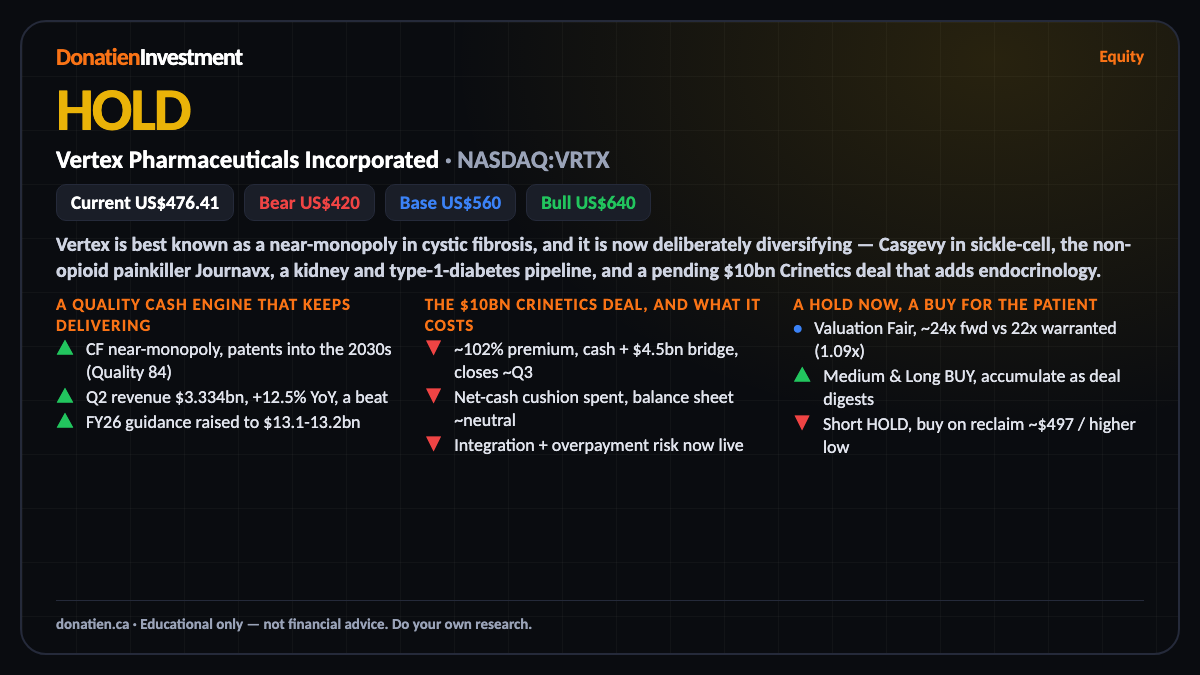
Vertex Pharmaceuticals Incorporated (NASDAQ:VRTX) HOLD
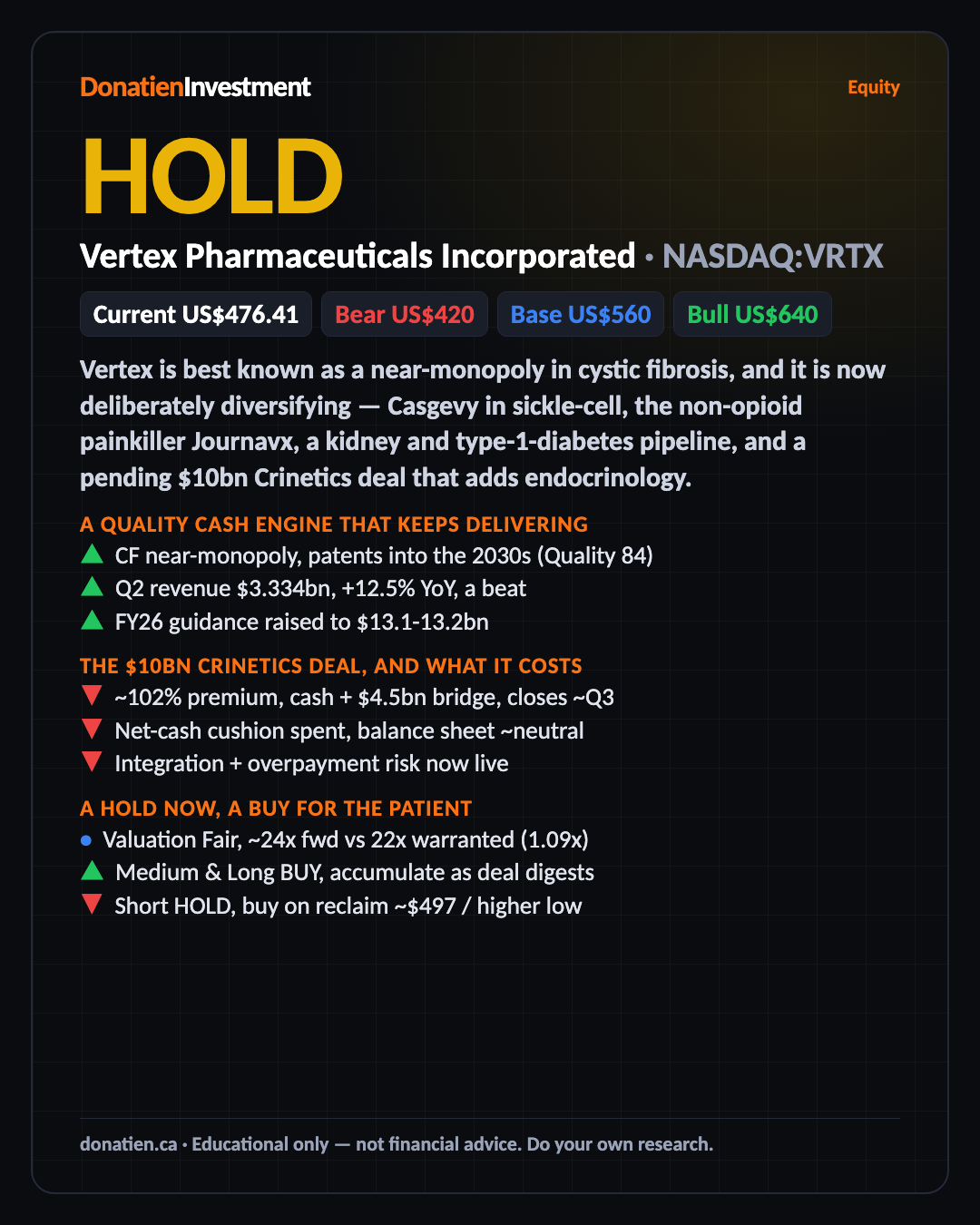
A hold at $476.41. Second-quarter results on 3 August were a beat-and-raise, but the stock barely moved (+1.2%) and there is no technical trigger yet. At a Fair multiple the medium and long calls are both BUY: a quality franchise to accumulate on confirmation or weakness.
Vertex is best known as a near-monopoly in cystic fibrosis, and it is now deliberately diversifying — Casgevy in sickle-cell, the non-opioid painkiller Journavx, a kidney and type-1-diabetes pipeline, and a pending $10bn Crinetics deal that adds endocrinology. On 3 August it reported second-quarter revenue of $3.334bn, up 12.5% and a beat, and raised full-year guidance to $13.1-13.2bn. The shares sit at $476.41. Two questions follow: is the business still worth owning, and why is the short-term call still a hold after a beat?
A quality cash engine that keeps delivering
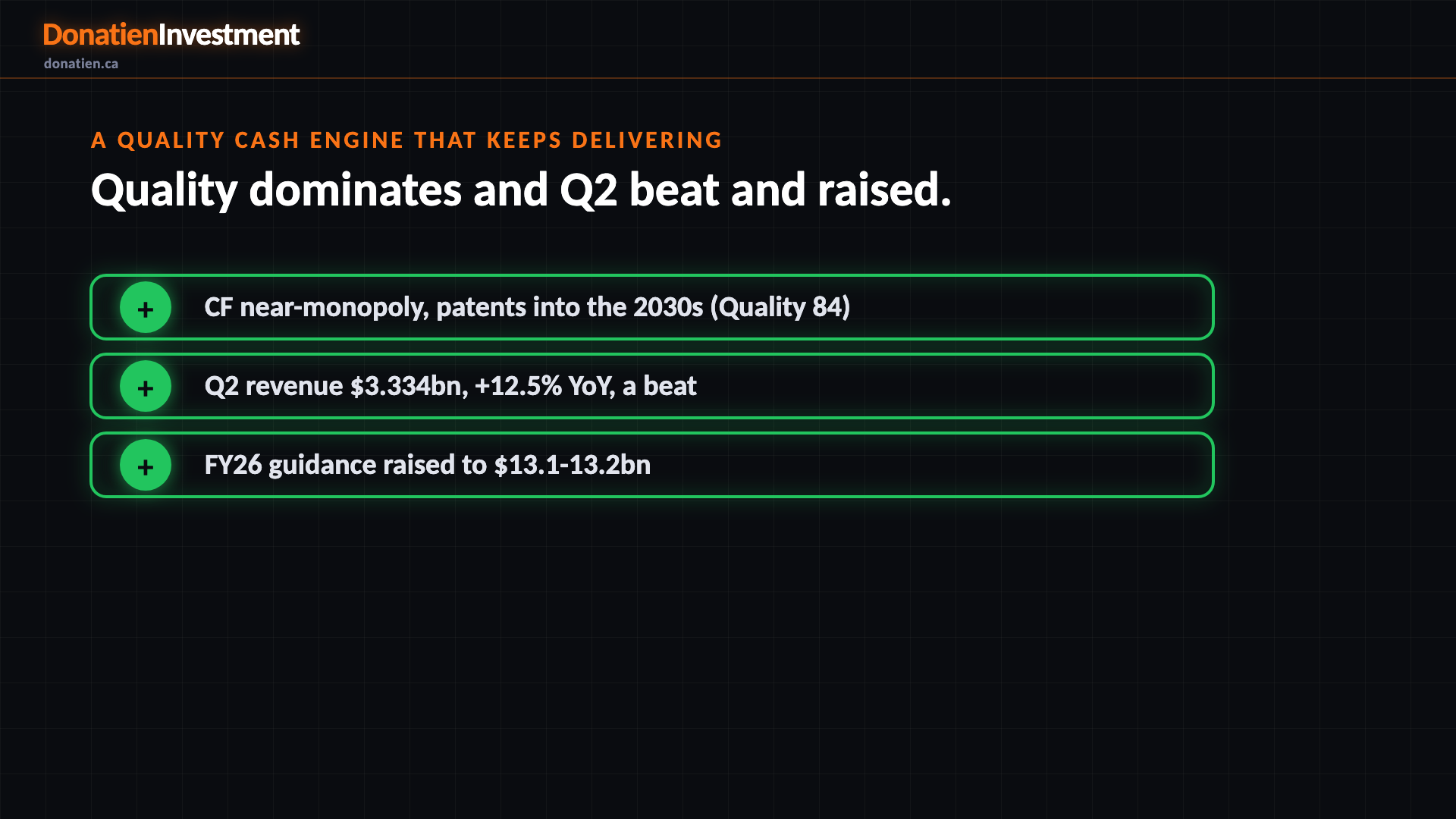
The core is genuinely rare: Vertex owns cystic fibrosis outright, a high-margin, cash-generative franchise with patent protection reaching into the 2030s. That earns a Quality score of 84. Second-quarter revenue came in at $3.334 billion, up 12.5% year on year and ahead of expectations, and management raised full-year guidance to $13.1-13.2bn. Diluted earnings of $4.31 slightly lagged consensus, but the top line and the raise confirm the franchise is compounding, not coasting. It is no longer a one-drug story either, with Casgevy, Journavx and a kidney and diabetes pipeline all reducing single-franchise risk.
The $10bn Crinetics deal, and what it costs
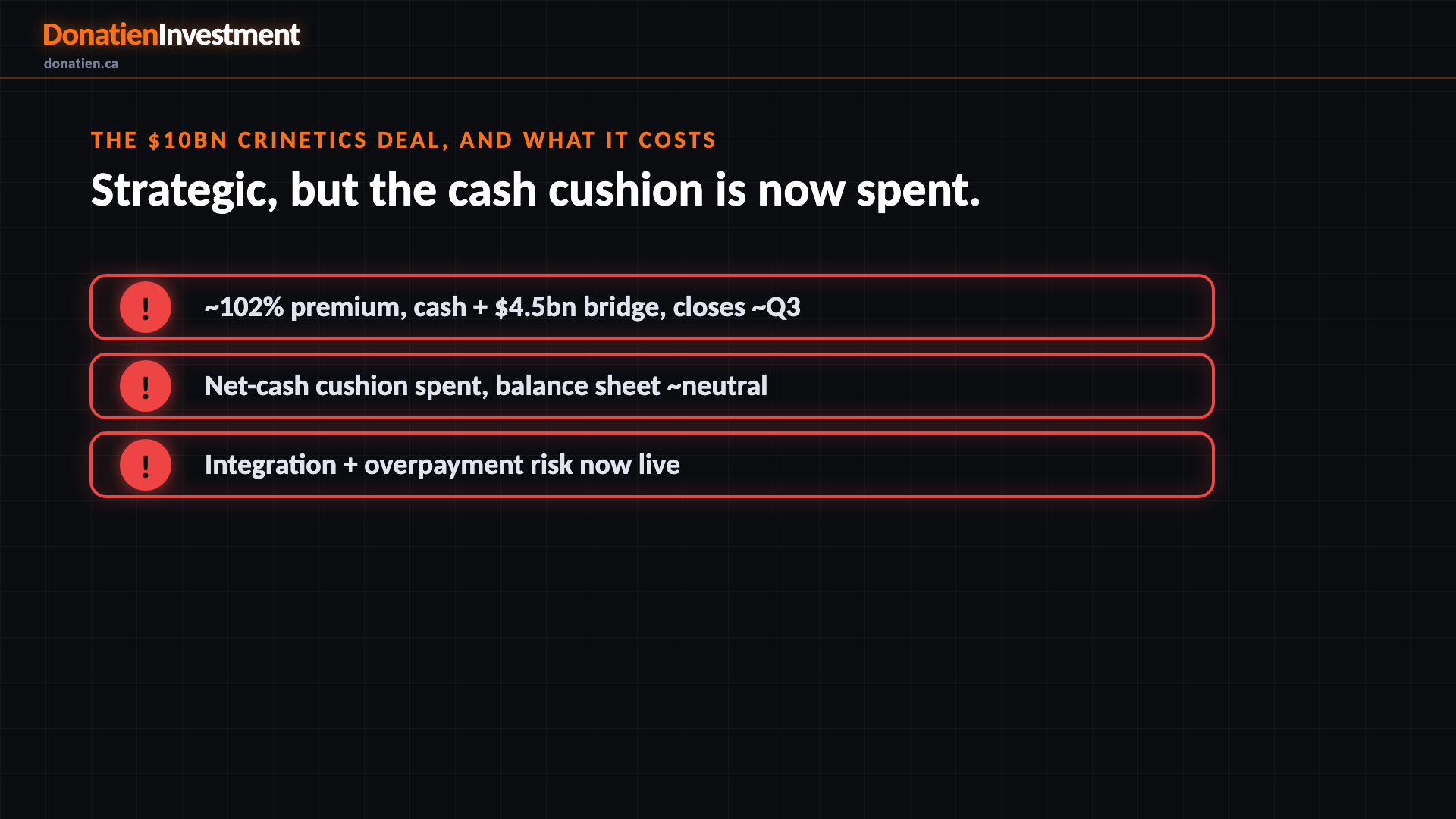
Nothing is free. Vertex agreed to buy Crinetics for about $10 billion all-cash at a roughly 102% premium, its largest deal ever, funded by cash plus a $4.5 billion bridge loan, with closing expected around the third quarter. It adds an endocrinology franchise in acromegaly, which is exactly the diversification the long-term bull case wanted. But it spends the net-cash fortress the old thesis leaned on: post-close the balance sheet is roughly neutral rather than a pile of spare cash. Strong free cash flow services the bridge quickly, so this is not distress, but integration and overpayment are now real, live risks.
A HOLD now, a BUY for the patient
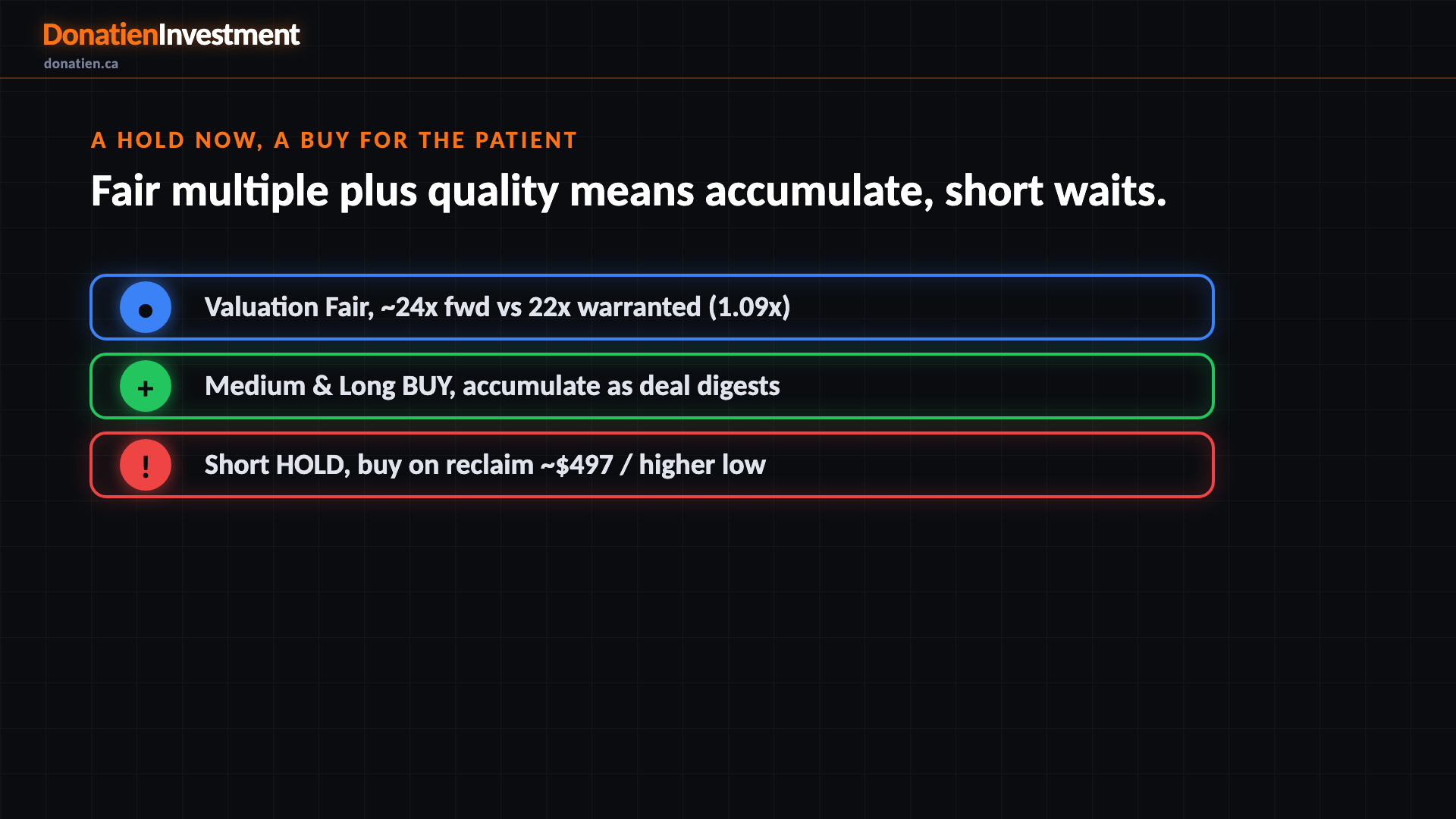
Valuation sits at about 24 times forward earnings against a warranted 22, a ratio of 1.09 that scores Fair, not stretched, for a franchise of this quality. That is why medium and long term the call is BUY: accumulate as the Crinetics deal digests. Short term it stays a hold. The beat drew only a 1.2% pop, not the greater-than-5% move or the above-average-volume breakout a short-term entry needs. The report would buy the Short on confirmation, a reclaim of about $497 or a tested higher low off the $469 to $465 fifty-day support. Patience over the next few weeks costs little.
What could go wrong
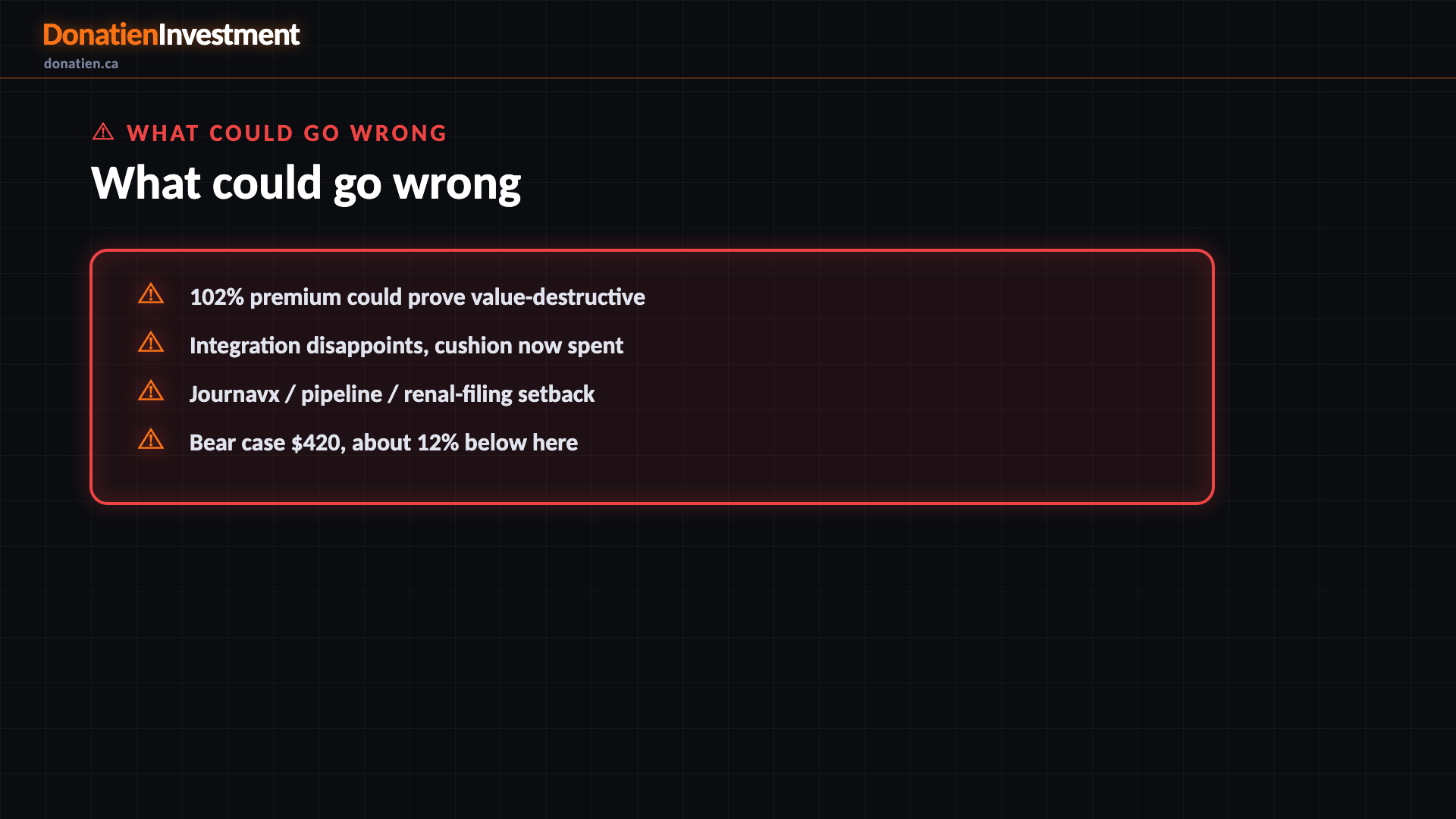
Weigh the downside honestly. If the roughly 102% premium proves value-destructive, or Crinetics integration disappoints, the market will punish a deal it already treats cautiously, and the balance-sheet cushion that used to absorb such shocks is now committed. A Journavx-uptake miss, a pipeline setback, or a regulatory disappointment on the inaxaplin renal filing would hurt. In the bear case the multiple de-rates toward $420, about 12% below here. This is why the short-term signal is a hold, not a buy, and why the stop sits at $445.
Risk vs Reward
Against the current US$476.41, the report frames a bull case at US$640 (+34%), a base case at US$560 (+18%) and a bear case at US$420 (-12%). See the full report for the probability weight behind each path.
The verdict
A hold at $476.41. Second-quarter results on 3 August were a beat-and-raise, but the stock barely moved (+1.2%) and there is no technical trigger yet. At a Fair multiple the medium and long calls are both BUY: a quality franchise to accumulate on confirmation or weakness.
Read the full report on donatien.ca →