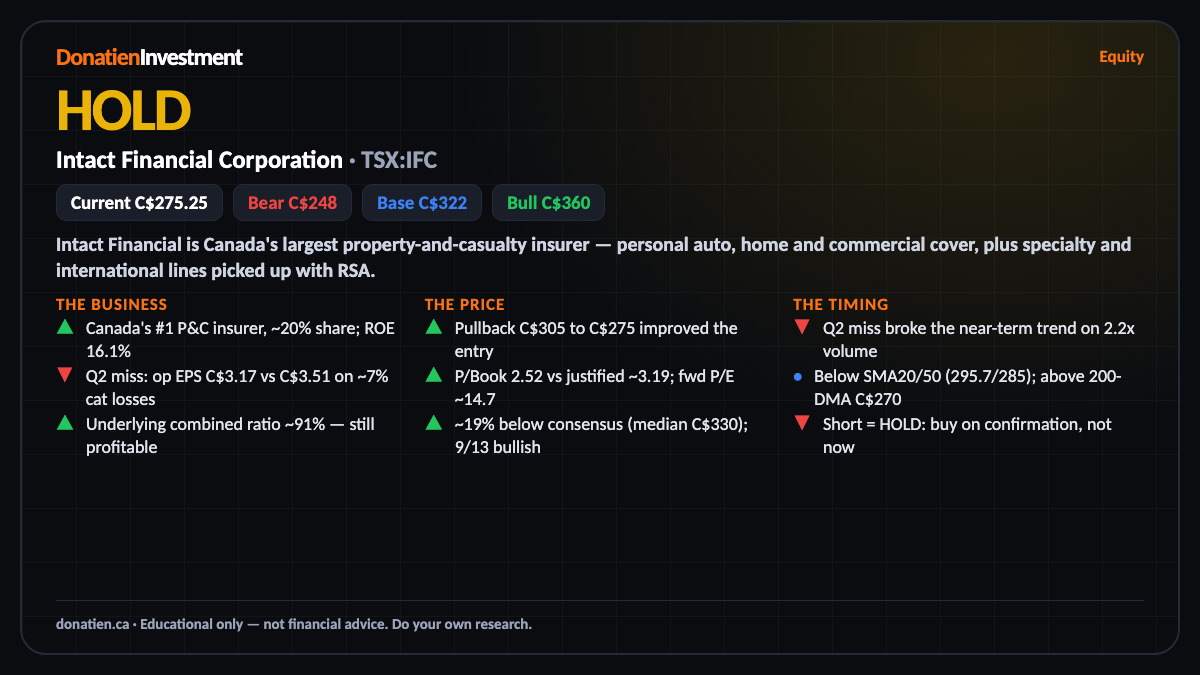
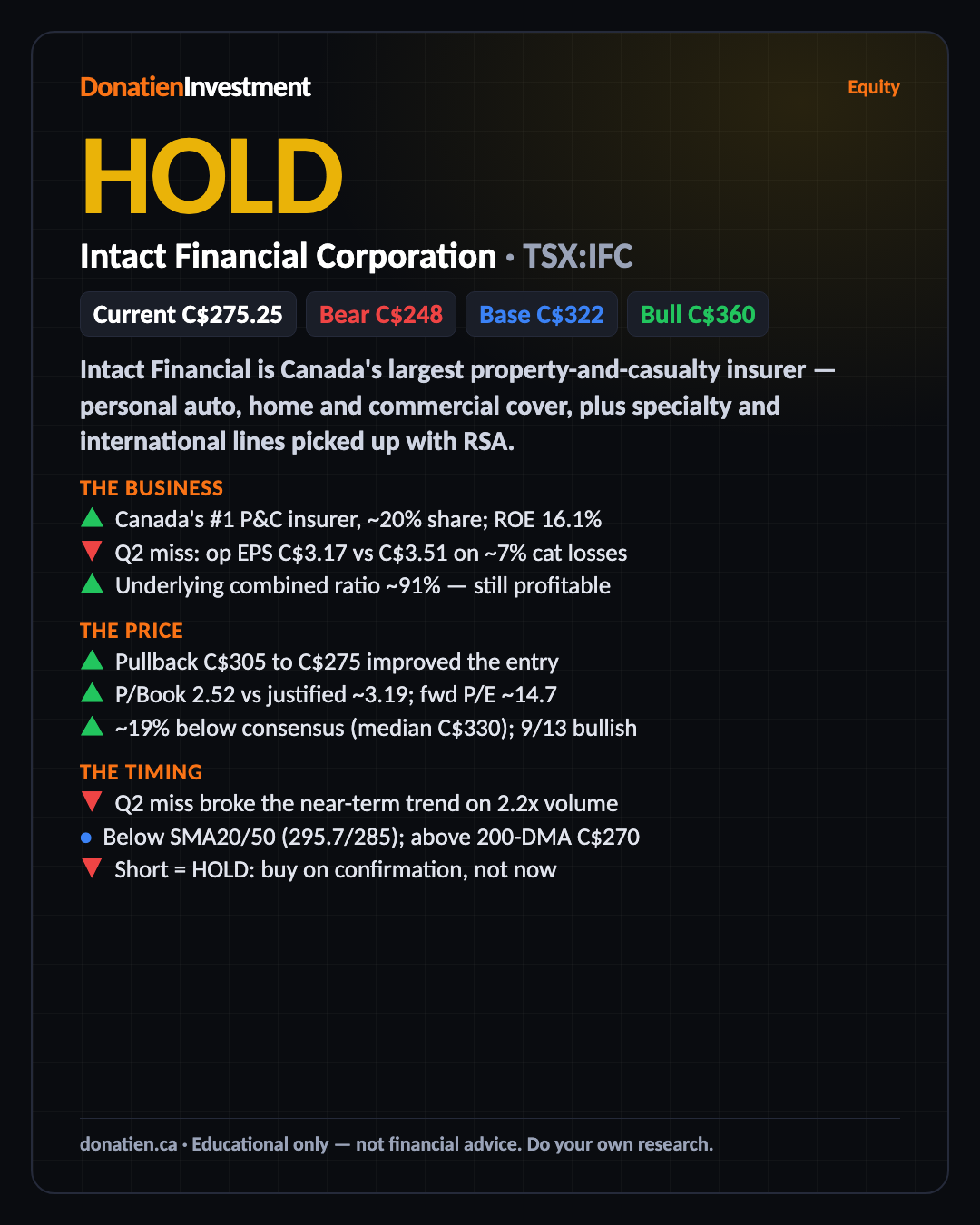
Intact Financial Corporation (TSX:IFC) HOLD
Intact is Canada's leading property-and-casualty insurer and a high-quality compounder, but it just missed Q2 on catastrophe losses and the near-term chart has broken down — so the short-term call is a HOLD. It is a Buy to accumulate for the medium and long term after the C$305-to-C$275 pullback. The one caution: Q3 is peak catastrophe season.
Intact Financial is Canada's largest property-and-casualty insurer — personal auto, home and commercial cover, plus specialty and international lines picked up with RSA. It collects premiums up front, invests the float, and aims to pay out less than it takes in, a discipline measured by the combined ratio. As the domestic number one, roughly one in five Canadian P&C dollars, it compounds through scale, data and disciplined acquisitions.
The business
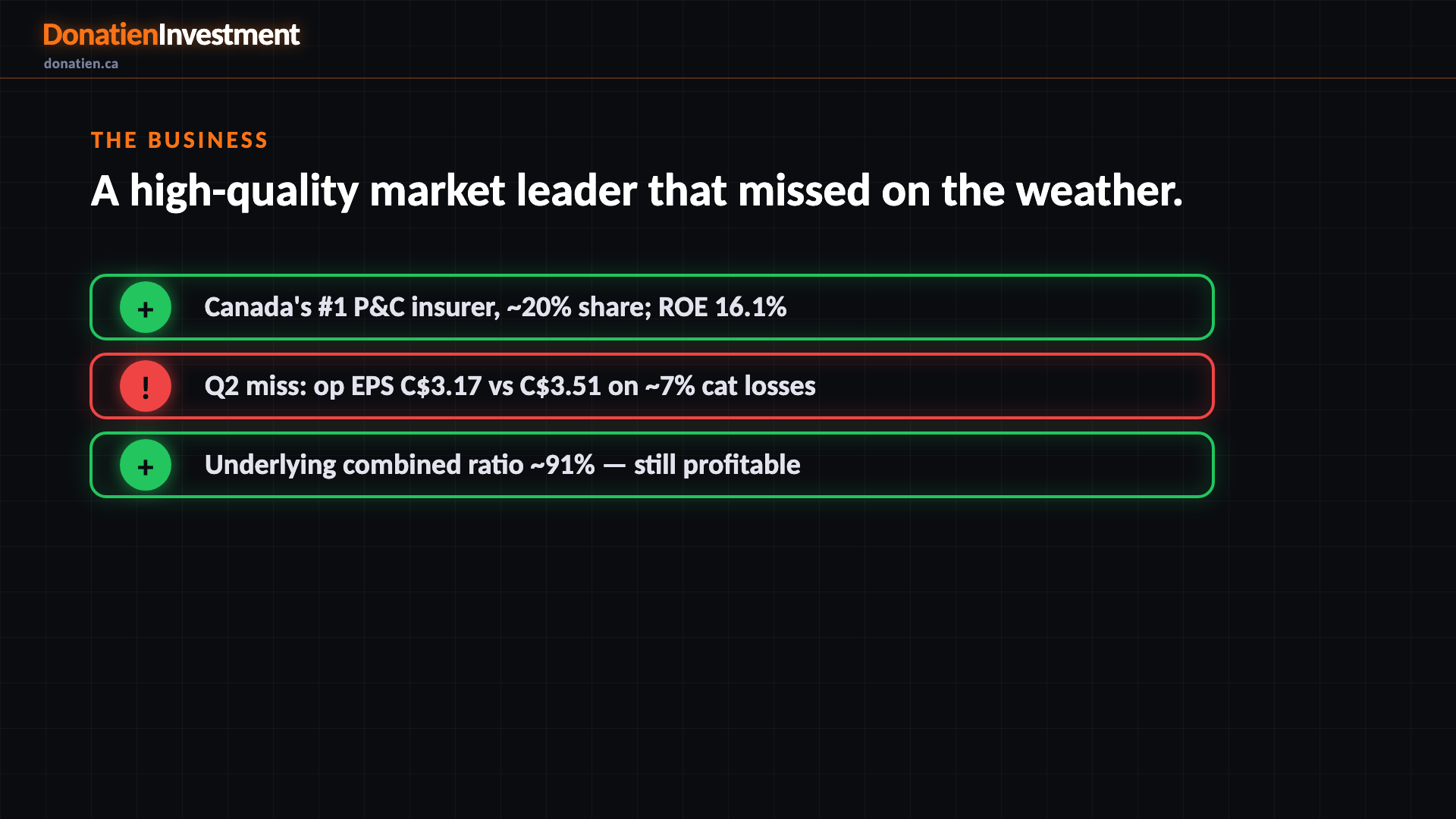
Intact is Canada's number-one property-and-casualty insurer, writing roughly one in five Canadian premium dollars, and it earns a mid-teens return on equity — sixteen-point-one percent — through a scale-and-data moat and a long record of disciplined acquisitions. The second quarter missed, though: catastrophe losses of about seven percent, from Canadian storms and fires in the UK and Ireland, cut operating earnings to three dollars seventeen a share against three-fifty-one expected. The important part is that the underlying business stayed underwriting-profitable — the combined ratio excluding catastrophes held near ninety-one percent. This was a weather quarter, not a franchise problem.
The price
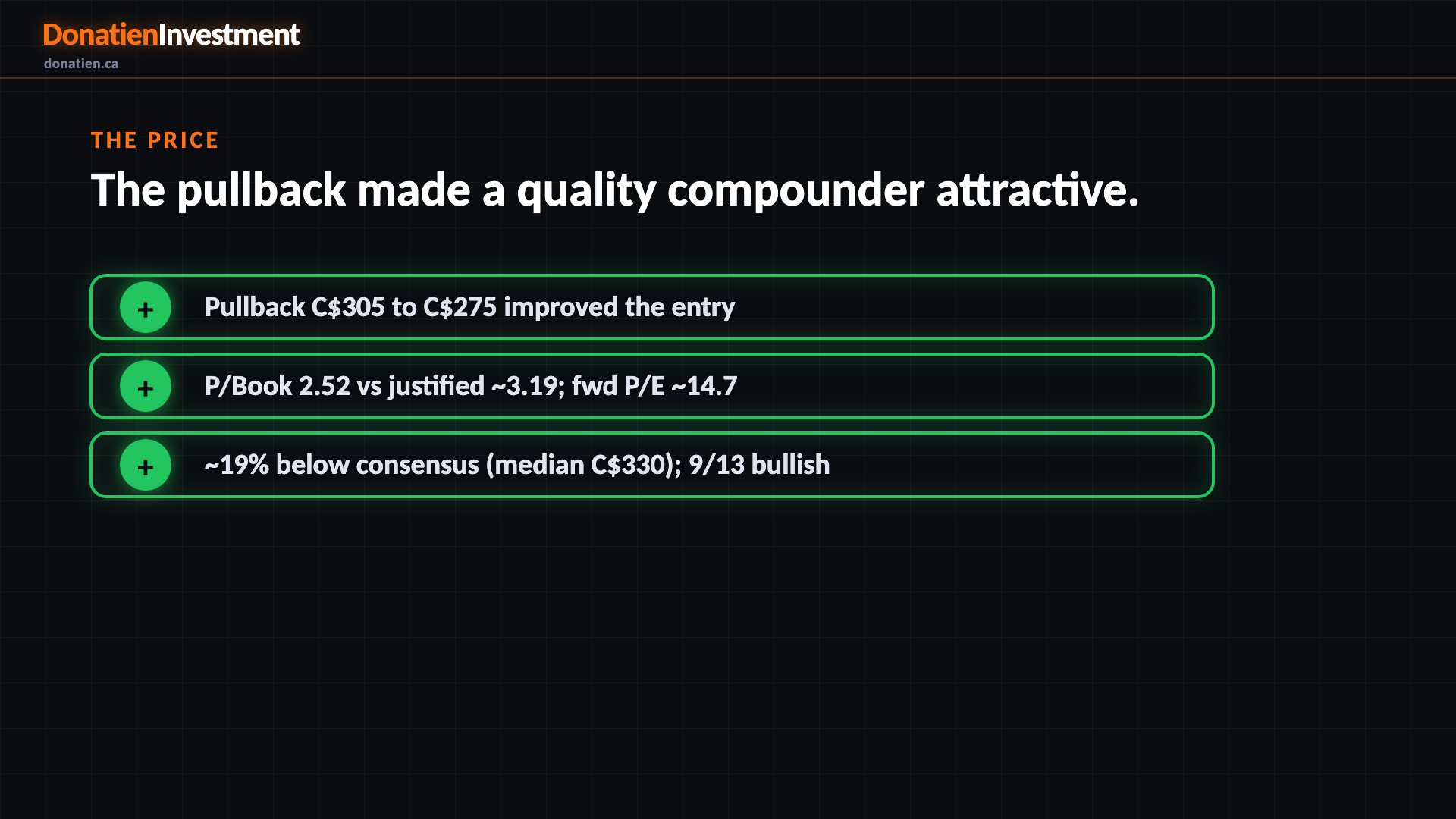
The miss did the valuation some good. The stock gapped from three-oh-five down to about two-seventy-five, and on the measure that matters for an insurer — price to book — it now trades at two-point-five-two against a justified multiple of about three-point-two. Forward earnings are around fourteen-and-a-half times, below the level that is rich for insurance. Thirteen analysts cover it, nine of them bullish, with a median target of three hundred thirty dollars — roughly nineteen percent above today's price, plus a two-percent dividend. That is why the medium and long-term signals are both a Buy: a high-quality leader at a better price.
The timing
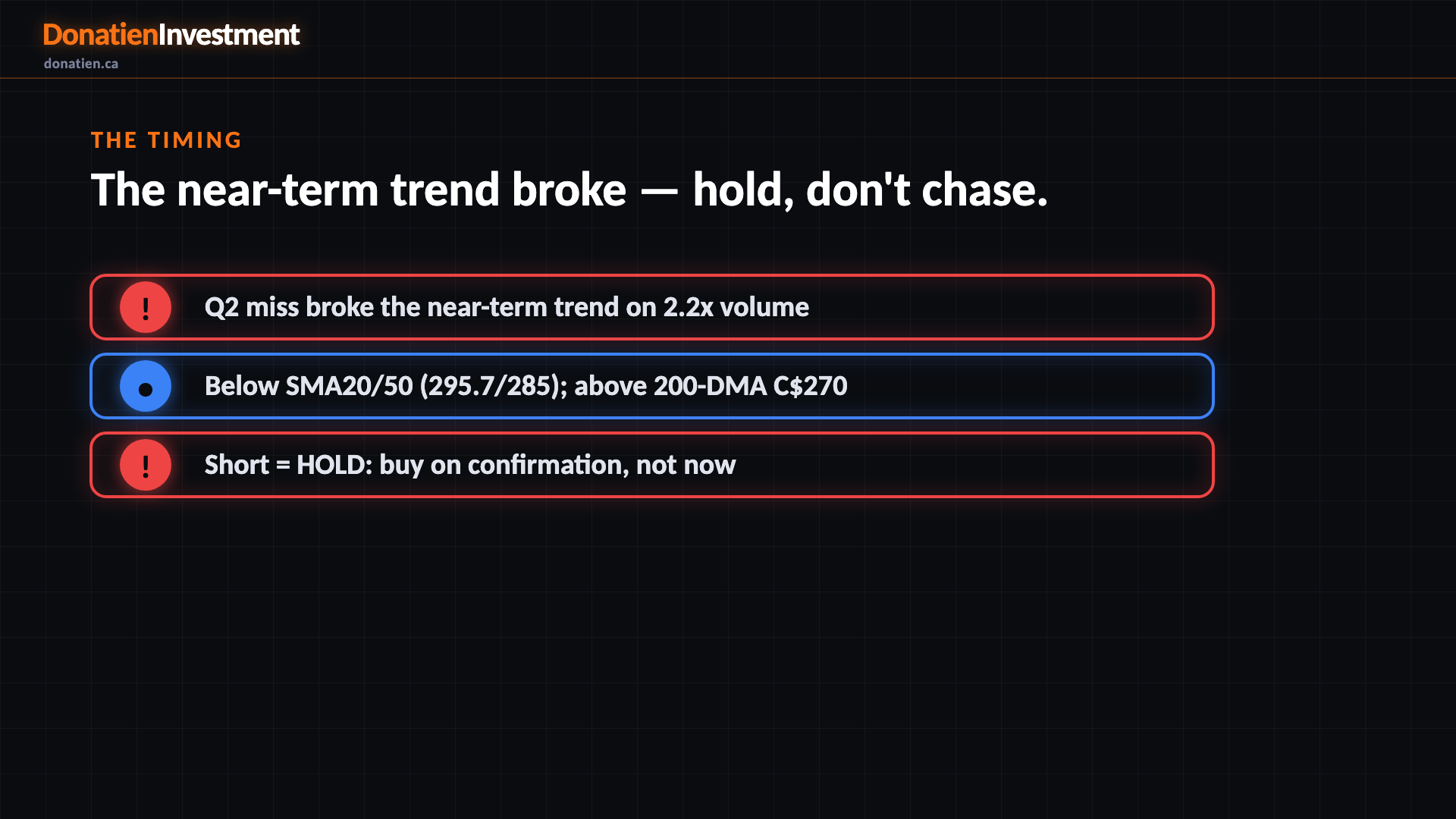
The reason the short-term call is only a hold is the chart. Running into earnings the stock made a fresh high at three-oh-five, then gapped down on the miss through both the twenty- and fifty-day averages, on more than twice the normal volume — real distribution, not noise. The longer-term uptrend is still intact; price holds above a rising two-hundred-day line near two-seventy. But with the near-term structure broken, this is a buy-on-confirmation, not a buy-now. A reclaim above two-eighty-five on volume, or a tested higher low off the two-seventy support, would flip the short-term signal to a buy and take the position to full size.
What could go wrong
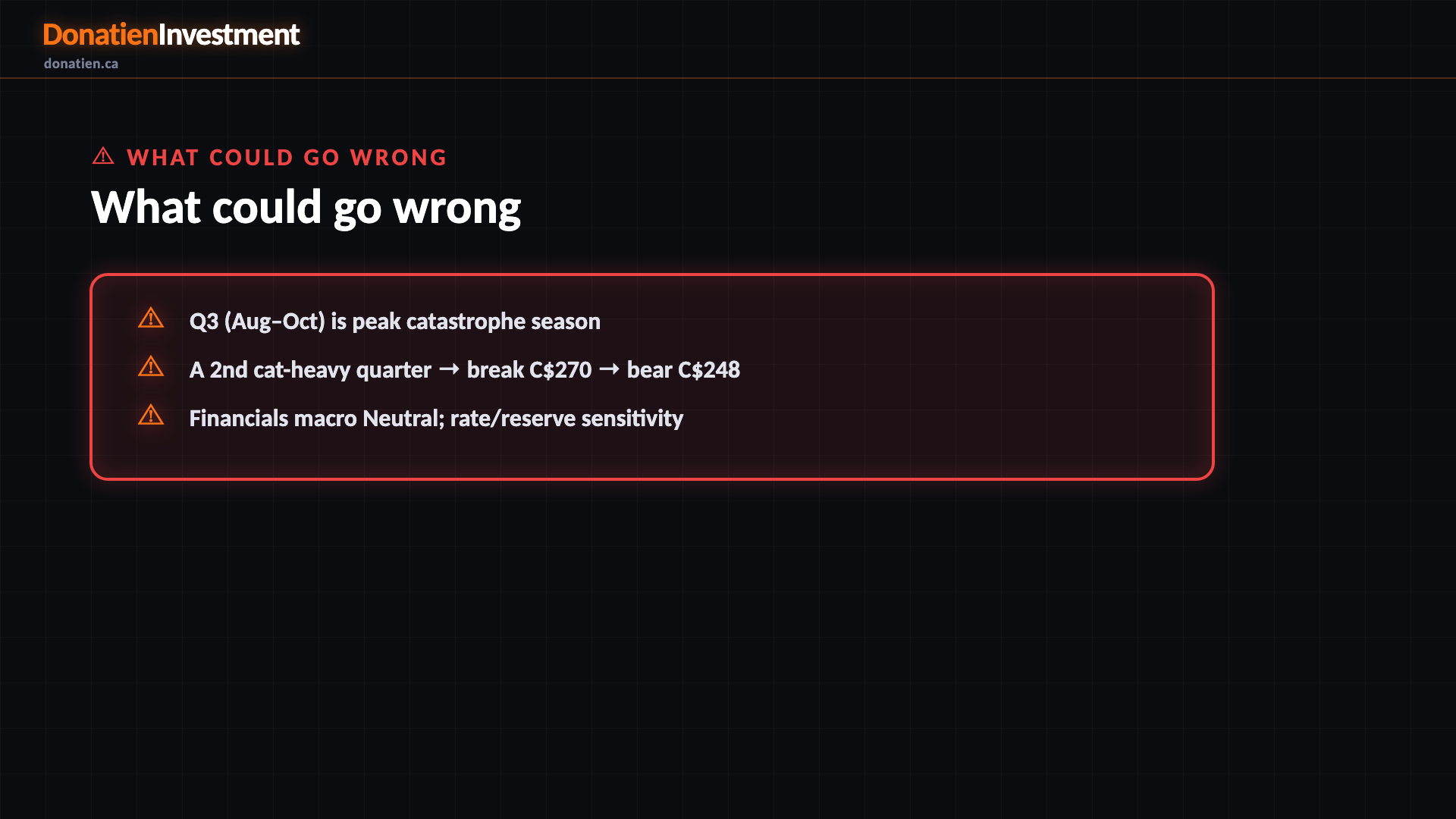
The dominant risk is the one that just hit: the weather. The third quarter — August to October — is peak catastrophe season for hurricanes and wildfires, so a second cat-heavy quarter could deepen the miss and push the stock through the two-seventy support toward the bear case near two hundred forty-eight. Beyond that, the macro read on financials is now neutral rather than a tailwind, and insurers carry rate and reserve sensitivity if the claims-inflation picture worsens. The cushion is the balance sheet — A-plus-rated subsidiaries, low leverage, a thirty-one percent payout — and an underlying combined ratio that stayed profitable through a bad quarter.
Risk vs Reward
Over twelve months the base case is about three hundred twenty-two dollars, a fifty-five percent probability — the catastrophe losses normalise, book value compounds in the mid-single digits, and the stock grinds back toward the consensus. The bull case is three hundred sixty, at twenty-two percent, if cat season is benign and investment income keeps climbing. The bear case is two hundred forty-eight, at twenty-three percent, on an active third-quarter cat season or a broad risk-off. That is a probability-weighted value near three hundred thirteen dollars, about fourteen percent above today's price.
The verdict
So: a hold on the short term, and a Buy to accumulate for the medium and long term. This is a high-quality Canadian insurer that missed on the weather, not on the business, and the pullback has handed you a better price on a mid-teens-ROE compounder. The discipline is the entry — half-size today on valuation, and add when the chart confirms with a reclaim above two-eighty-five or a tested low near two-seventy, rather than chasing an active breakdown. And keep peak catastrophe season in view. Educational, not advice — do your own research.
Read the full report on donatien.ca →