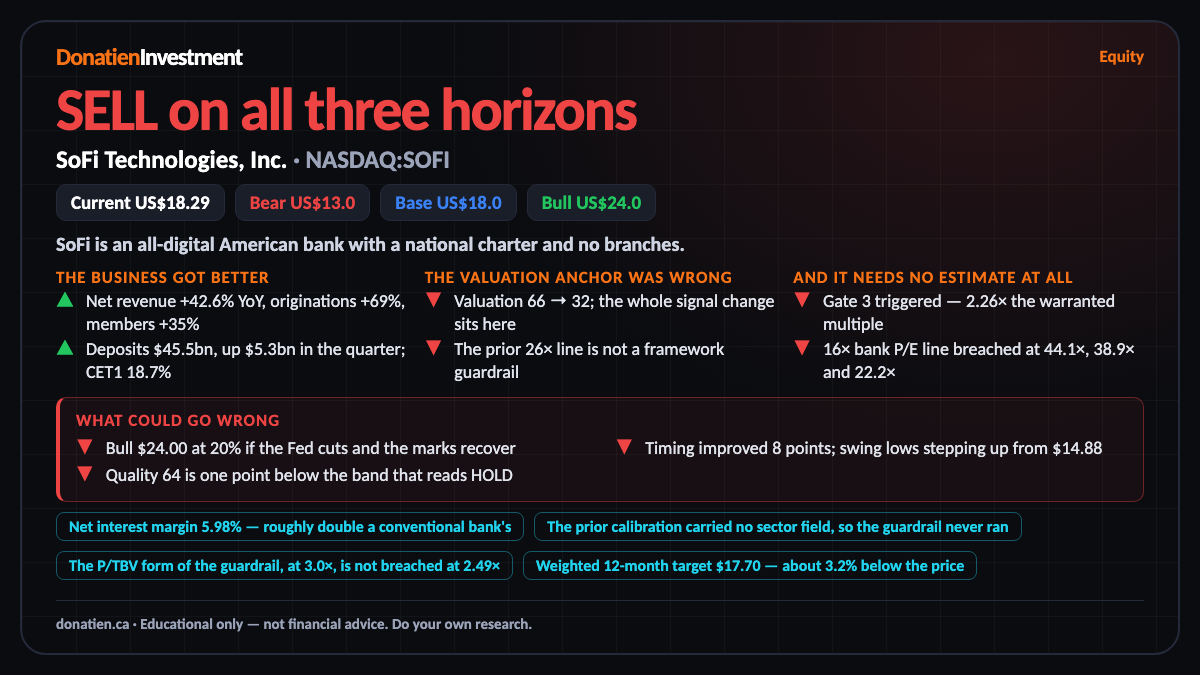
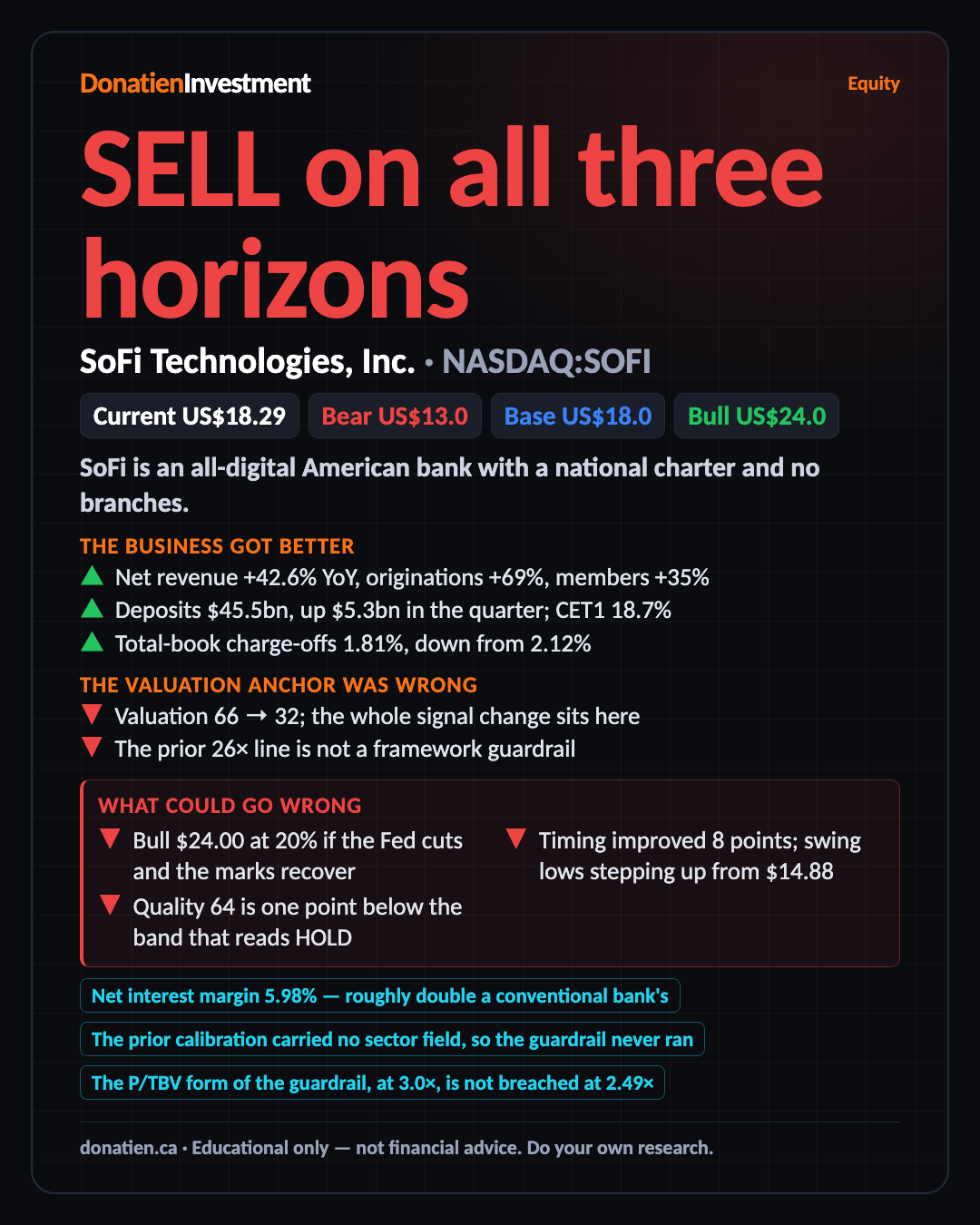
SoFi Technologies, Inc. (NASDAQ:SOFI) SELL on all three horizons
Re-anchored on the framework's bank test — price to tangible book of 2.49× against a warranted 1.10× — Valuation falls from 66 to 32 and the Valuation Ceiling gate triggers.
SoFi is an all-digital American bank with a national charter and no branches. It takes $45.5bn of deposits, lends them back out, and sells brokerage and card products to the same 15.8 million members.
The business got better
Start with what went right, because most of it did. Net revenue compounded at forty-two point six percent year on year. Loan originations rose sixty-nine percent. Members grew thirty-five percent to fifteen point eight million, and deposits rose five point three billion dollars in the quarter to forty-five and a half billion, funding more than ninety percent of the balance sheet. The credit read improved too: charge-offs across the whole book fell to one point eight one percent from two point one two. Common equity tier one capital sits at eighteen point seven percent against a ten percent strong line. Six consecutive quarters of rising operating income. None of that is the problem.
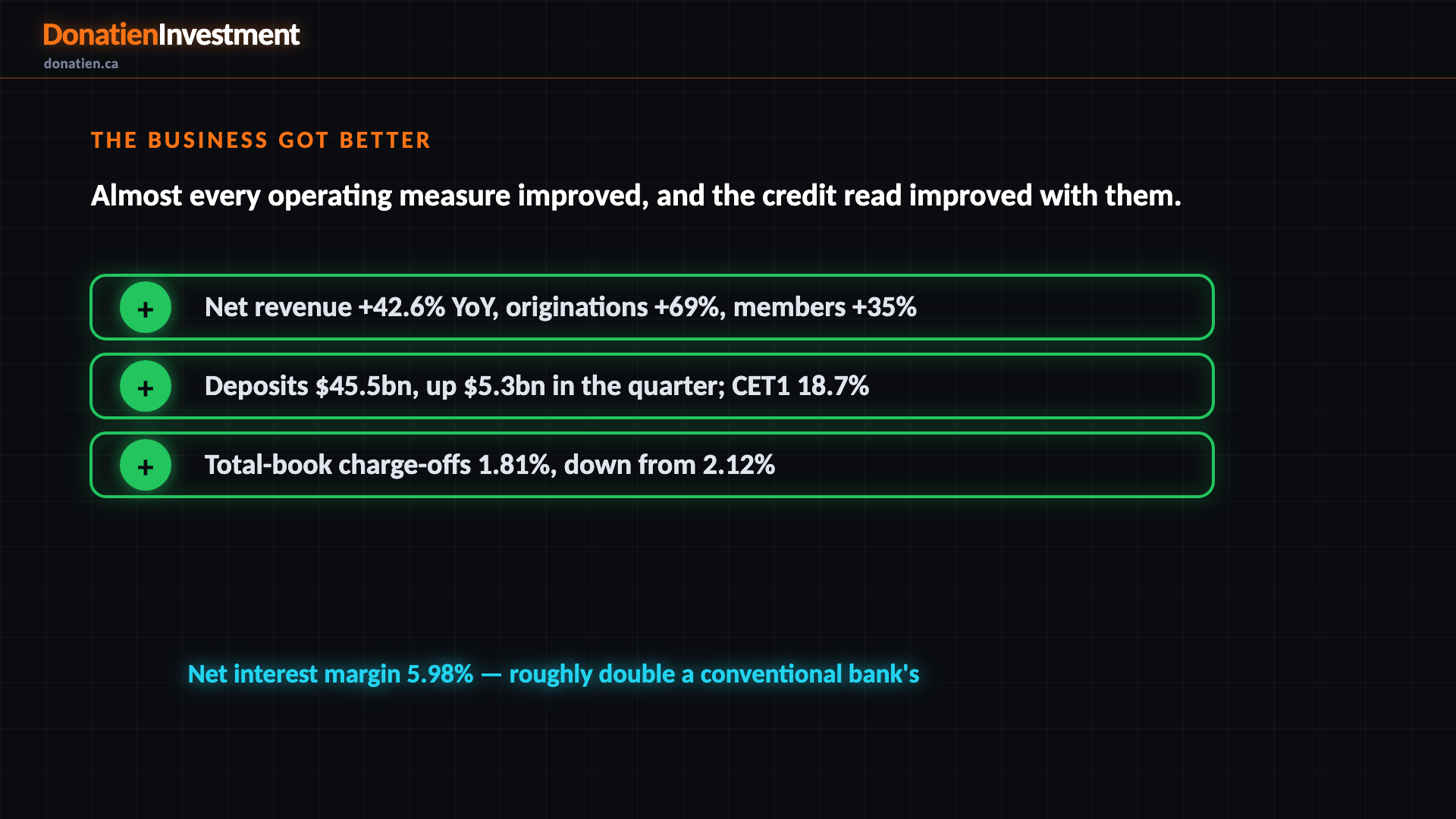
Net interest margin 5.98% — roughly double a conventional bank's
The valuation anchor was wrong
Now the correction. The last report anchored this name on a compounder forward price-to-earnings line of twenty-six times, scored a forward multiple against it, and read the valuation as attractive. That twenty-six times line is not either of the framework's financials guardrails. The prior calibration carried no sector field at all, so the guardrail check could not run, and the framework specifies the clean trailing multiple rather than the forward one. Re-anchored on the mandated bank test — justified price to tangible book, because sixty-five percent of net revenue is net interest income and this is a chartered deposit-taker — it reads two point four nine times actual against one point one zero times warranted. Valuation falls from sixty-six to thirty-two. That single pillar is the whole downgrade.
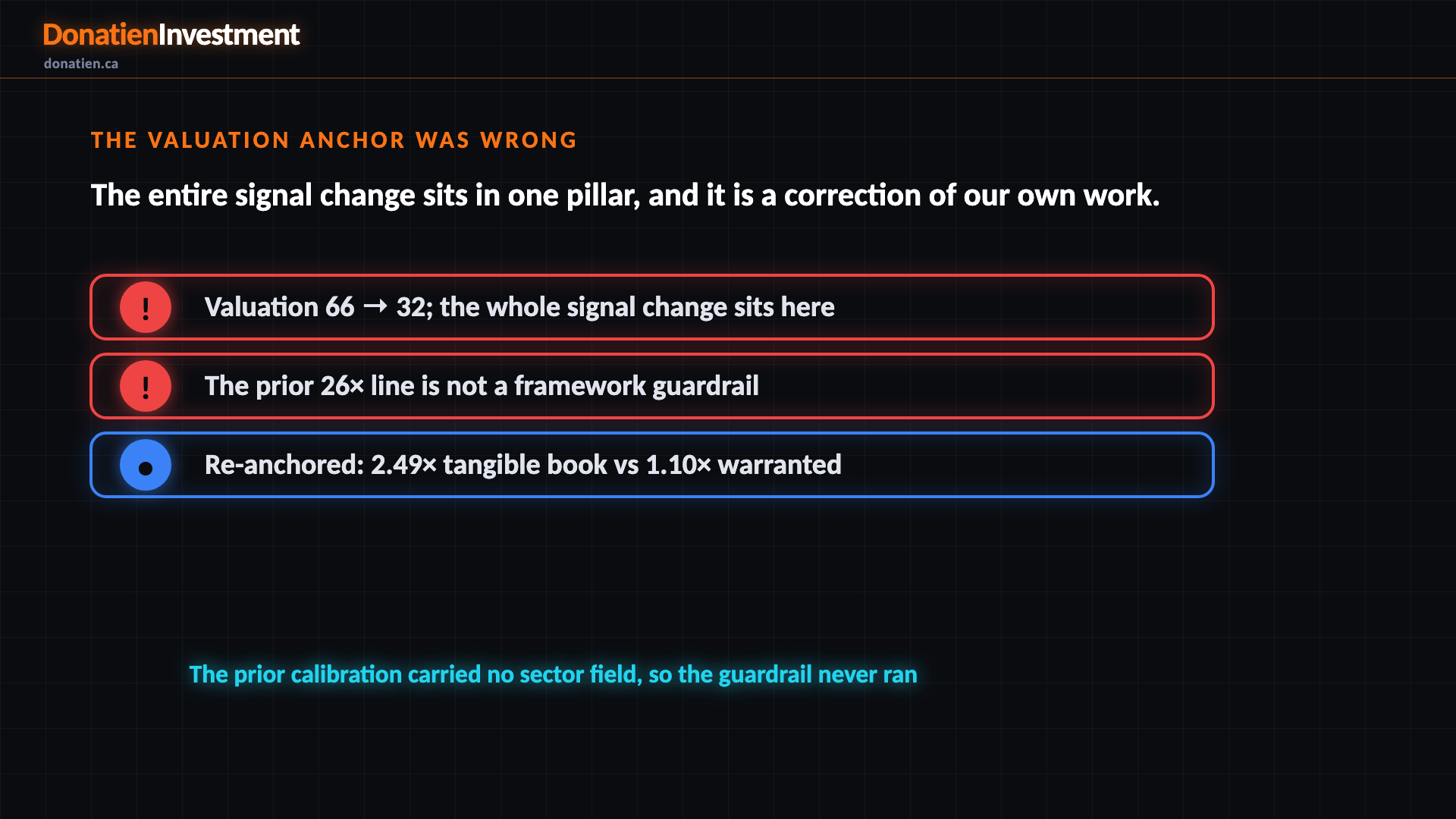
The prior calibration carried no sector field, so the guardrail never ran
And it needs no estimate at all
The obvious objection is that a warranted multiple is a judgement, so the downgrade rests on our assumptions. On this name it does not. The framework's deposit-taking guardrail puts a sixteen times price-to-earnings floor under the Expensive band, and that floor is breached three separate ways with no estimate of any kind: the clean trailing multiple at forty-four point one, the reported multiple at thirty-eight point nine, and even the forward twenty-twenty-seven multiple at twenty-two point two. To escape Expensive on the book-value route this business would need a normalised return on tangible equity of seventeen point six percent. It currently earns six point eight, against a cost of equity of eleven point two.
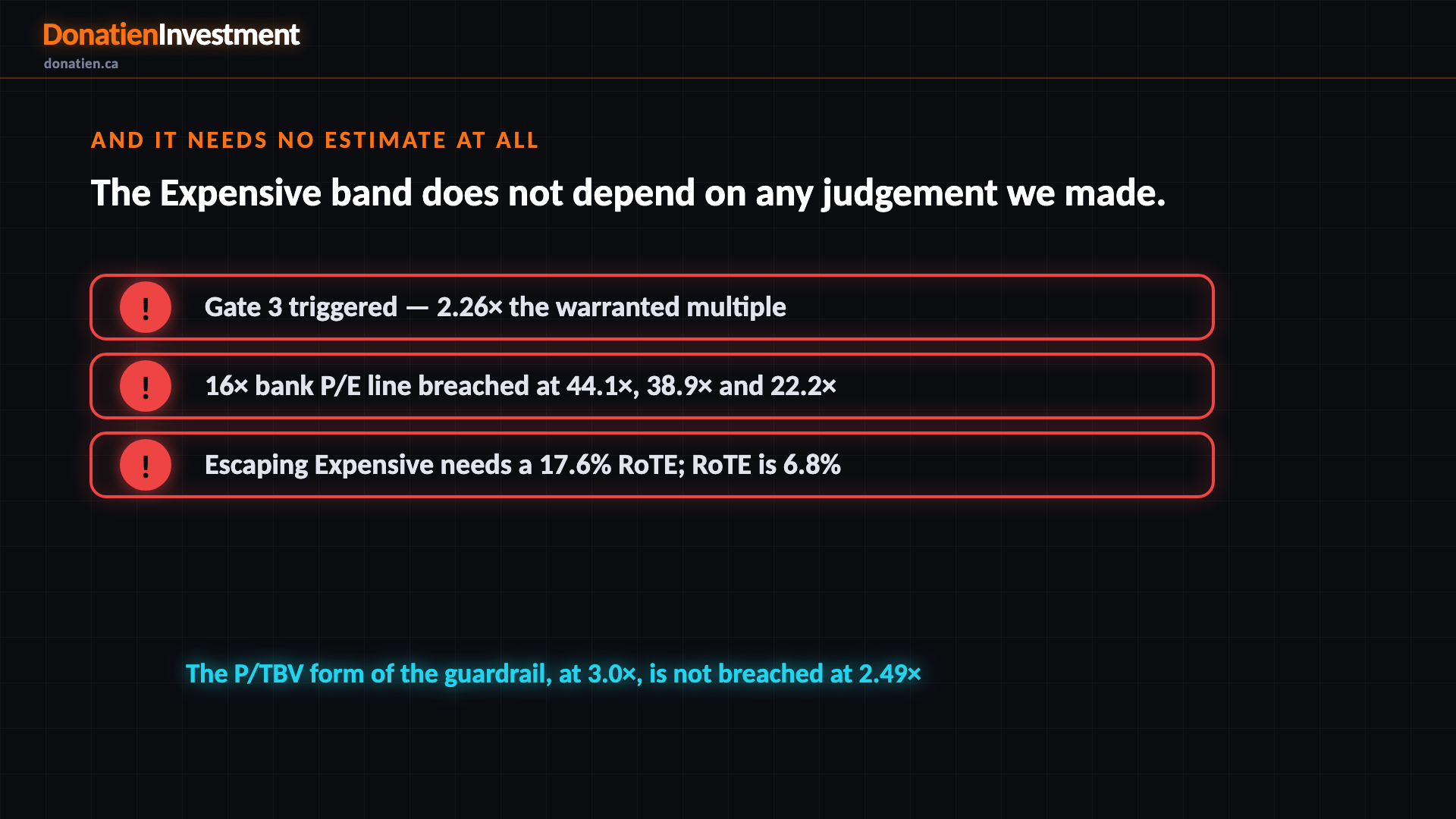
The P/TBV form of the guardrail, at 3.0×, is not breached at 2.49×
What a SELL means here
Be clear about what this signal is and is not. The base case is not a collapse. It is the operating story delivering exactly as guided while tangible book grows toward roughly eight dollars ninety, so a flat share price is itself a de-rating from two and a half times book to about two. The shareholder's return comes from the multiple compressing into the book value rather than from the price. Behind that sits the gap this report is flagging: the intrinsic anchors value the equity between eight dollars seven and ten dollars nineteen, against a price of eighteen twenty-nine. With no buy at any horizon the Donatien Pick stops. It stays visible, and it reactivates automatically on any future buy.
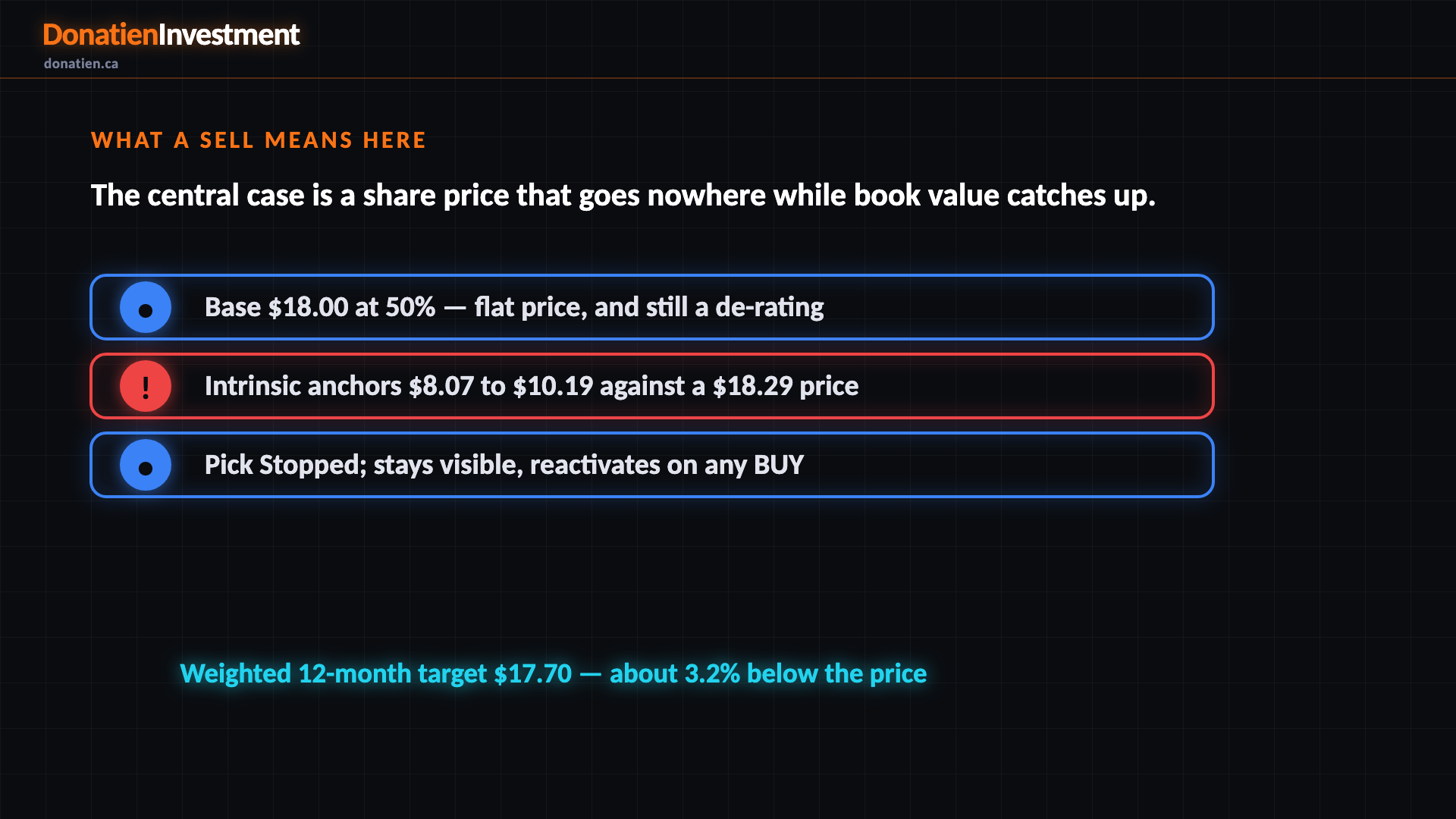
Weighted 12-month target $17.70 — about 3.2% below the price
What could go wrong
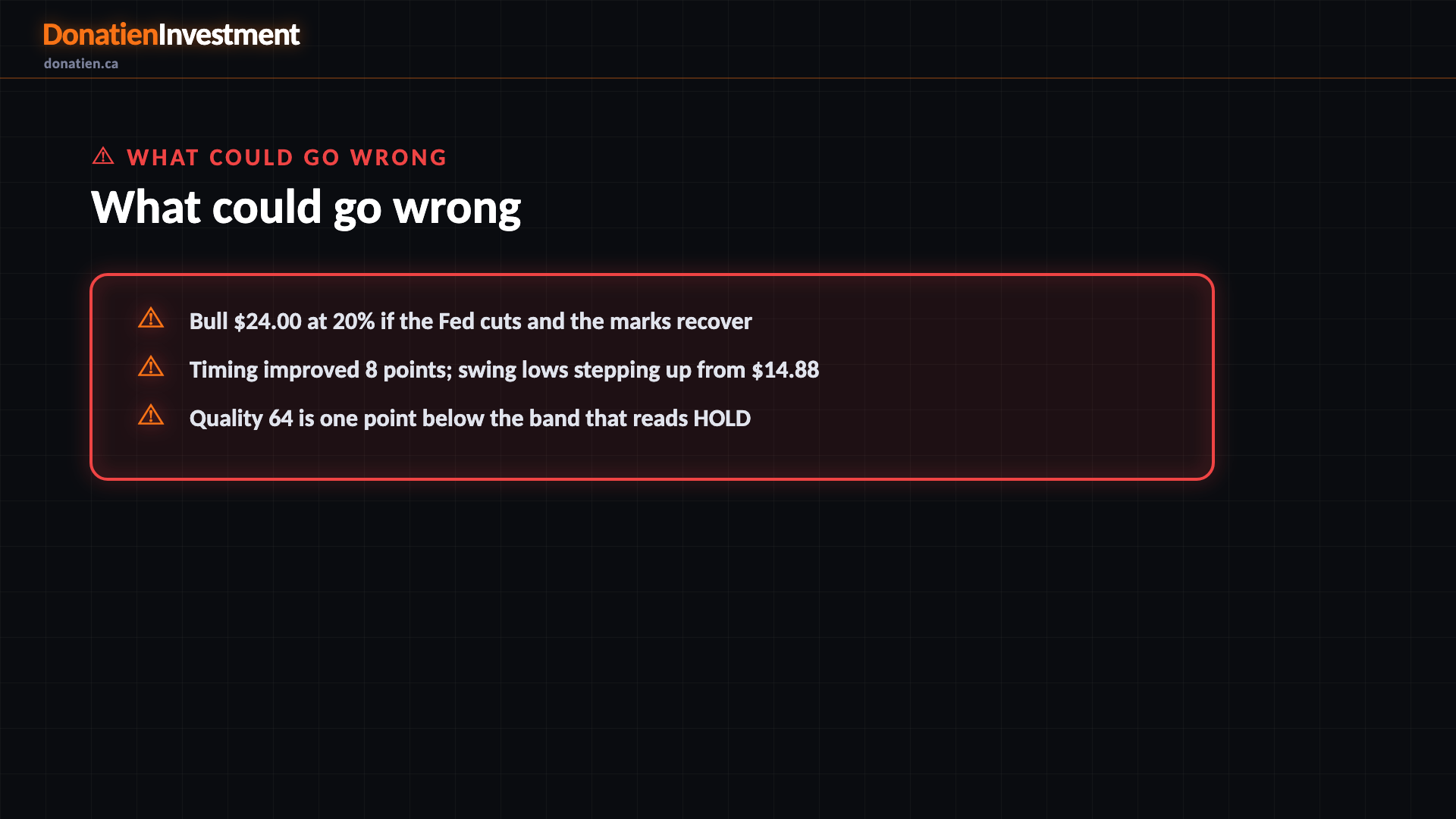
On a sell the balance is the upside case, and it is real. Timing genuinely improved eight points: swing lows have stepped up from fourteen eighty-eight at the end of July through fifteen sixty-five, sixteen forty-seven, sixteen seventy-two and seventeen oh eight, price is back above the twenty and fifty-day averages, and the technical entry path is open. The bull case at twenty-four dollars carries twenty percent: the energy shock subsides, the Fed resumes cutting, deposit costs fall, the fair-value mark recovers and guidance rises. The analyst consensus sits at twenty-one eleven, fifteen percent above the price. And business quality is one single point below the high band, where this same valuation would read hold rather than sell. Note what that does not change: neither row produces a buy, so the pick stops either way.
Risk vs Reward
Bull twenty-four dollars at twenty percent, on the rate path reversing and the whole chain reversing with it. Base eighteen dollars at fifty percent, essentially flat, on the company delivering its guided four point seven five to four point eight five billion of adjusted net revenue while no re-rating arrives. Bear thirteen dollars at thirty percent, and that weight is deliberately above a conventional twenty because the bear's leading mechanism is a September rate hike the macro report scores as live at about forty-four percent, feeding a fair-value loan book whose mark has already fallen seventy-one basis points in a quarter. The probability-weighted target is seventeen seventy, about three percent below the price.
The verdict
Sell, on all three horizons, and the Donatien Pick is stopped. This is not a verdict on the operating business, which is compounding faster than almost anything else we cover and improving its credit book while it does. It is a verdict on the price against the framework's own bank test, and it is partly a correction of our own previous work — we scored this name against a line that is not in the framework, and on a calibration that could not run the guardrail check. We would rather say that plainly than quietly re-rate and move on. The next report is due the twentieth of August, one trading day after the FOMC minutes.
It is a quantitative framework for educational purposes only, and it is not financial advice. Always do your own research.
Read the full report on donatien.ca →