Palantir Technologies Inc. (NASDAQ:PLTR) HOLD on all three horizons
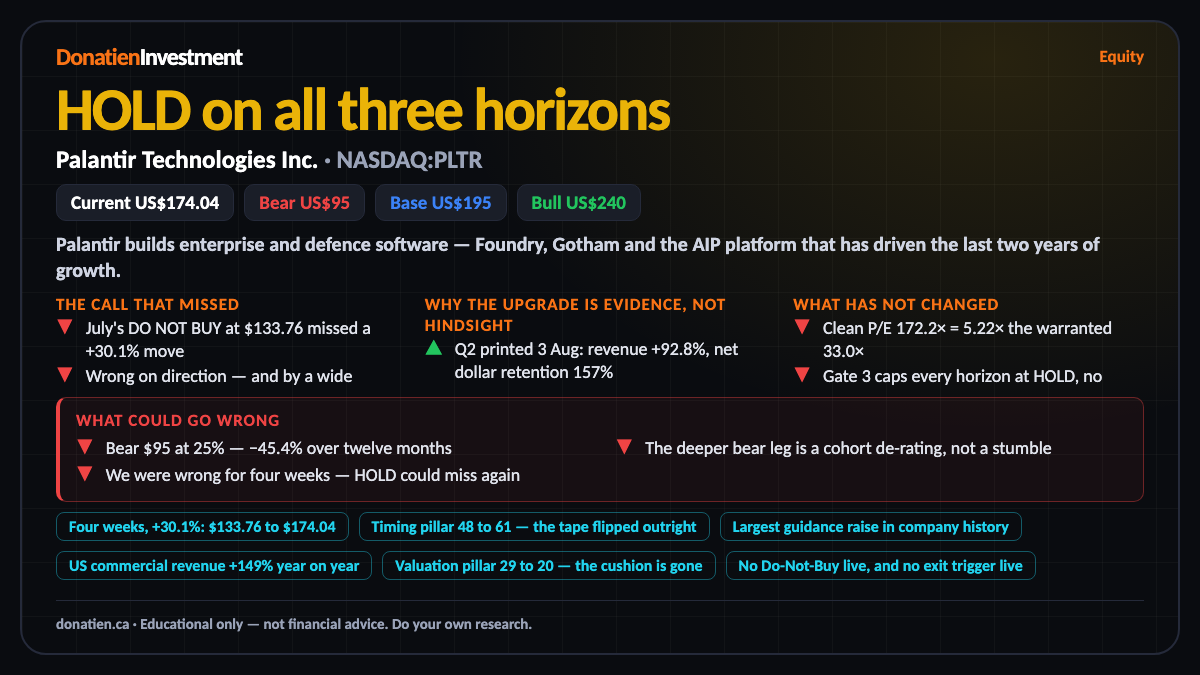
Clean P/E of 172.2× is 5.22× the warranted 33.0×, so Gate 3 caps every horizon at HOLD — but both Do-Not-Buy legs are withdrawn on evidence that arrived after 16 July.
Palantir builds enterprise and defence software — Foundry, Gotham and the AIP platform that has driven the last two years of growth. This report is unusual in two ways: it upgrades the signal, and it opens by publishing a call that cost the reader money. Business Quality scores 86 and Underlying Drivers 86. Nothing here says the business is weak. The argument is entirely about what you pay for it.
The call that missed
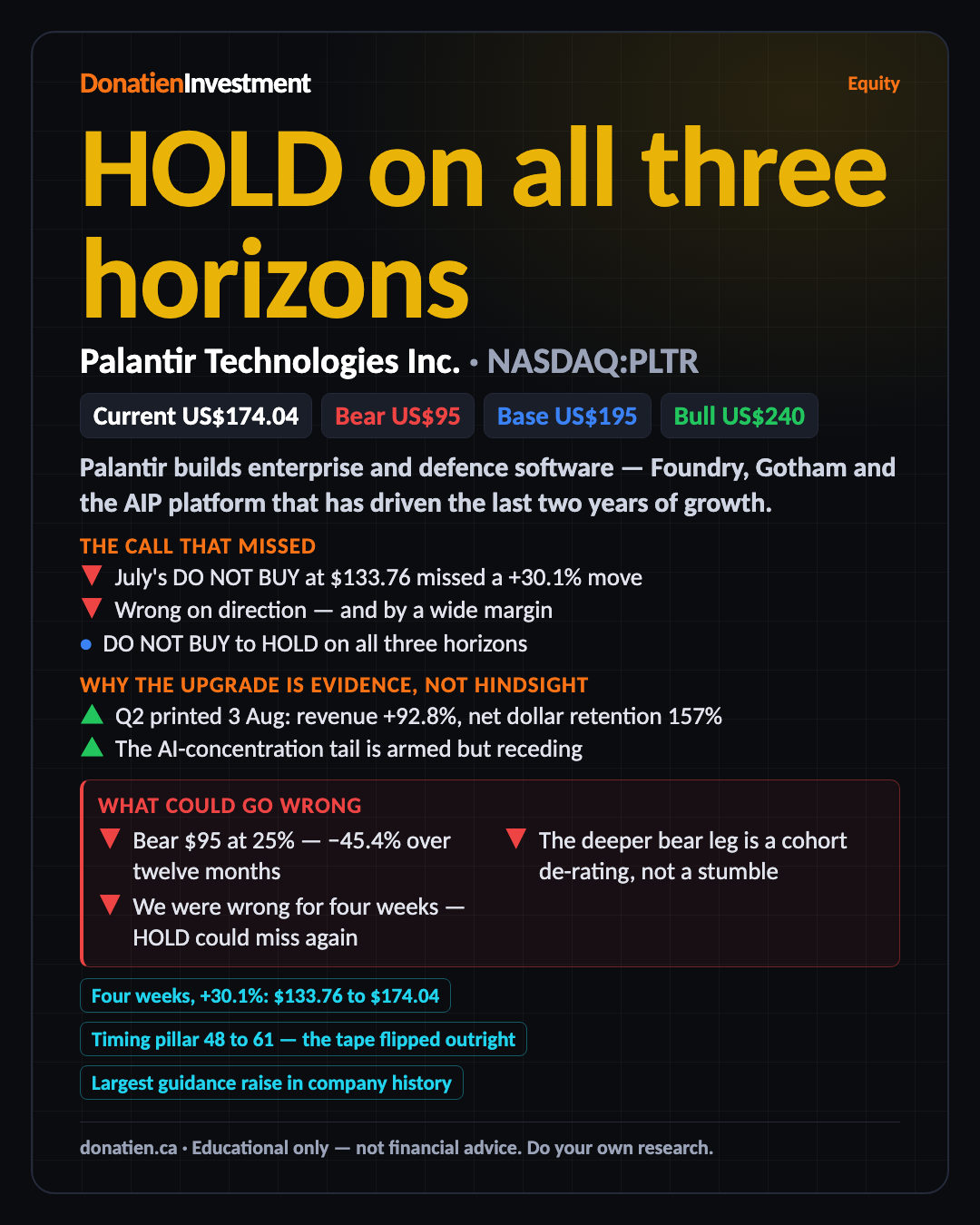
Start with the loss, because the report does. On the sixteenth of July we put a hard do-not-buy on Palantir at one hundred thirty-three dollars seventy-six, across all three horizons. The stock is now one hundred seventy-four dollars four — up thirty point one percent in four weeks. On the short horizon that call was simply wrong, and wrong by a wide margin. Anyone who acted on it missed a thirty percent move in a month. We are not going to bury that under a paragraph of framework language, and we are not going to describe the upgrade that follows as intellectual hygiene, because it is not.
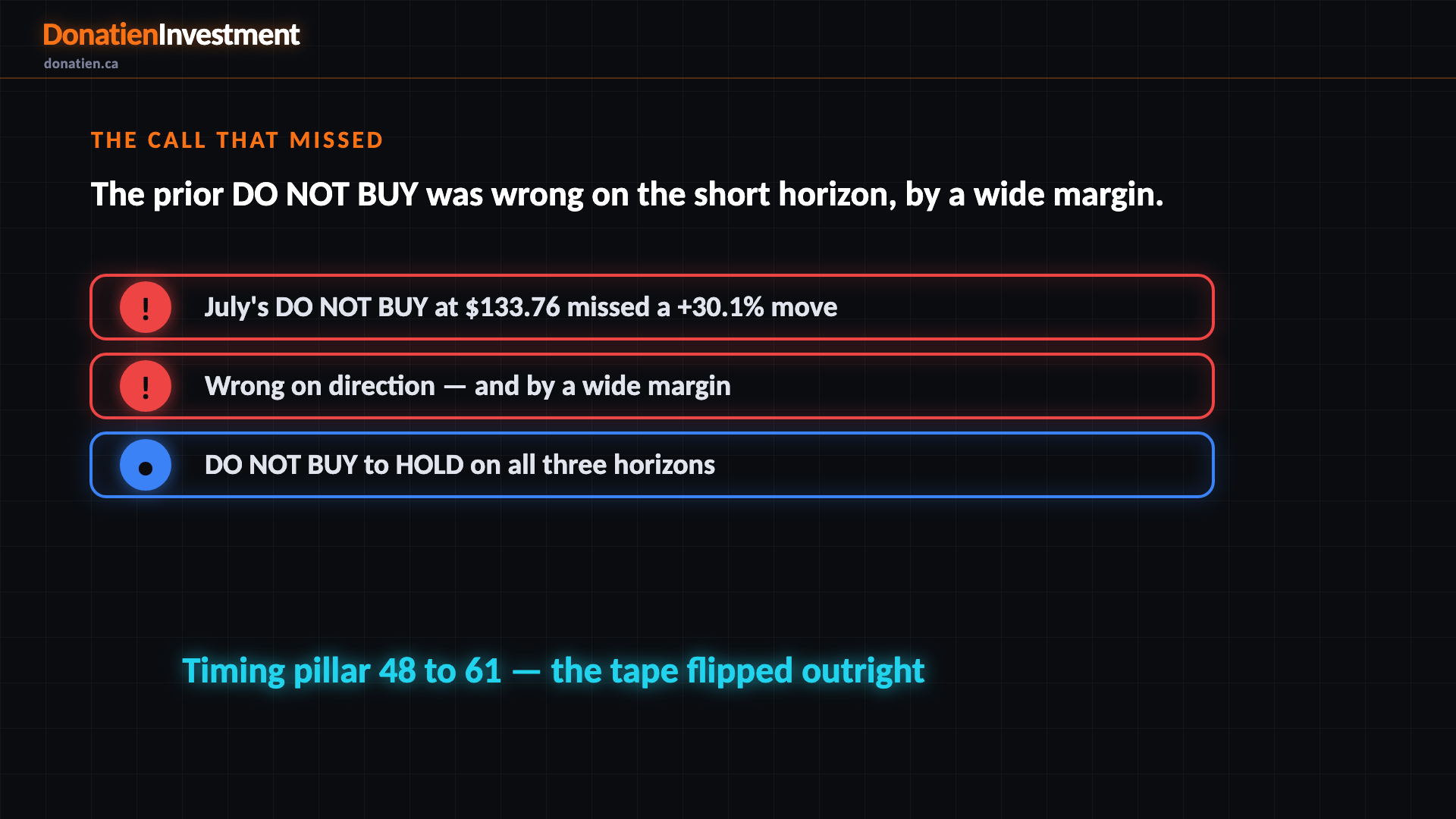
Four weeks, +30.1%: $133.76 to $174.04 · Timing pillar 48 to 61 — the tape flipped outright
Why the upgrade is evidence, not hindsight
The upgrade has to survive an obvious objection: did the evidence change, or did we simply re-read our own rule more kindly? The dates answer it. One leg required exceptional, proven, durable growth to be absent — and the figures that put it beyond argument, ninety-two point eight percent revenue growth and net dollar retention of one hundred fifty-seven percent, printed on the third of August, eighteen days after that report. The other leg required a live de-rating catalyst from the macro report's concentration tail; that tail was graded armed with breadth narrowing in July, and by the twelfth of August it read armed but receding as breadth broadened. Both withdrawals are correct on today's evidence. Neither is the act of self-correction we would prefer to claim.
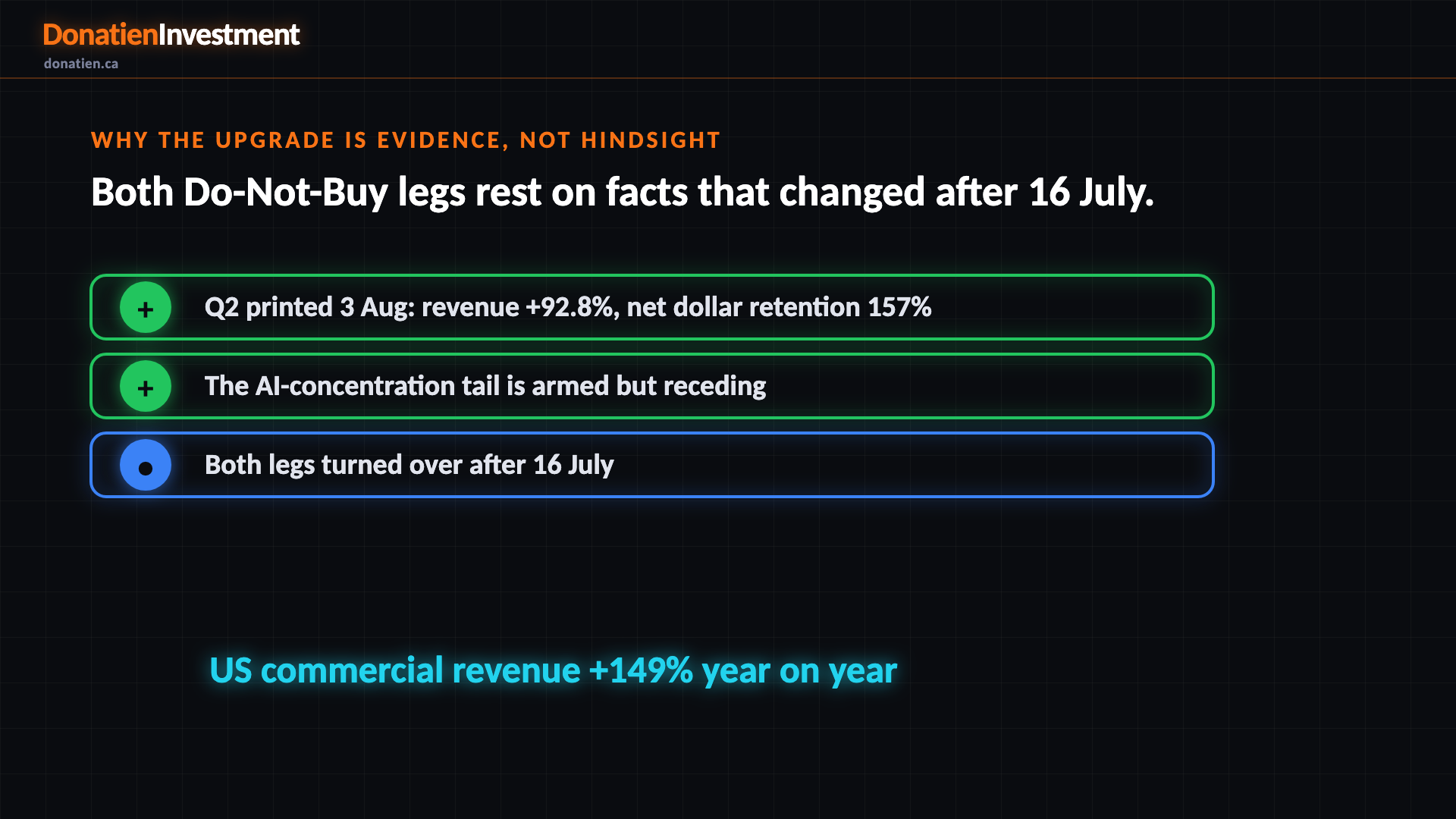
Largest guidance raise in company history · US commercial revenue +149% year on year
What has not changed
Here is the observation that matters more than the upgrade. The stock rose thirty percent and the multiple barely moved — clean price-to-earnings went from one hundred sixty-nine times at the last report to one hundred seventy-two point two today, because second-quarter earnings grew almost as fast as the price did. So the framework was not wrong about the multiple being extreme. It was wrong about the four-week direction. The de-rating risk that produced the original verdict is entirely undiminished. At five point two two times the warranted multiple of thirty-three, the valuation ceiling gate fires and caps every horizon at hold, with no growth exception available.
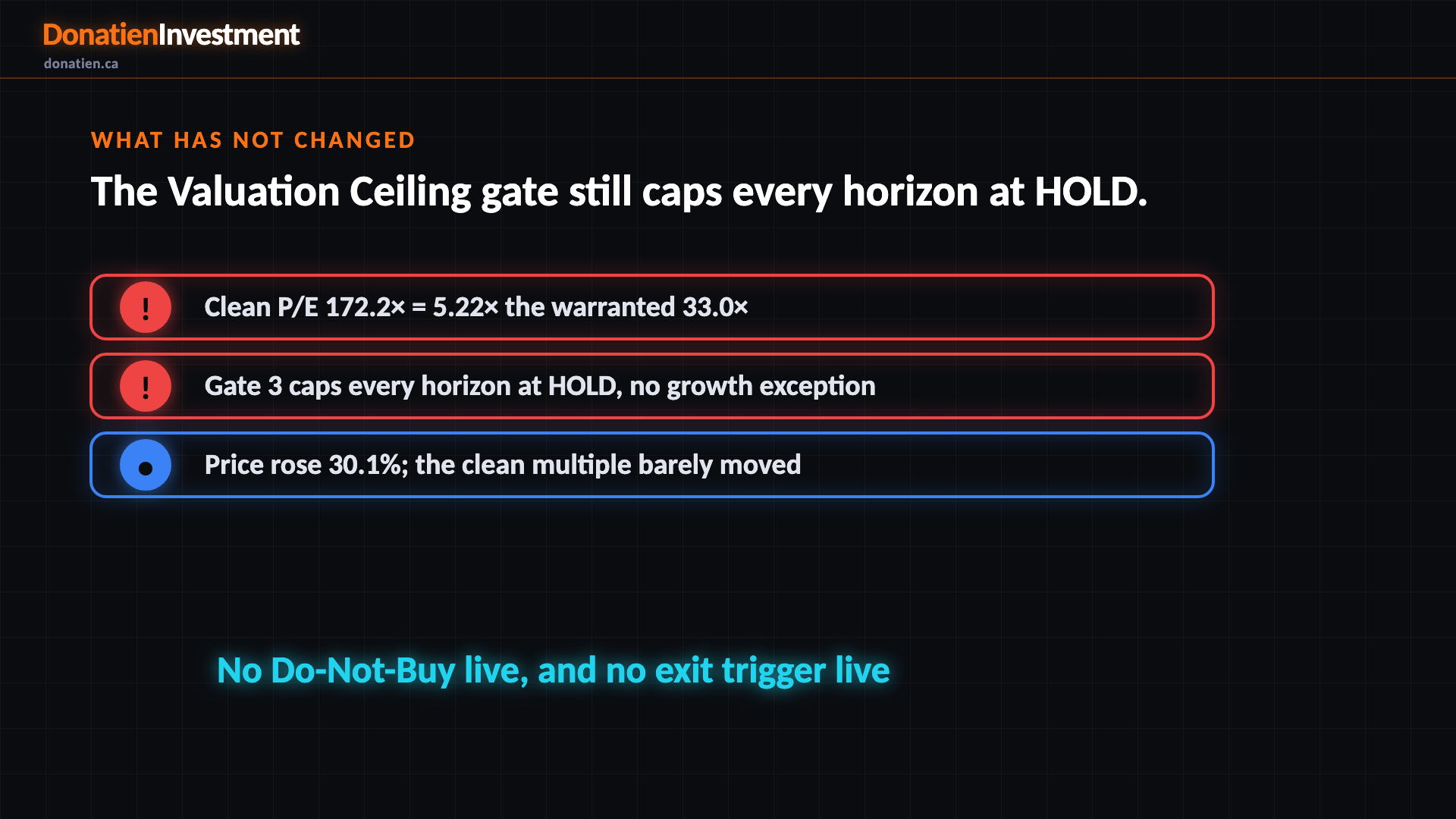
Valuation pillar 29 to 20 — the cushion is gone · No Do-Not-Buy live, and no exit trigger live
The base case assumes the multiple never normalises
Read the central case honestly. It has the multiple staying roughly where it is while earnings compound into it — which is exactly what happened over the last four weeks. That produces one hundred ninety-five dollars, up twelve percent. But the disciplined fair value on the same page is one hundred and twelve. The gap between those two numbers is not an inconsistency; it is the assumption, written down: the base case explicitly assumes the multiple does not normalise. Weight all three paths and you get one hundred eighty-one twenty-five, or four point one percent above the current price. That is the expected return for carrying a forty-five percent downside tail.
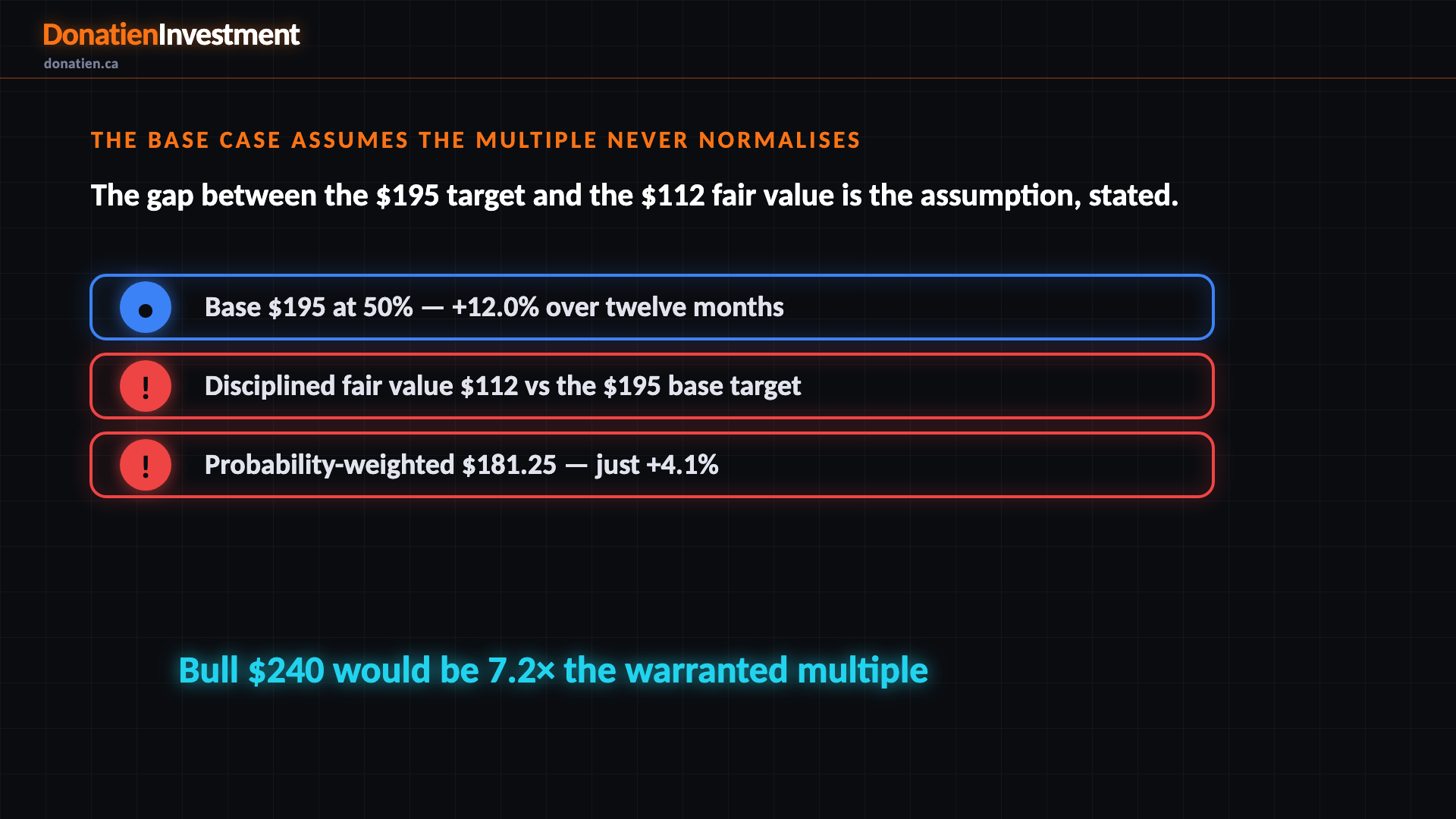
Base $195 is 86× FY2027 consensus EPS · Bull $240 would be 7.2× the warranted multiple
What could go wrong
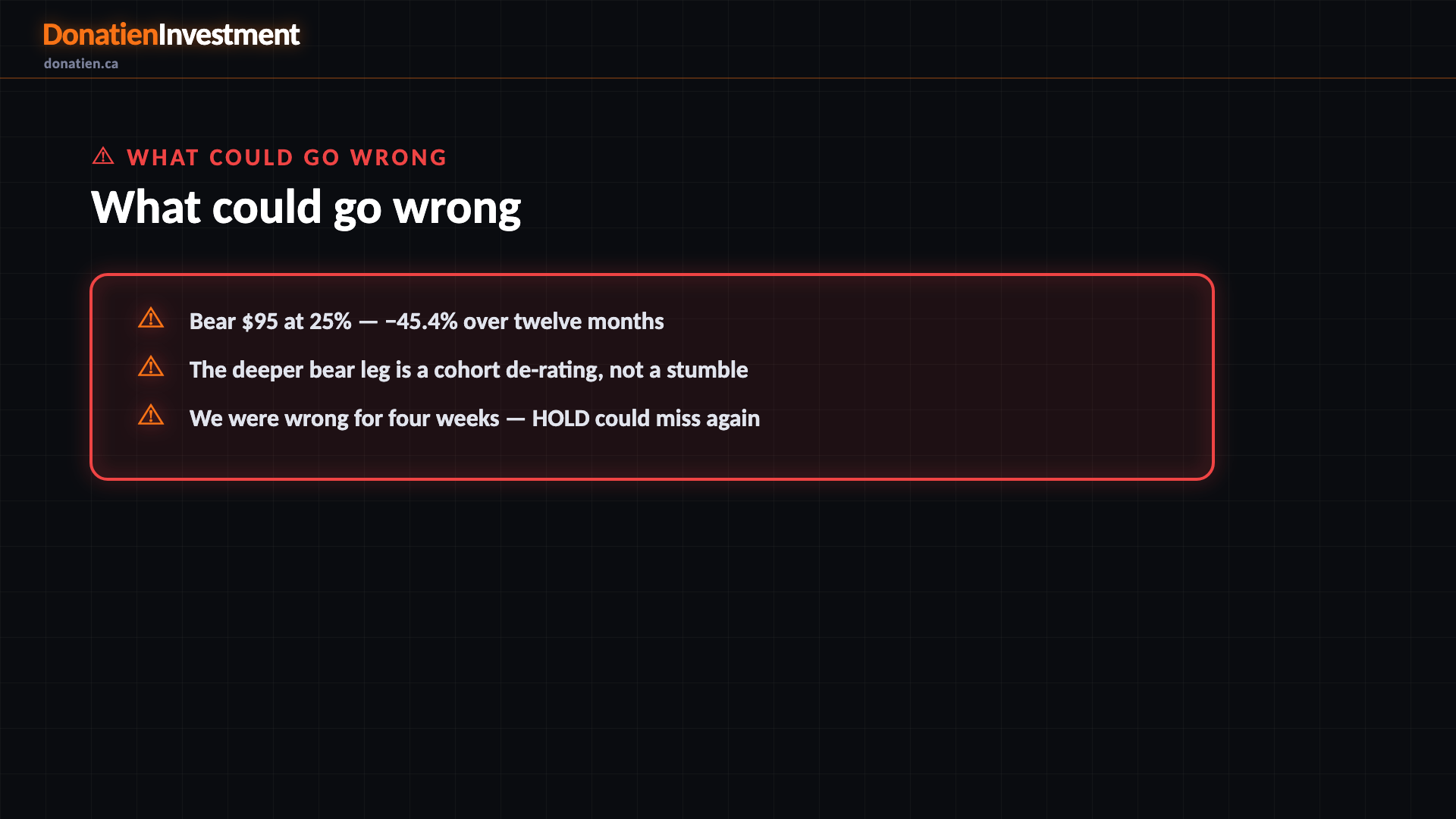
The risks run in both directions, and the last four weeks proved the upside one. Start with the downside: the bear case is ninety-five dollars, minus forty-five point four percent, and its larger leg is an index-level de-rating of the whole AI cohort rather than Palantir executing badly — which means it can fire while every operating number stays excellent. The stop sits at one hundred and fifty, thirteen point eight percent below, and it has to be that wide because the nearest real support is the one fifty-two to one fifty-three cluster. There is also a disclosure worth carrying: the sixty-two percent adjusted operating margin the bull case quotes is not the forty-two point eight percent margin shareholders actually earn. And then the honest one — a hold capped by valuation is the same kind of call that missed thirty percent last month. The mechanism that produced that move, earnings growing into an extreme multiple, is still live.
Risk vs Reward
Bull two hundred and forty at twenty-five percent, plus thirty-seven point nine percent, if growth holds above sixty percent into next year and the sovereign-AI work converts into a named government win. Base one hundred ninety-five at fifty percent, plus twelve percent, on the multiple simply holding while earnings compound. Bear ninety-five at twenty-five percent, minus forty-five point four percent, on a cohort-wide de-rating plus a competitive loss. The weighted value is one hundred eighty-one twenty-five — four point one percent of expected return against a forty-five percent tail.
The verdict
Hold, on all three horizons. There is no do-not-buy trigger live on this report and no exit trigger live either, so hold means what it says: an outstanding business at a price that leaves no room for anything to go wrong. The conviction ladder reads half-size, one of three groups open, because the catalyst path opened on the second-quarter print. If you own it, nothing here tells you to sell. If you do not, the valuation ceiling is the reason we are not calling it a buy — and we have just shown you, in public, what that caution cost over the last four weeks.
This report is refreshed on the thirty-first of August, and the next earnings are due in early November. It is a quantitative framework for educational purposes only, and it is not financial advice. Always do your own research.
Read the full report on donatien.ca →