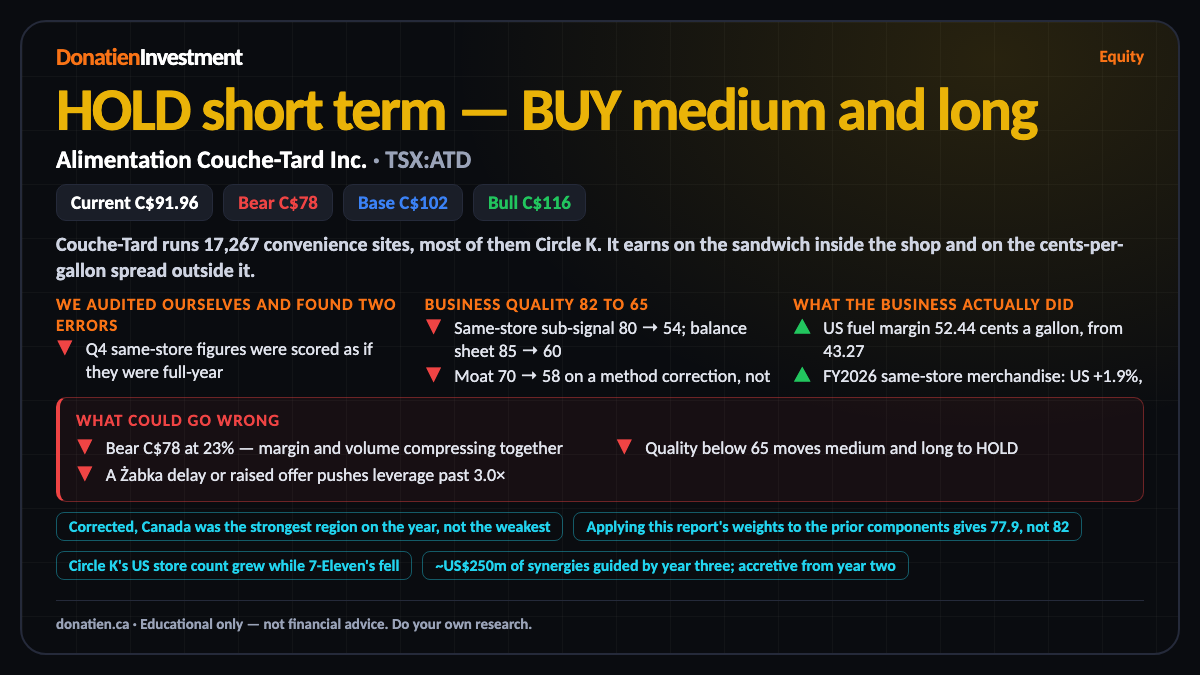
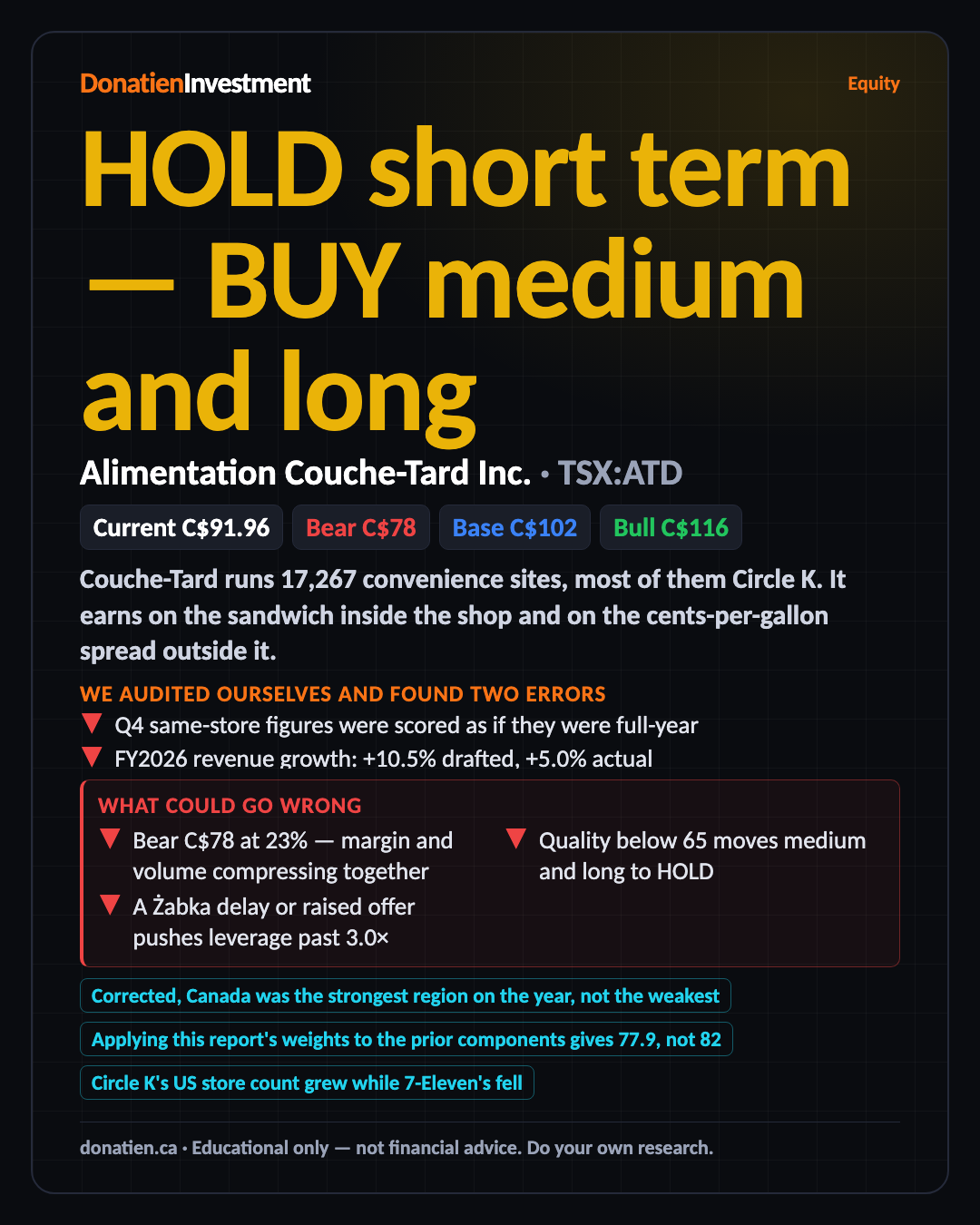
Alimentation Couche-Tard (Circle K, TSX:ATD) HOLD short term — BUY medium and long
65 is exactly the High-band threshold, and clearing it by 0.3 of a point is what keeps medium and long at BUY. The short is capped pending technical confirmation.
Couche-Tard runs 17,267 convenience sites, most of them Circle K. It earns on the sandwich inside the shop and on the cents-per-gallon spread outside it.
We audited ourselves and found two errors
The most important thing that happened to this name this cycle happened inside our own report. A pre-publication audit found that the twenty-fifth of July report scored several business-quality sub-signals on fourth-quarter same-store figures while labelling them full-year, and recorded net debt to earnings at about zero point eight times when the company's own disclosure was one point nine nine to one. Headline revenue growth had been drafted at ten and a half percent when the actual full-year figure was five. And the period error reversed the regional story: on the full year Canada was the strongest region at plus two point three percent, not the weakest.
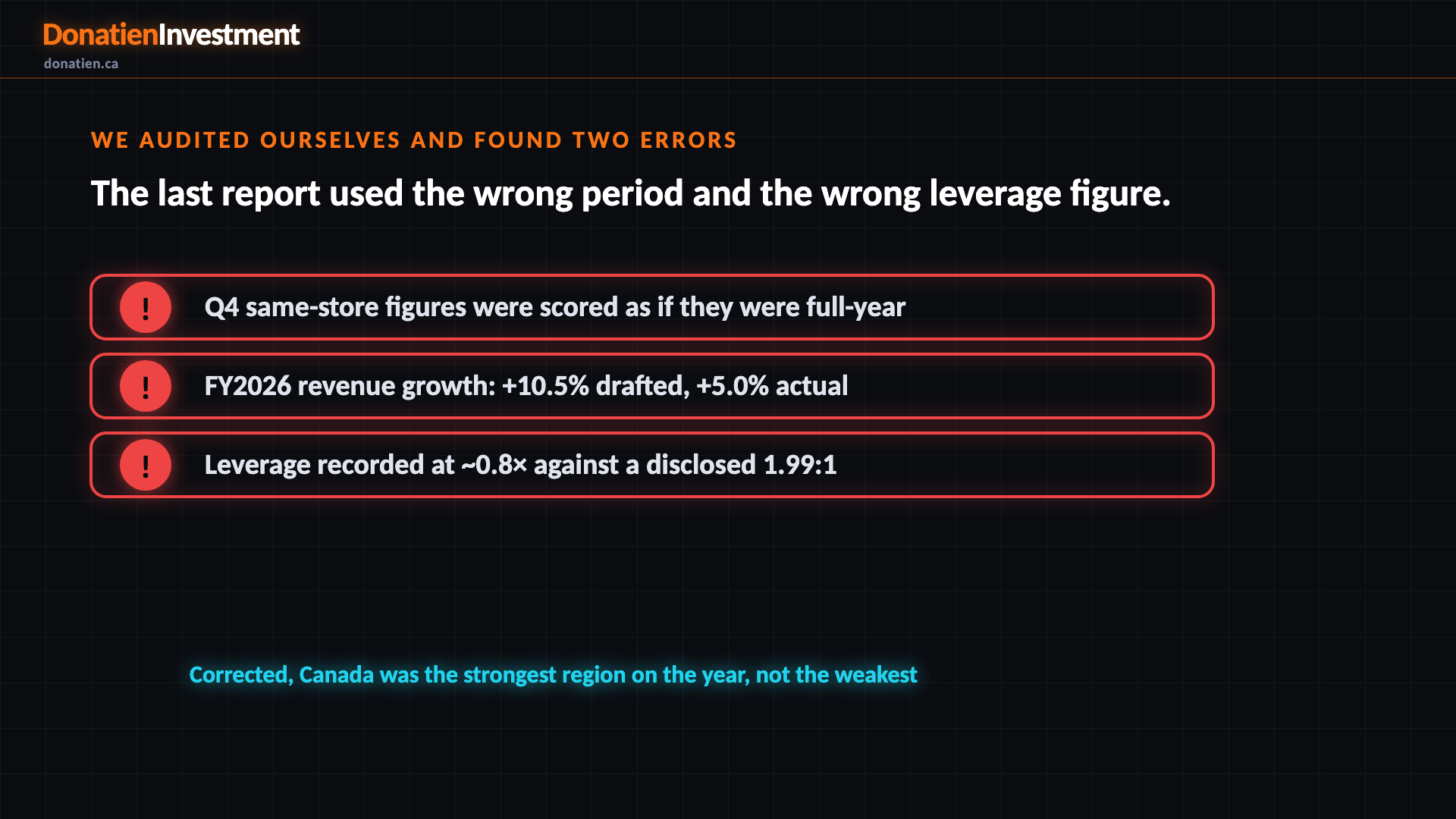
Corrected, Canada was the strongest region on the year, not the weakest
Business Quality 82 to 65
The bridge is worth walking because a seventeen-point move in the pillar that gates the signal deserves to be shown. The same-store sub-signal falls from eighty to fifty-four on the period correction. The balance-sheet sub-signal falls from eighty-five to sixty, most of it correcting that leverage figure. The moat falls from seventy to fifty-eight, which is a genuine method correction rather than new information — the sub-scores are now derived from the competitor read. And note that applying this report's weights to the prior report's own published components gives seventy-seven point nine rather than the eighty-two it printed, so about four points were never reconstructible. Sixty-five is the high-band threshold. This clears it by three tenths of a point.
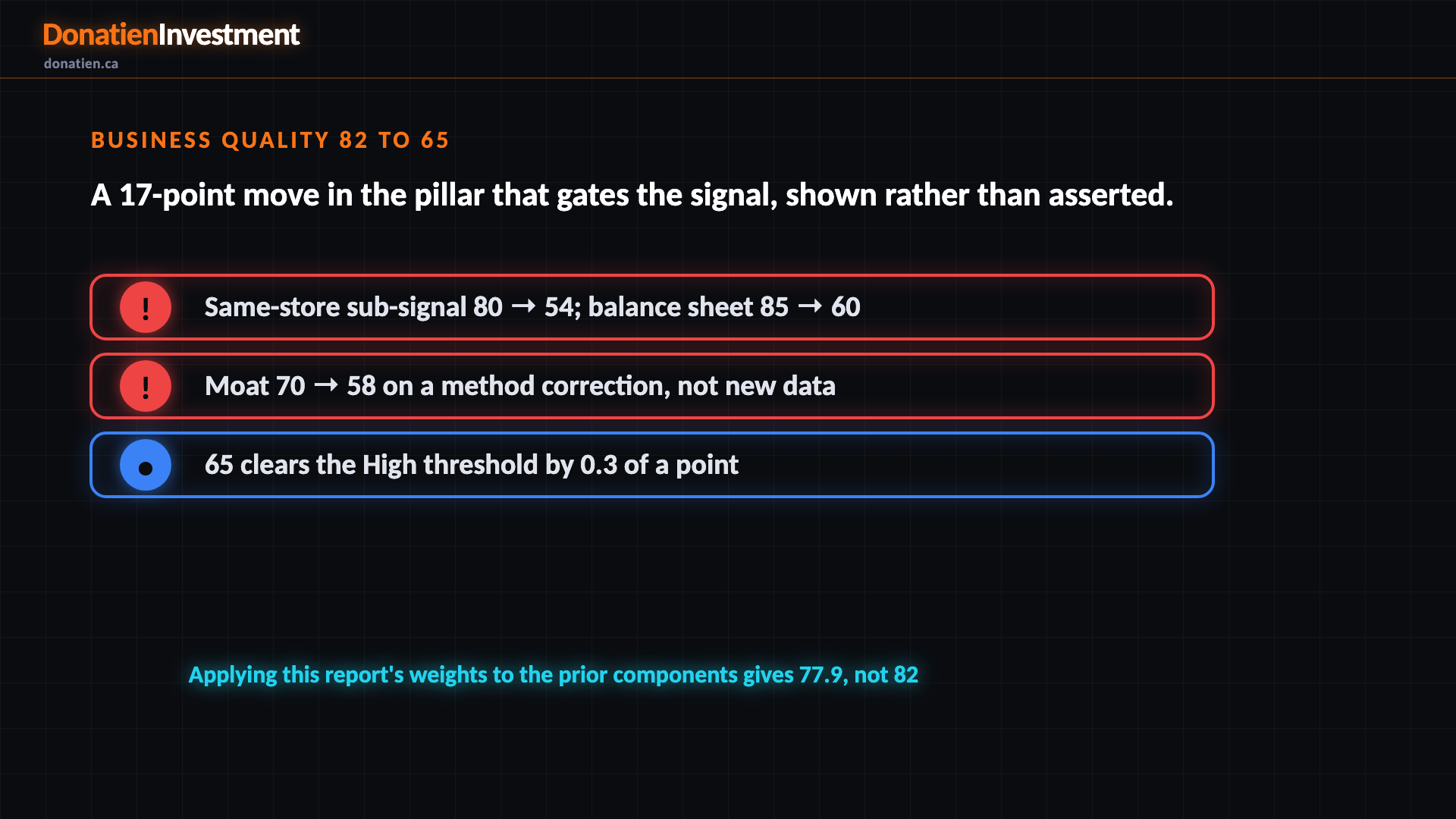
Applying this report's weights to the prior components gives 77.9, not 82
What the business actually did
Underneath the correction, the operating year was solid on margin and soft on volume. United States fuel margin reached fifty-two point four four cents a gallon in the fourth quarter against forty-three point two seven a year earlier, and a flat-to-falling wholesale crude trend expands that spread for a retailer. Full-year same-store merchandise grew one point nine percent in the States, one point four in Europe and two point three in Canada. Against that, same-store fuel volumes fell one percent in the States and two point two in Europe — the slow structural drag of electrification, and it does not reverse. Circle K's American store count grew while 7-Eleven's fell, but the specialists take foodservice traffic in contested cities.
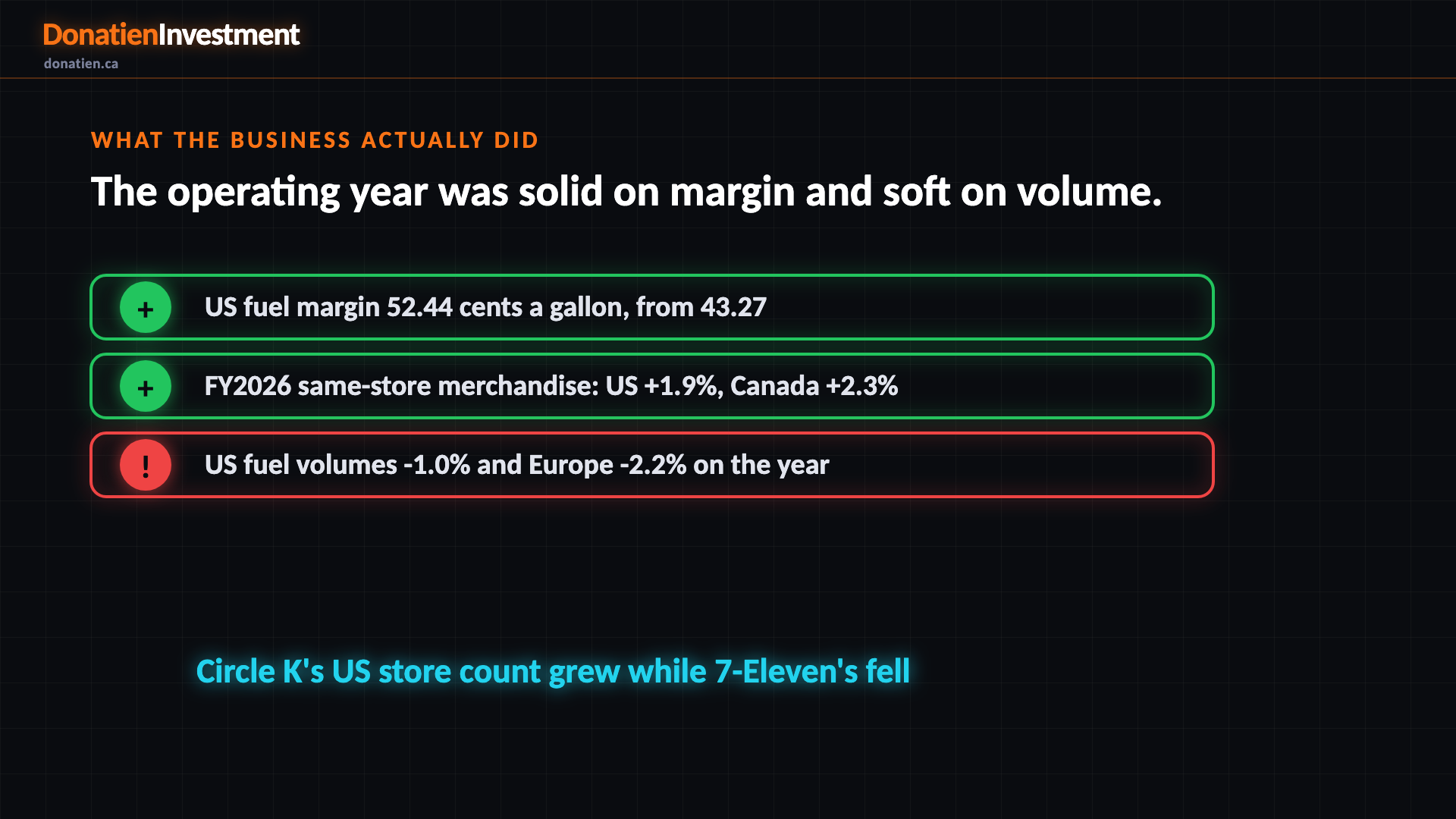
Circle K's US store count grew while 7-Eleven's fell
Żabka, and why the short is capped
On the thirty-first of July the company agreed to buy a controlling stake in Poland's Żabka Group for about eight point six billion US dollars — the largest acquisition in its history, fully debt-financed, taking pro-forma leverage from one point nine nine times to roughly three. Management guides to about two hundred and fifty million dollars of synergies by the third year, with earnings dilution in year one and accretion from year two. The tender is expected to open around the twenty-sixth of August. On the short horizon the base signal is a buy, but neither the technical nor the catalyst entry path is open: the fourteenth of August traded six hundred and fifty-seven thousand shares against a one and a half million average, less than half. No path, no short-term buy.
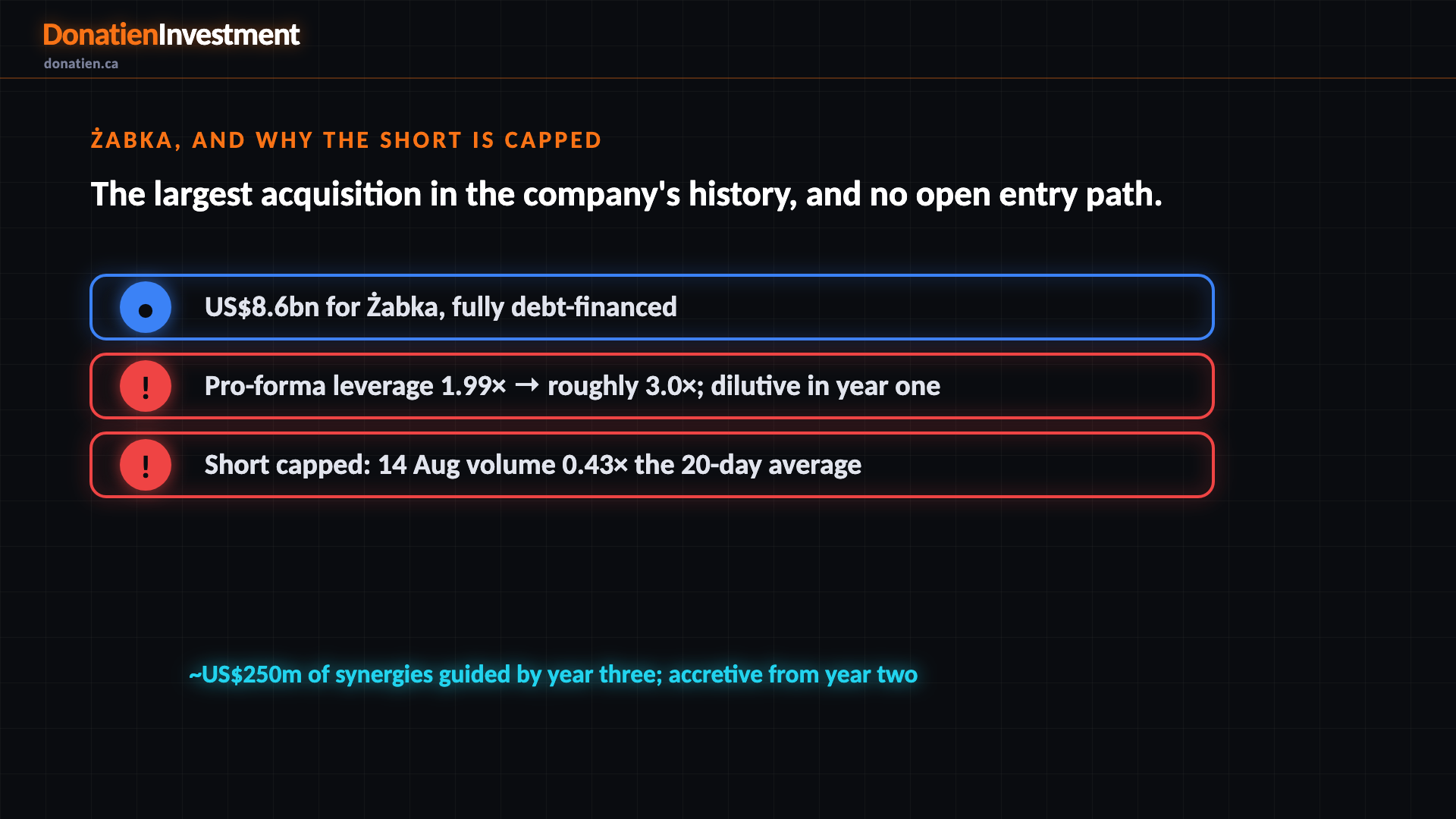
~US$250m of synergies guided by year three; accretive from year two
What could go wrong
The bear is the one combination this business model cannot absorb: margin and volume compressing at the same time. August's consumer data proves to be the start rather than a wobble, merchandise comparable sales go from plus one point nine percent to negative, fuel volumes fall faster than their one percent run-rate, and cents-per-gallon mean-reverts toward forty-three as crude re-spikes. Alongside it, the competitive leg — the specialists keep taking foodservice traffic and comparable sales stay below one percent, which would confirm that the switching-cost weakness is real rather than theoretical. And the quality trigger is unusually close: a deterioration in the revenue-trajectory sub-signal takes business quality below sixty-five, which moves medium and long to hold on the framework's own matrix. Seventy-eight dollars is minus fifteen point two percent.
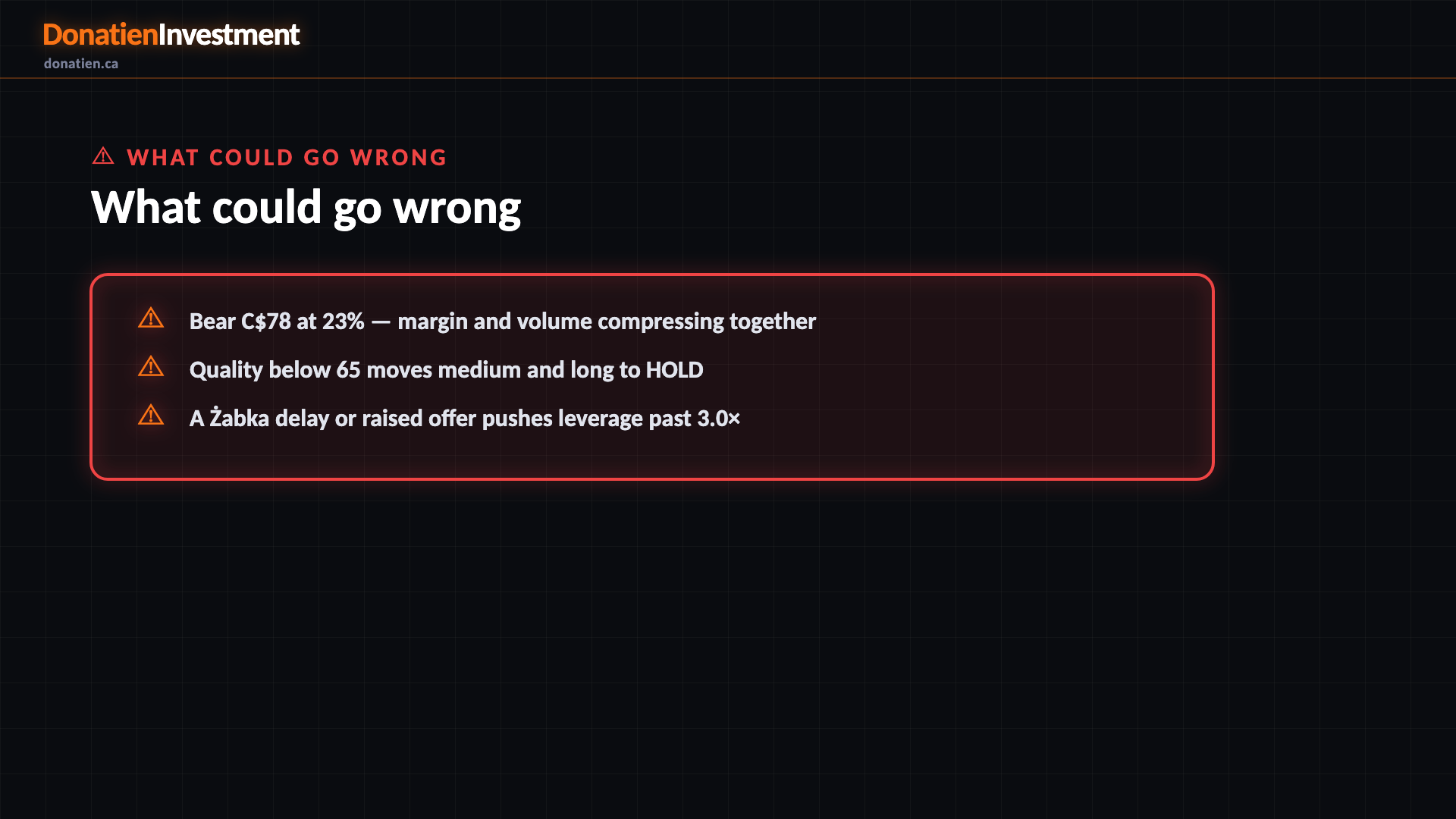
Risk vs Reward
Bull a hundred and sixteen at twenty-two percent, needing comparable sales to roughly double from their full-year run-rate within a quarter while the August consumer data points the other way. Base a hundred and two at fifty-five percent, plus ten point nine percent, and it sits almost exactly on the seventeen-analyst consensus — the multiple stays where it is and you are paid for compounding rather than re-rating. Bear seventy-eight at twenty-three percent. Probability-weighted that is ninety-nine fifty-six, about eight point three percent above the price. Note how little of that return is re-rating: if you are buying here, you are buying earnings growth, not a cheap price.
The verdict
Hold on the short horizon, buy on the medium and the long, unchanged — but that word is doing less work than it looks. The signal is the same as three weeks ago and almost everything underneath it has been rebuilt, because our own audit found we had scored a quarter as if it were a year and understated the company's leverage by more than half. Corrected, business quality clears the threshold that gates the medium and long-term buy by three tenths of a point. That is a genuinely thin margin, and it is the number to watch when the first-quarter results land on the first of September. The next report is due the twenty-seventh of August, a day after the Żabka tender is expected to open.
It is a quantitative framework for educational purposes only, and it is not financial advice. Always do your own research.
Read the full report on donatien.ca →