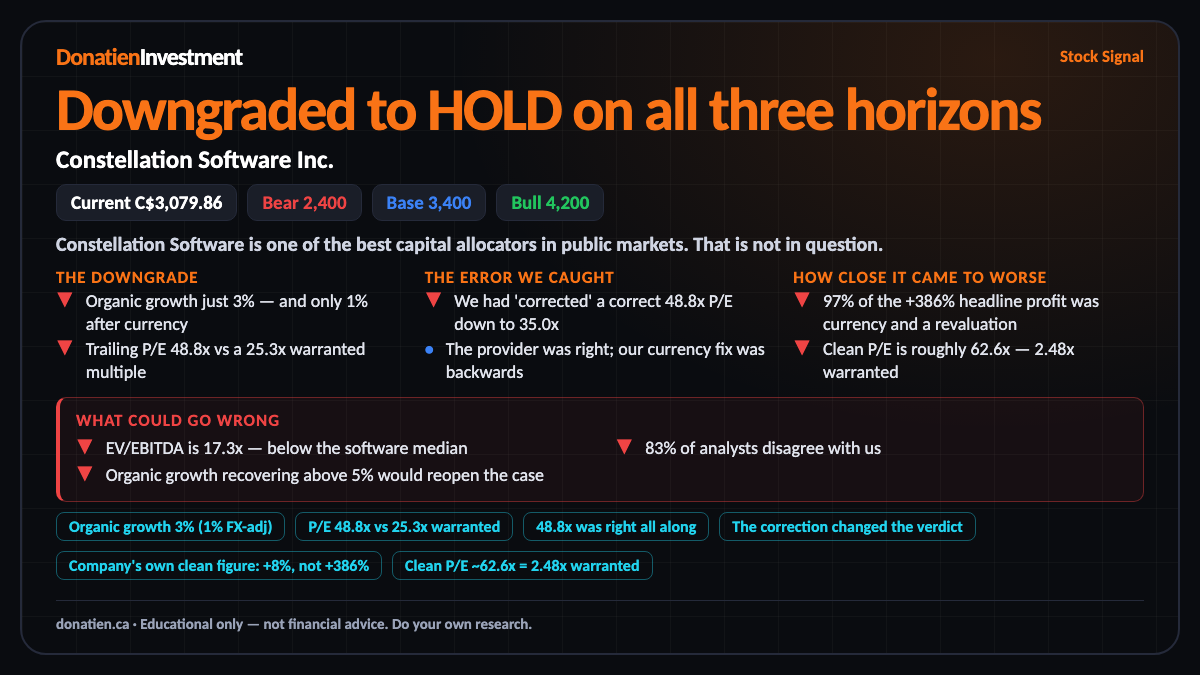
Constellation Software Inc. Downgraded to HOLD on all three horizons
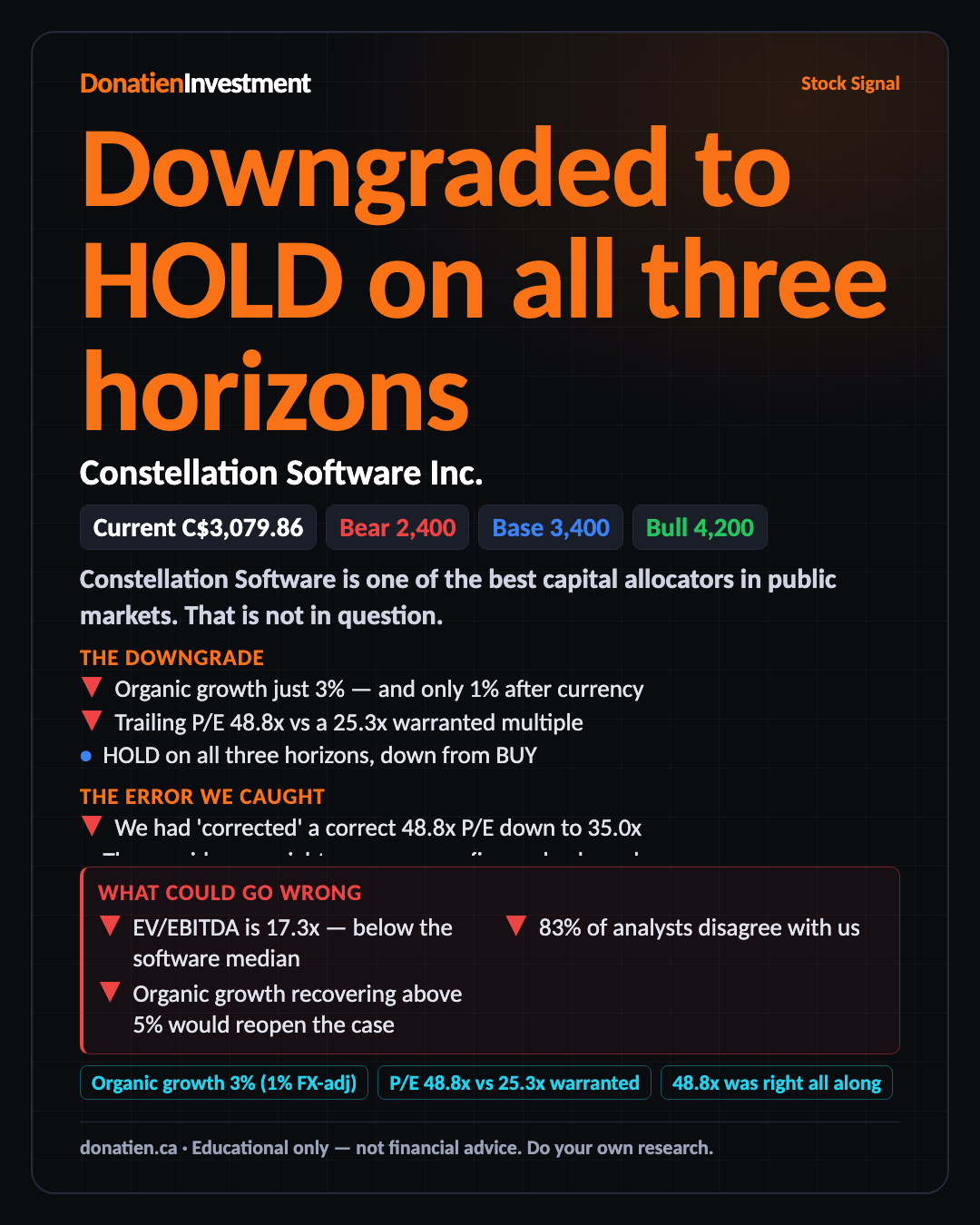
Trailing P/E is 48.8x against a 25.3x warranted multiple, and organic growth just fell to 3% — 1% after currency.
Constellation Software is one of the best capital allocators in public markets. That is not in question. What changed is the price we are being asked to pay for it, and a mistake we made in our own last report.
The downgrade
Nine days ago we rated Constellation a buy. Today it is a hold on all three horizons, and there are two reasons. The first is the Q2 result on the eleventh of August: revenue grew seventeen percent, but organic growth — the part that is not bought — was just three percent, and only one percent after currency. Management pointed to Altera, Dark Matter, recent Lumine deals and a large customer lost in South America. The second reason is ours. We made a valuation error in the last report, we caught it in audit, and correcting it is what moved the signal.
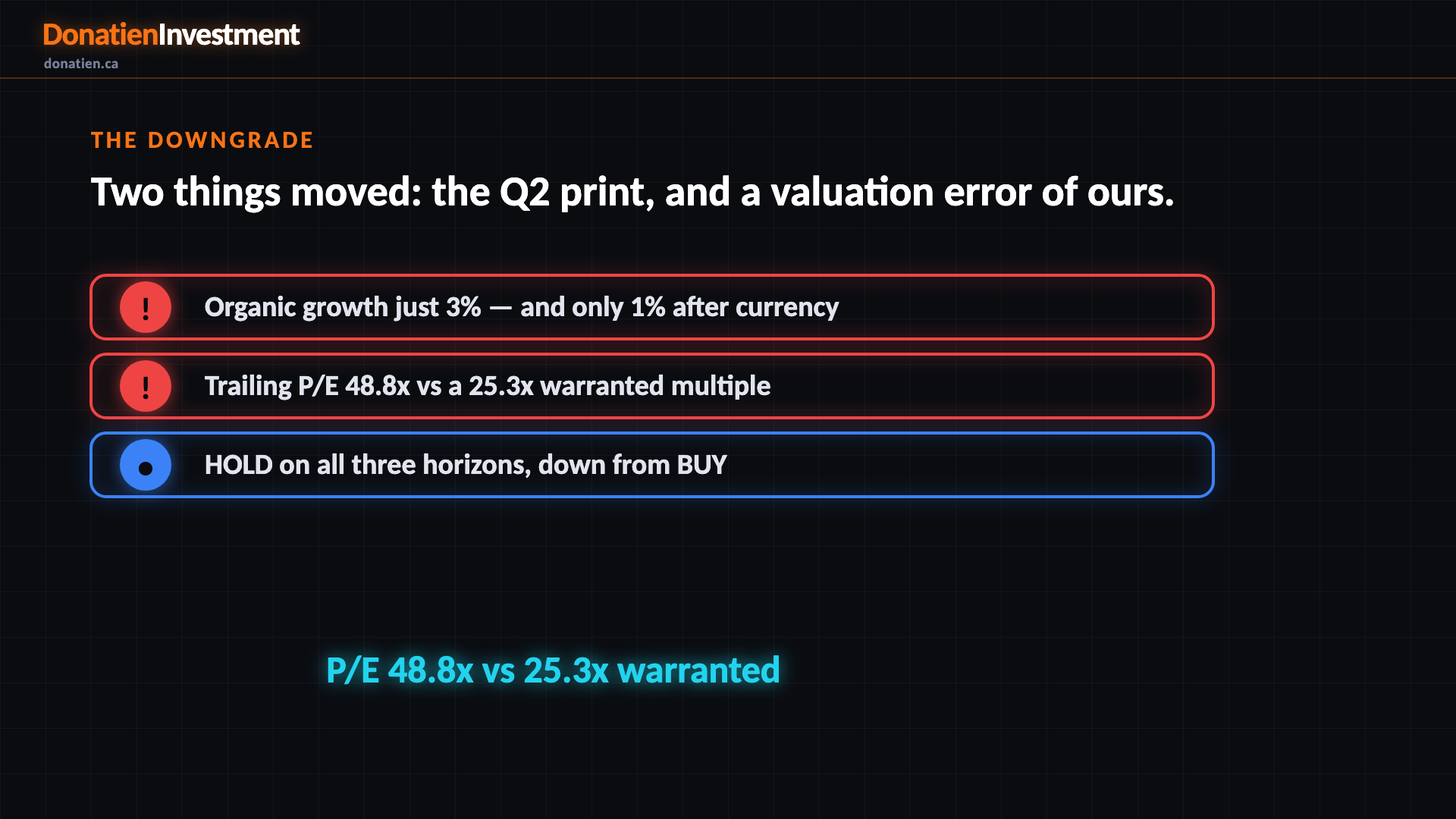
Organic growth 3% (1% FX-adj) · P/E 48.8x vs 25.3x warranted
The error we caught
Constellation trades in Canadian dollars and reports in US dollars, so we assumed the data provider had mixed the two and we restated its price-to-earnings ratio from forty-eight point eight down to thirty-five. That was backwards. The provider's earnings figure was already converted — the four reported quarters sum to forty-five dollars thirty-three US, which at one point three nine is sixty-three Canadian dollars, exactly what it showed. So forty-eight point eight was right, and our fix is what introduced the error. At that level the stock breaches the thirty-three times line we treat as rich for software, the valuation ceiling gate fires, and every horizon caps at hold. We are telling you this because the correction is the reason the signal changed.
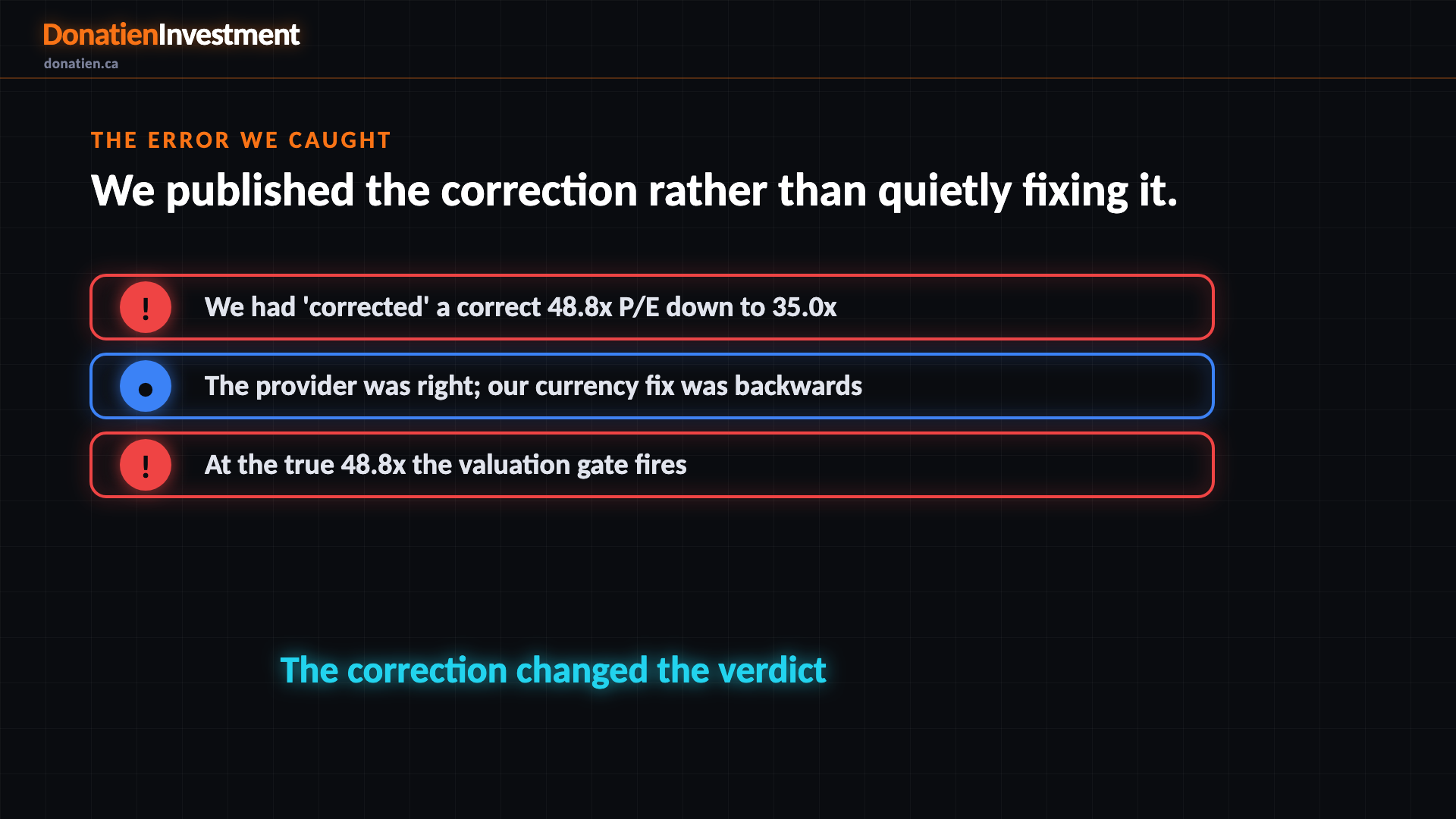
48.8x was right all along · The correction changed the verdict
How close it came to worse
The headline said profit rose three hundred and eighty-six percent. Constellation's own release says that excluding currency and a liability revaluation, the increase was eight percent. So almost all of it was non-operating. Strip that out and the multiple is not forty-nine times — it is closer to sixty-three, which is nearly two and a half times what the arithmetic warrants. That clears the threshold for a do-not-buy. It does not fire, but only because the rule carves out companies with exceptional, proven, durable growth, and Constellation has that on total growth. Read it on organic growth instead and you would reach do-not-buy rather than hold. We think hold is right. You are entitled to disagree, and we would rather show you the join than hide it.
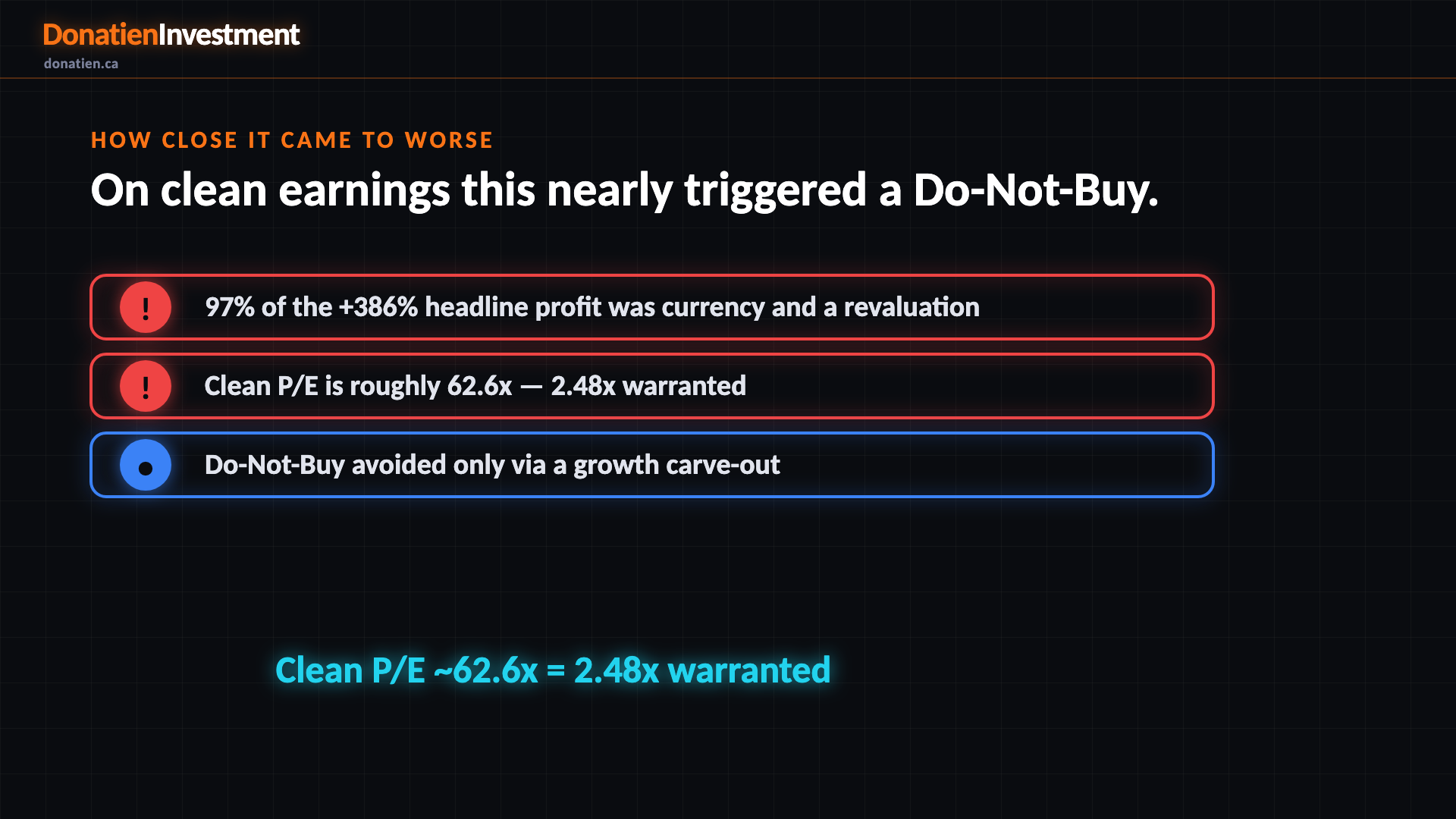
Company's own clean figure: +8%, not +386% · Clean P/E ~62.6x = 2.48x warranted
What would change it
None of this makes it a bad business. Three quarters of revenue is recurring and growing at nineteen percent, the balance sheet has capacity, and twelve analysts see nearly twenty-nine percent upside with eighty-three percent of them bullish. They are valuing it on cash flow, where it looks reasonable. But for the valuation path to open on price alone you would need roughly two thousand two hundred and thirty-three dollars — twenty-seven percent below here. The realistic route is through earnings, not through price: organic growth recovering, and doing it while the currency benefit washes out of the comparisons rather than with its help.
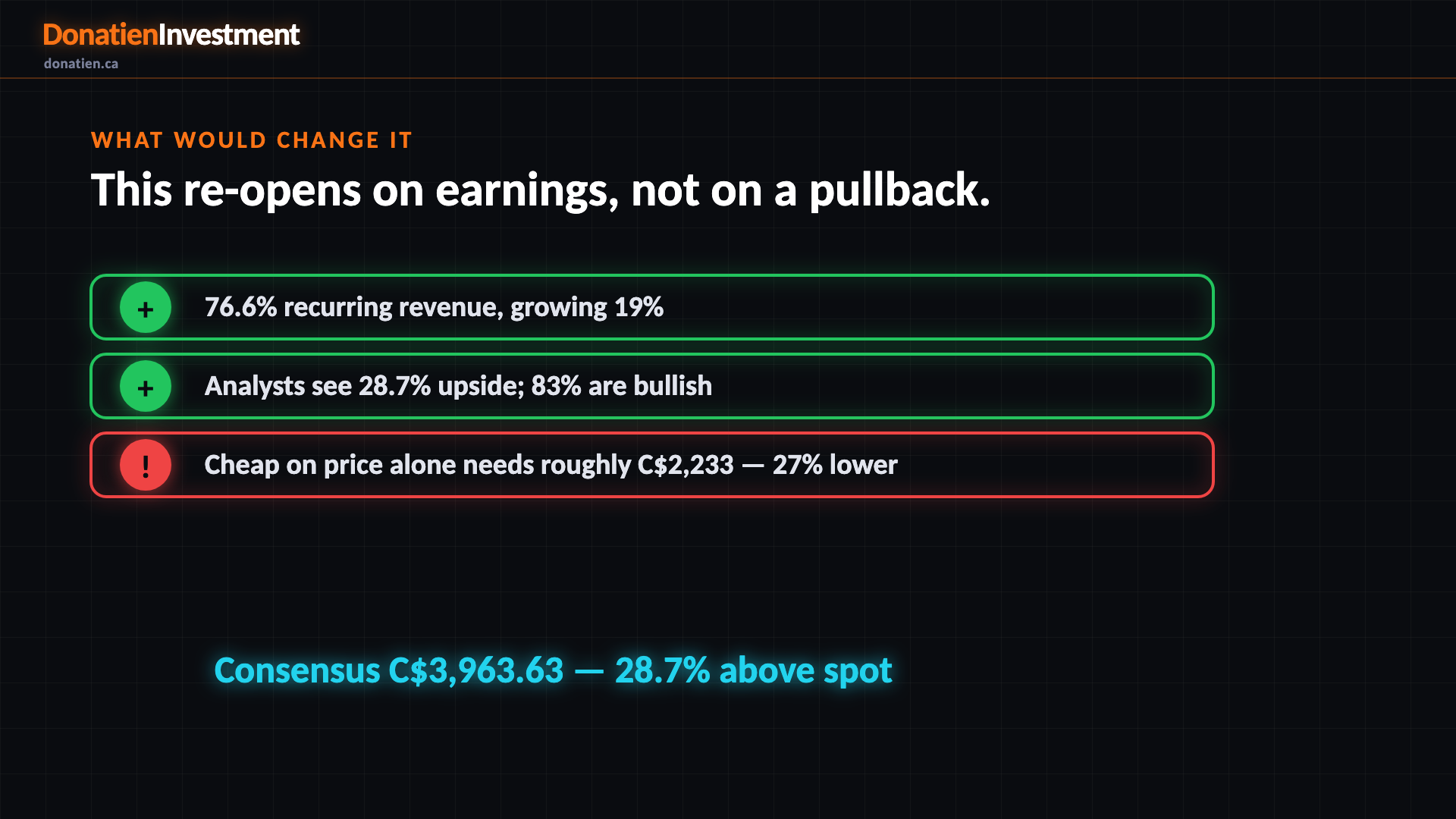
Recurring revenue 76.6%, +19% · Consensus C$3,963.63 — 28.7% above spot
What could go wrong
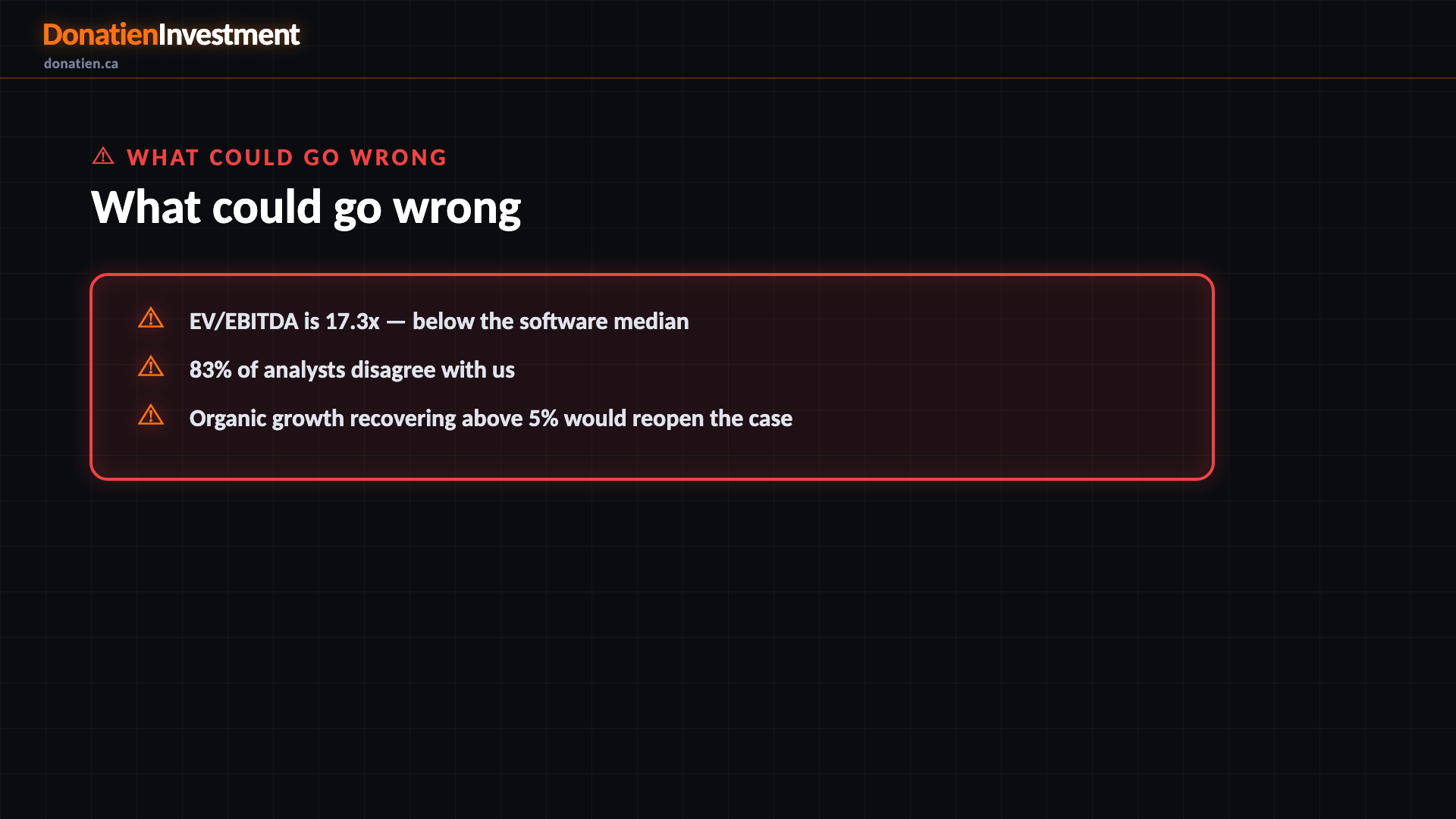
The strongest argument against this call is that we may be using the wrong lens. On enterprise value to earnings before interest, tax, depreciation and amortisation, Constellation trades at seventeen point three times — below the software median. Its free cash flow yield is five point six percent. Most of the Street values it that way and reaches a buy. If organic growth recovers above five percent for two quarters, we would be wrong and the case reopens.
Risk vs Reward
Bull four thousand two hundred at twenty-five percent — but that needs the earnings base to roughly double, so it is an earnings story, not a re-rating. Base three thousand four hundred at fifty-five percent, about ten percent up. Bear two thousand four hundred at twenty percent, and worth noting even that leaves the stock above the line we call rich.
The verdict
Hold means hold. If you own Constellation, nothing here is a reason to sell — no exit rule is triggered, and the business is intact. If you do not own it, this is not the price to start. The entry ladder reads wait, because no fundamental, technical or catalyst path is currently open.
This report is refreshed on the twenty-seventh of August. As always, it is not financial advice — it is how we are reading the company, published so you can check our work, including the part we got wrong.
Read the full report on donatien.ca →