Alphabet (Google, NASDAQ:GOOGL) DO NOT BUY
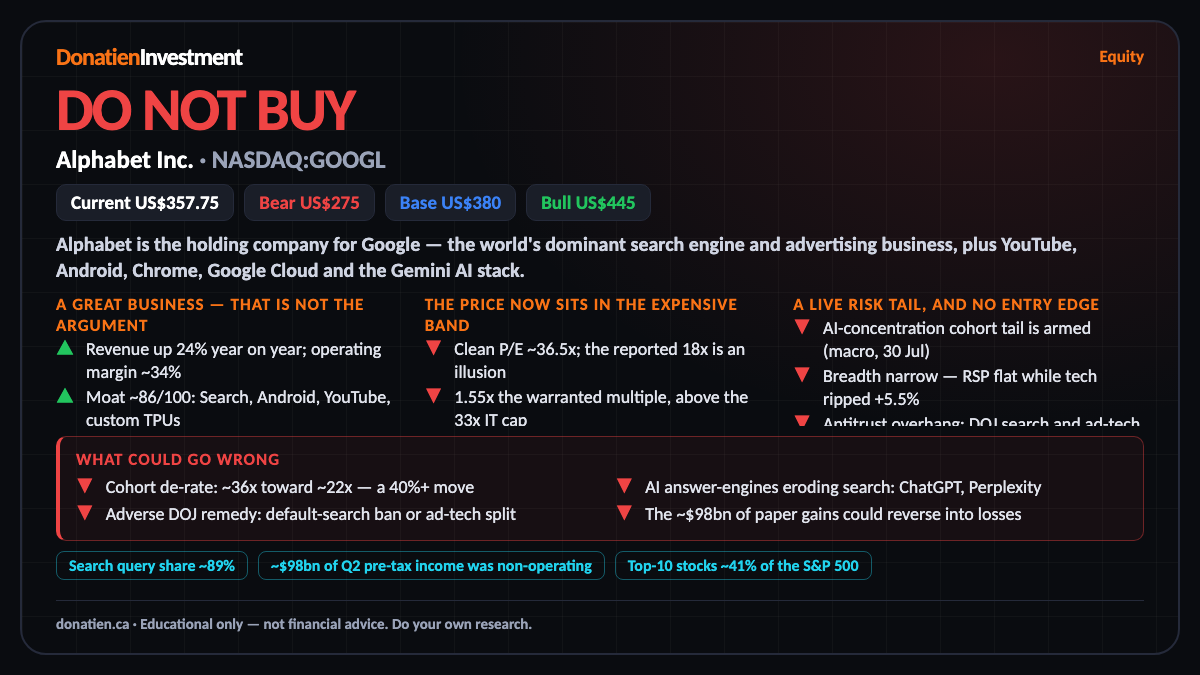
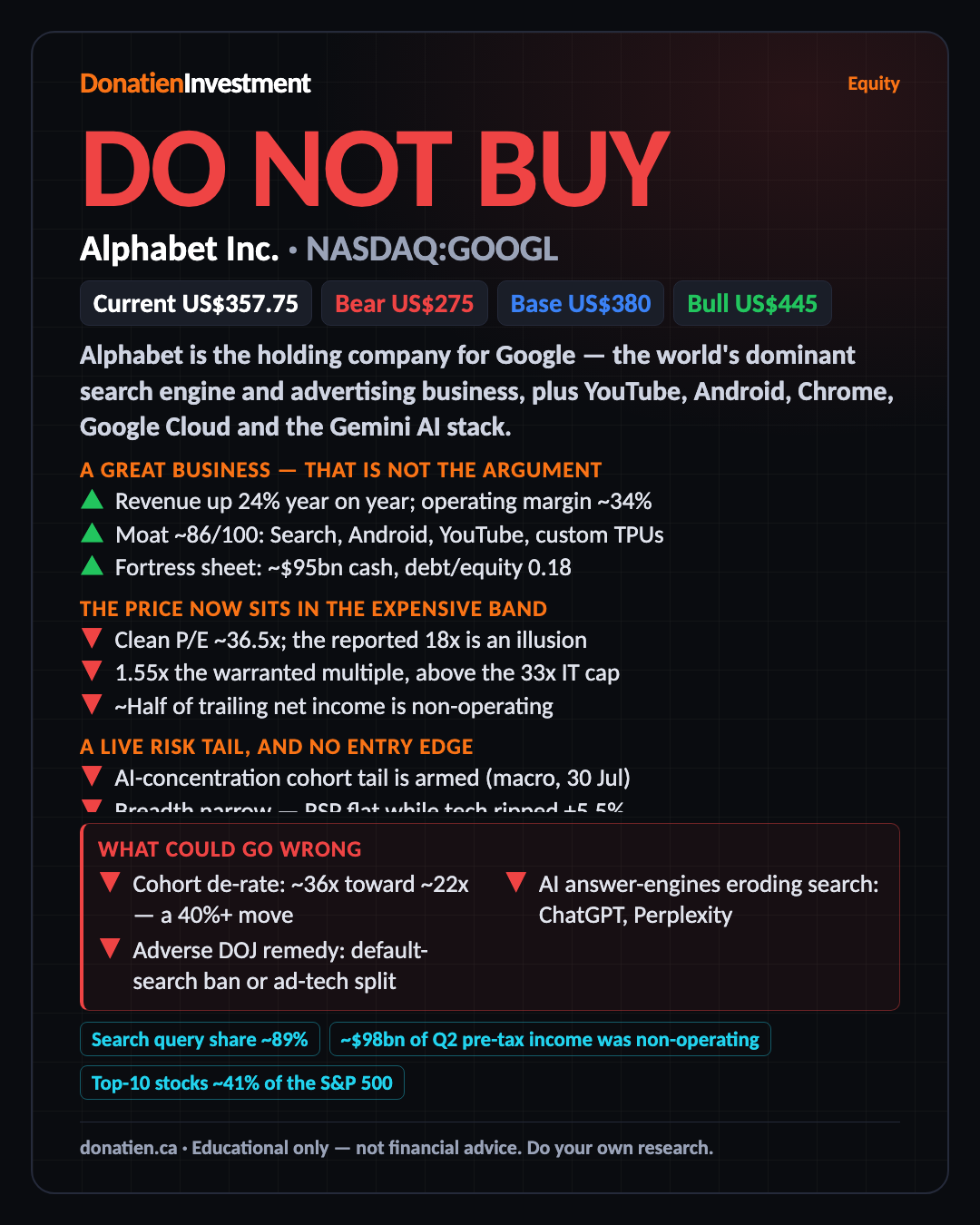
The business is excellent; the price is not. A twelve-per-cent rally has pushed Alphabet's clean valuation into the Expensive band — a clean price-to-earnings of about 36.5 times against a warranted 23.5 — and, with the market's AI-concentration tail armed and breadth narrow, that combination trips a Do-Not-Buy. A great company at the wrong price, with a live risk you are not being paid to carry.
Alphabet is the holding company for Google — the world's dominant search engine and advertising business, plus YouTube, Android, Chrome, Google Cloud and the Gemini AI stack. It is a rare thing: a cash machine and a frontier-technology bet at once. None of that is in dispute here. This report is about one question only — whether the price on 7 August, $357.75 a share, is one you should pay. Our answer is no, and the reason is valuation and risk, not quality.
A great business — that is not the argument
Let us give Alphabet its due first, because it earns it. Revenue grew twenty-four per cent in the second quarter, with operating margins around thirty-four per cent and returns on capital in the top quartile of the mega-caps. The moat is one of the widest in the market — search, Android, YouTube and a custom-silicon cost advantage that few can match. The balance sheet is a fortress: roughly ninety-five billion in cash and almost no debt. On quality alone this scores an eighty-three. So nothing that follows is a complaint about the company. It is a statement about the price.
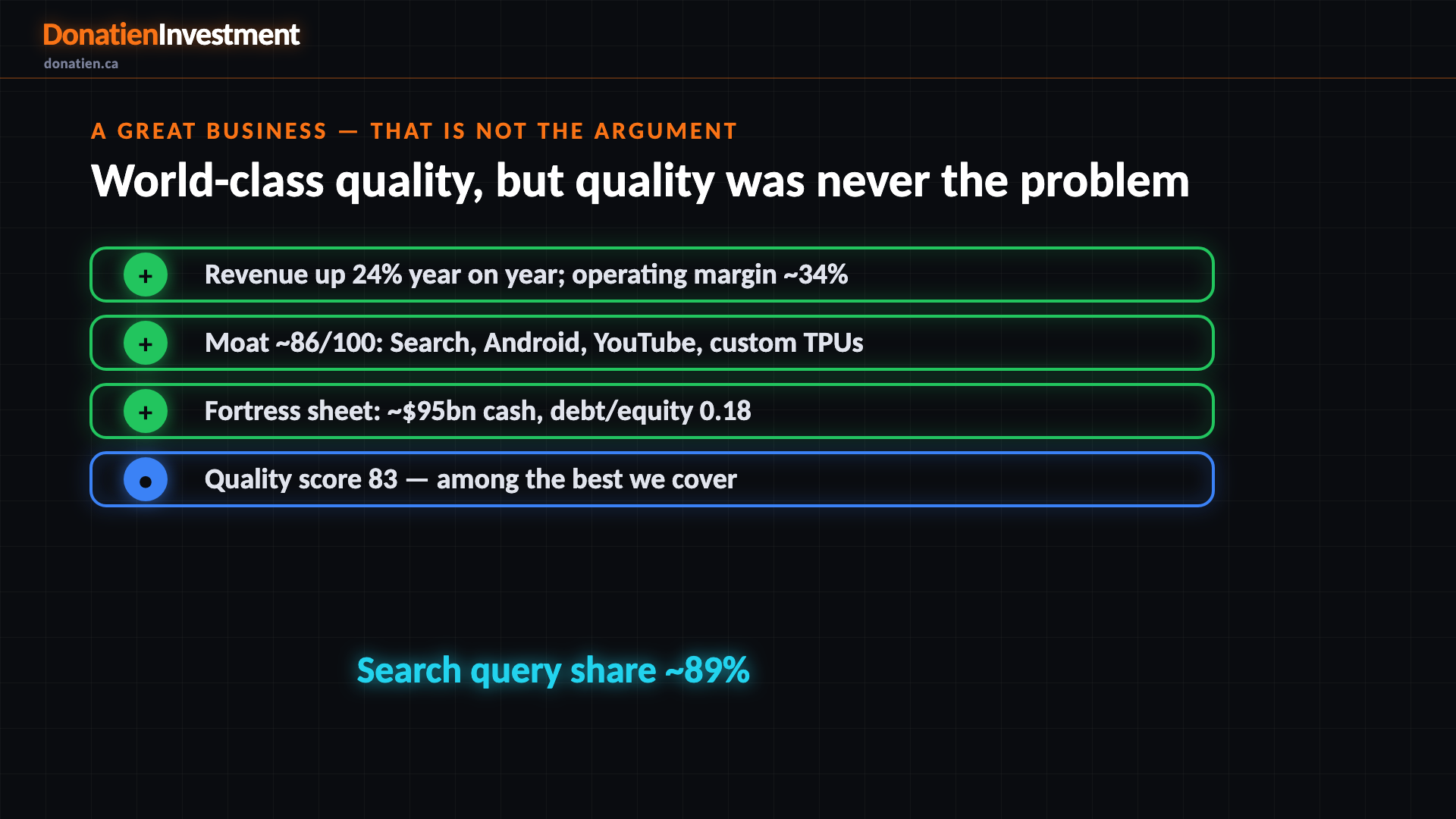
Search query share ~89%
The price now sits in the Expensive band
Here is the catch that the headline number hides. Alphabet's reported price-to-earnings looks cheap at about eighteen times — but roughly half of its trailing net income, and about eighty-seven per cent of the second quarter, comes from non-operating mark-ups on private equity stakes, not from running Google. Strip those out and the clean, operating price-to-earnings is around thirty-six and a half times. Our framework says a business like this warrants about twenty-three and a half. That makes it one and a half times over — and past the thirty-three-times guardrail for its sector. The valuation score is thirty-six. Fair value anchors near two hundred and thirty dollars; the shares are three hundred and fifty-eight.
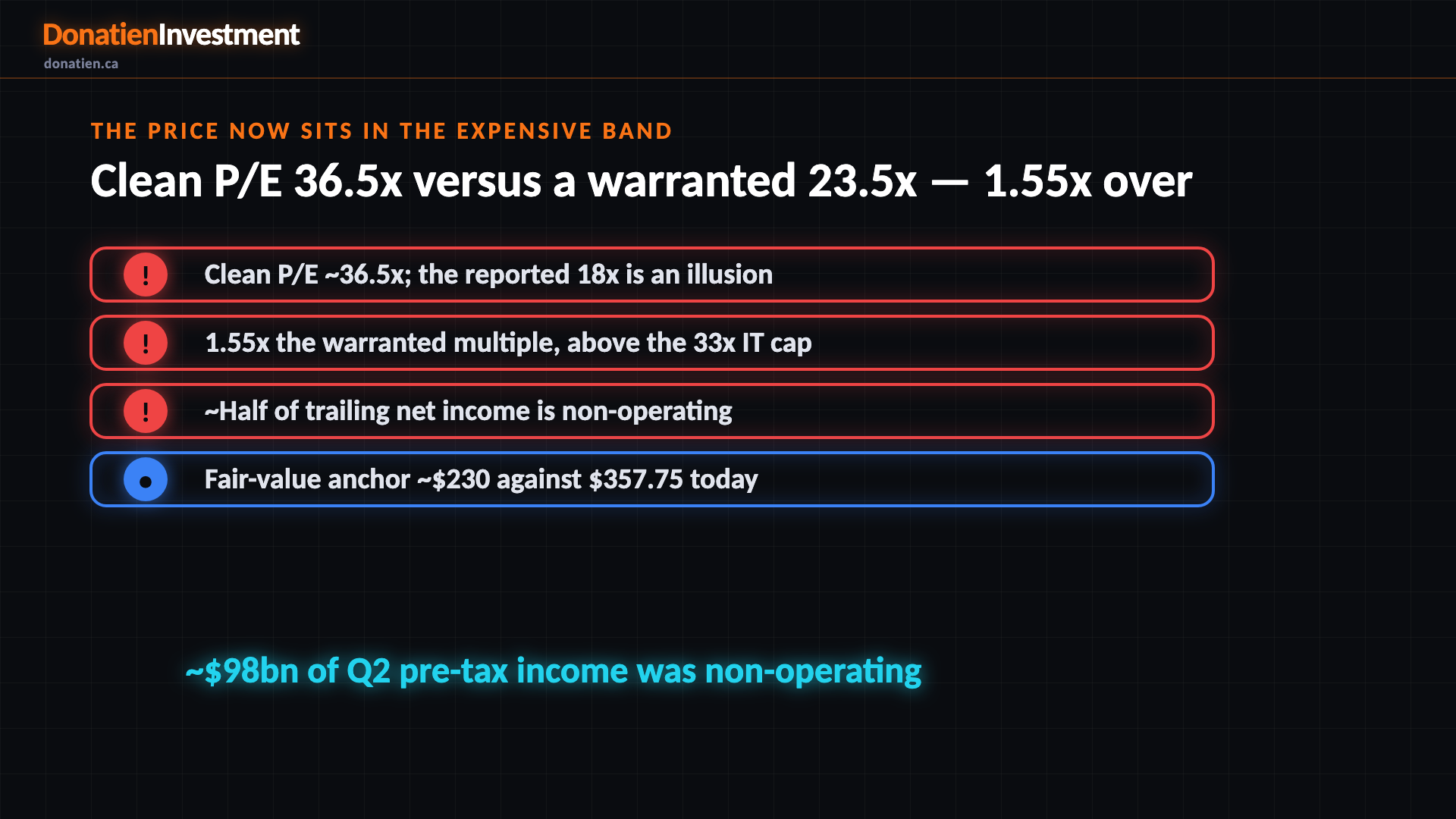
~$98bn of Q2 pre-tax income was non-operating
A live risk tail, and no entry edge
On its own, expensive would cap this at a hold. What turns it into a Do-Not-Buy is that the risk is live, not theoretical. Our macro read on the thirtieth of July shows the top handful of stocks at around forty-one per cent of the index, with the AI-concentration tail armed. The safety valve — market breadth broadening, the equal-weight index catching the cap-weighted one — is absent: breadth is narrow, equal-weight flat while technology ripped five and a half per cent. So the tail is a live de-rating catalyst, and Alphabet is a top-weight member of exactly that cohort. Add the ongoing antitrust overhang, and note there is no entry edge anyway — conviction reads Wait, none of the three entry paths is open at this price.
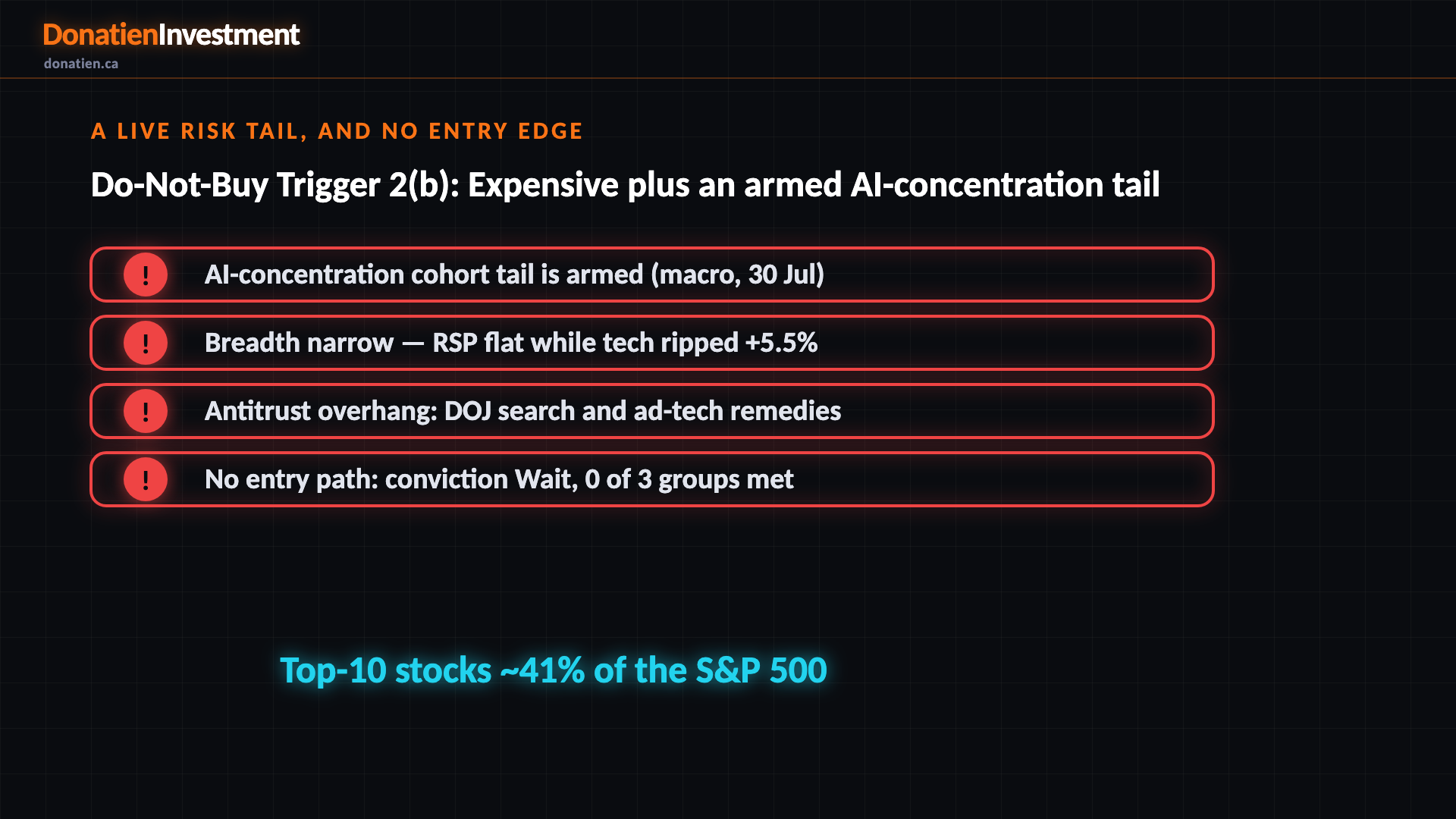
Top-10 stocks ~41% of the S&P 500
What could go wrong
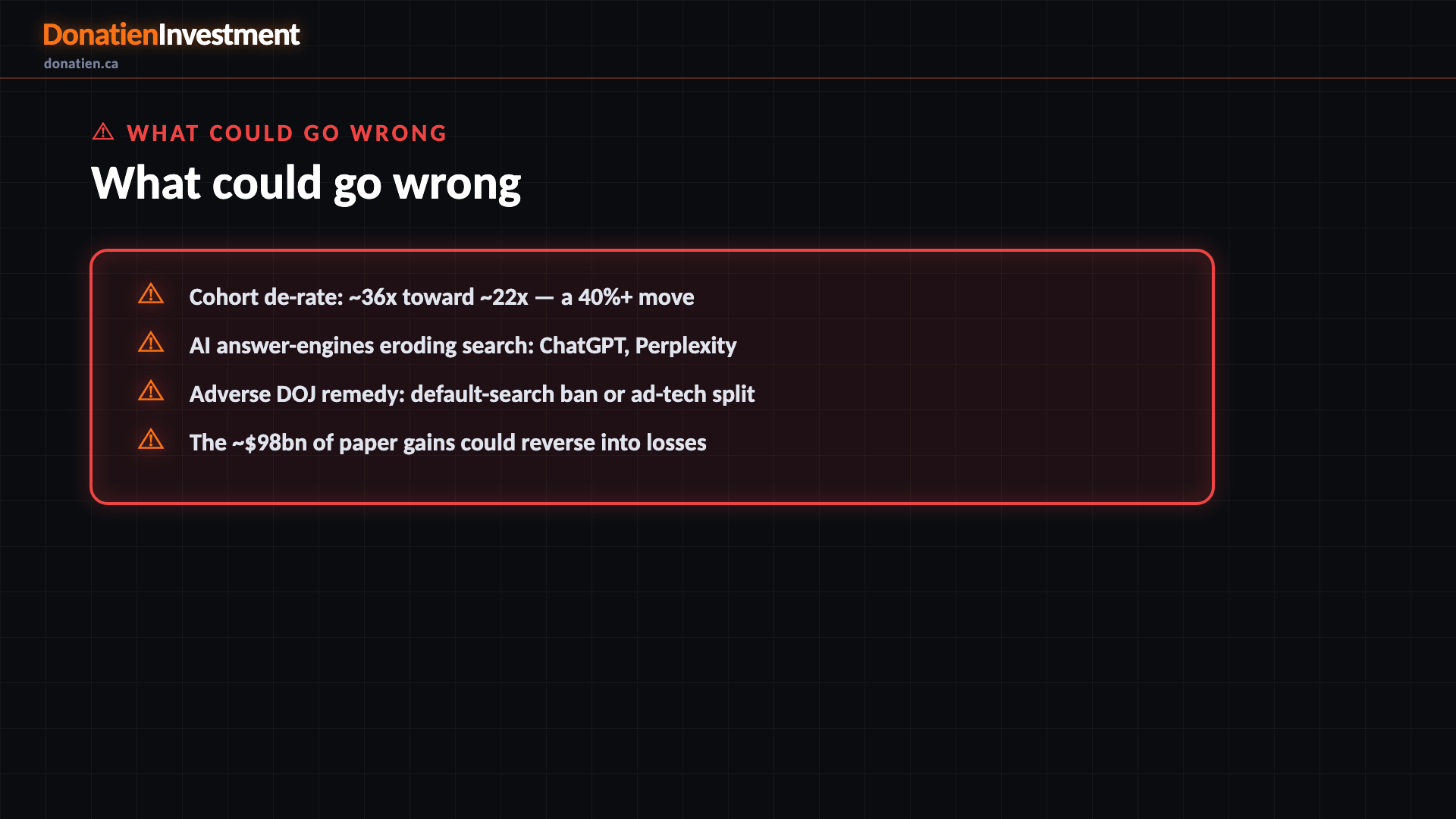
Be honest about the shape of the downside, because it is not gentle. The main risk is not company-specific at all — it is the whole AI cohort's clean multiple compressing from about thirty-six times toward twenty-two, a forty-per-cent move that would drag Alphabet with it regardless of how well Google trades. On top of that sits a genuine business threat: AI answer-engines like ChatGPT and Perplexity chipping at the ten-blue-links search that pays the bills, and a Justice Department that could ban default-search payments or force an ad-tech break-up. And the ninety-eight billion of paper gains flattering the accounts can reverse into losses just as easily. The bear case lands at two hundred and seventy-five dollars — about twenty-three per cent below today. That is the risk you would be carrying, unpaid.
Risk vs Reward
Weigh the three paths and the reason for the call becomes plain. The bull case at four hundred and forty-five — a one-in-four chance — needs AI monetisation to prove out and breadth to broaden, disarming the tail. The base case at three hundred and eighty, at even odds, is a modest grind higher as earnings grow into a premium that drifts only slightly lower. The bear at two hundred and seventy-five, again one in four, carries the cohort de-rate. Blend them and the probability-weighted value is about three hundred and seventy — essentially today's price. The reward is roughly symmetric to the risk, and that is exactly why the answer is Do-Not-Buy: you are not being paid for the tail you would be taking on.
The verdict
So, to be clear: this is not a sell of a bad company — it is a refusal to buy a very good one at this price, with this risk live. Do-Not-Buy across every horizon. If the shares pull back toward the two-hundred-and-thirty anchor, or breadth broadens and disarms the tail, the picture changes. Until then, the honest call is to wait.
Read the full report on donatien.ca →