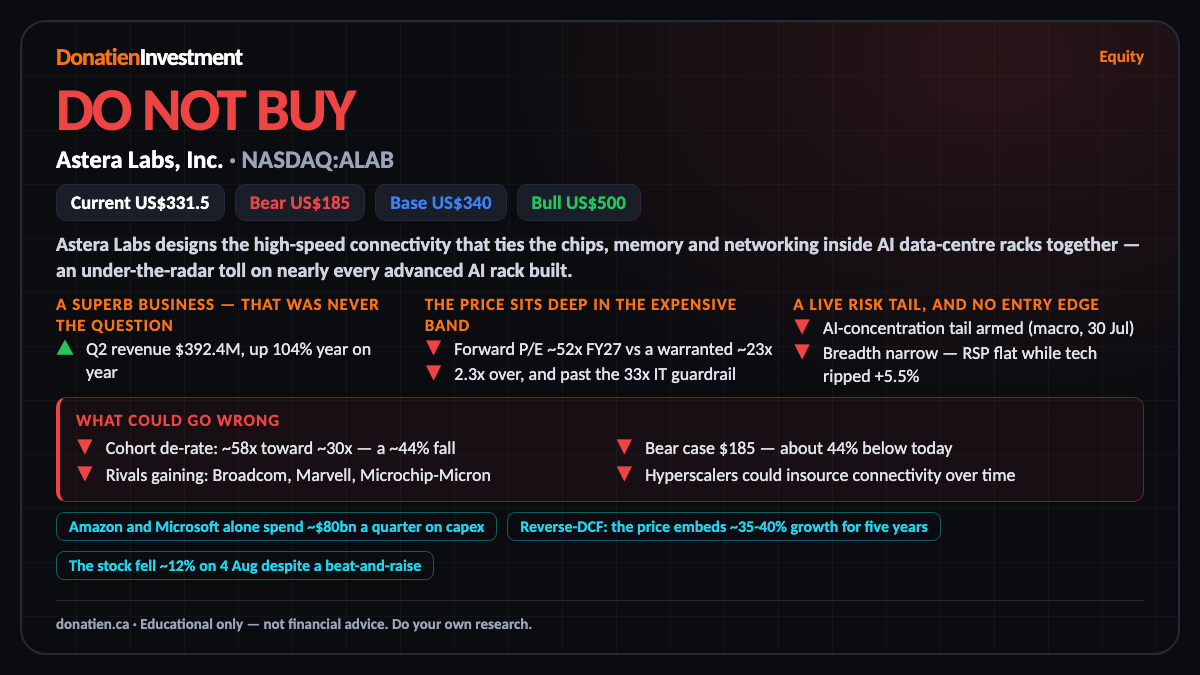
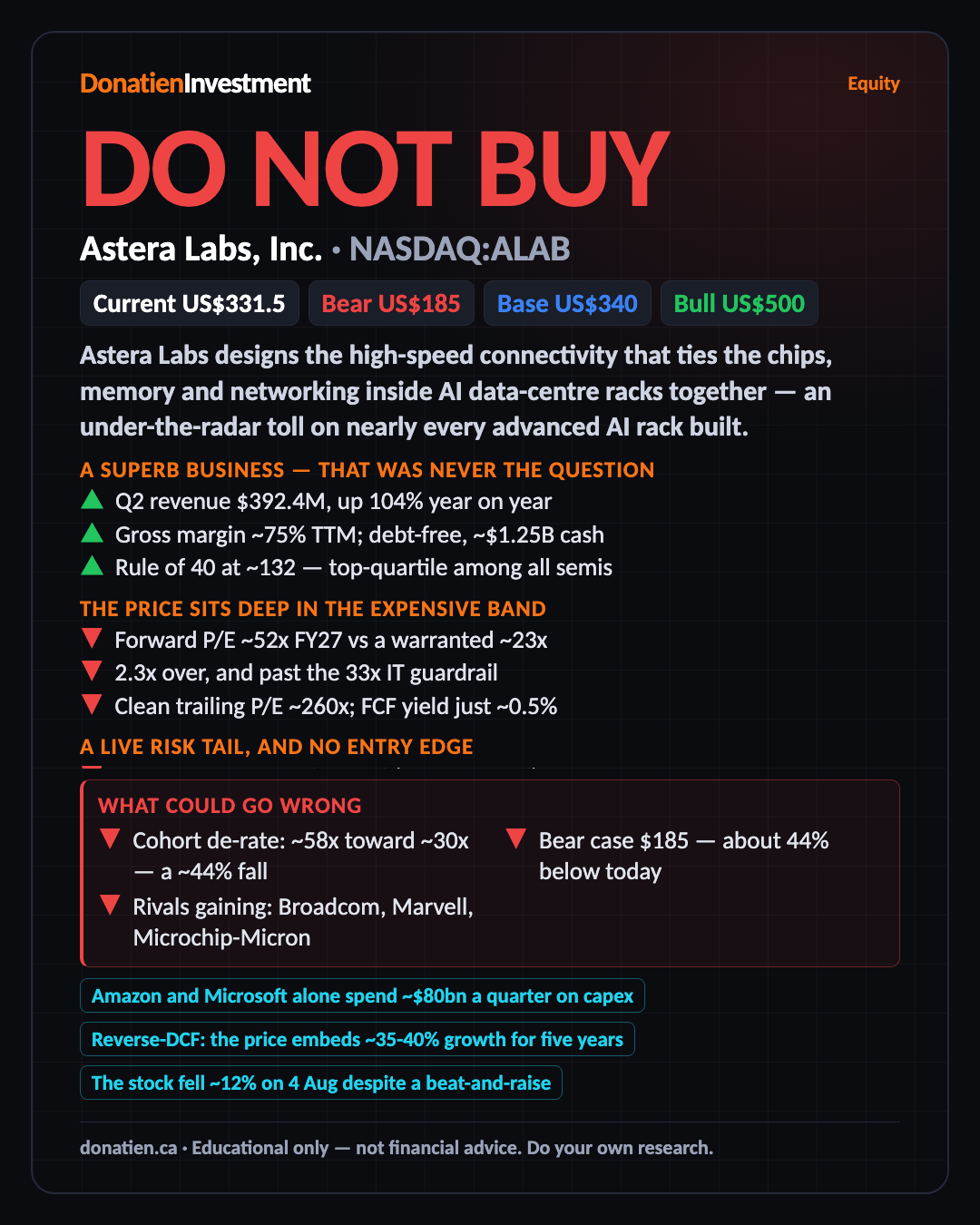
Astera Labs, Inc. (NASDAQ:ALAB) DO NOT BUY
Astera Labs is a superb business — a Q2 revenue beat of a hundred and four per cent proves that. But the price already embeds it. The shares trade around fifty-two times forward earnings against a warranted twenty-three — roughly two-and-a-third times over — and, with the market's AI-concentration tail armed and breadth narrow, that combination trips a Do-Not-Buy. A great company at the wrong price, carrying a live risk you are not paid to hold.
Astera Labs designs the high-speed connectivity that ties the chips, memory and networking inside AI data-centre racks together — an under-the-radar toll on nearly every advanced AI rack built. The business quality is not in dispute here. This report is about one question only: whether the price on the seventh of August, three hundred and thirty-one dollars fifty a share, is one you should pay. Our answer is no, and the reason is valuation and risk, not quality.
A superb business — that was never the question
Let us give Astera its due first, because it earns it. Second-quarter revenue grew a hundred and four per cent year on year to three hundred and ninety-two million dollars, with gross margins around seventy-five per cent and real operating leverage as it scales. It runs debt-free with about one and a quarter billion in cash. On the Rule of Forty — growth plus cash-flow margin — it scores about a hundred and thirty-two, far above the forty pass line and top-quartile among all semiconductors. Quality lands at seventy-nine. So nothing that follows is a complaint about the company. It is a statement about the price.
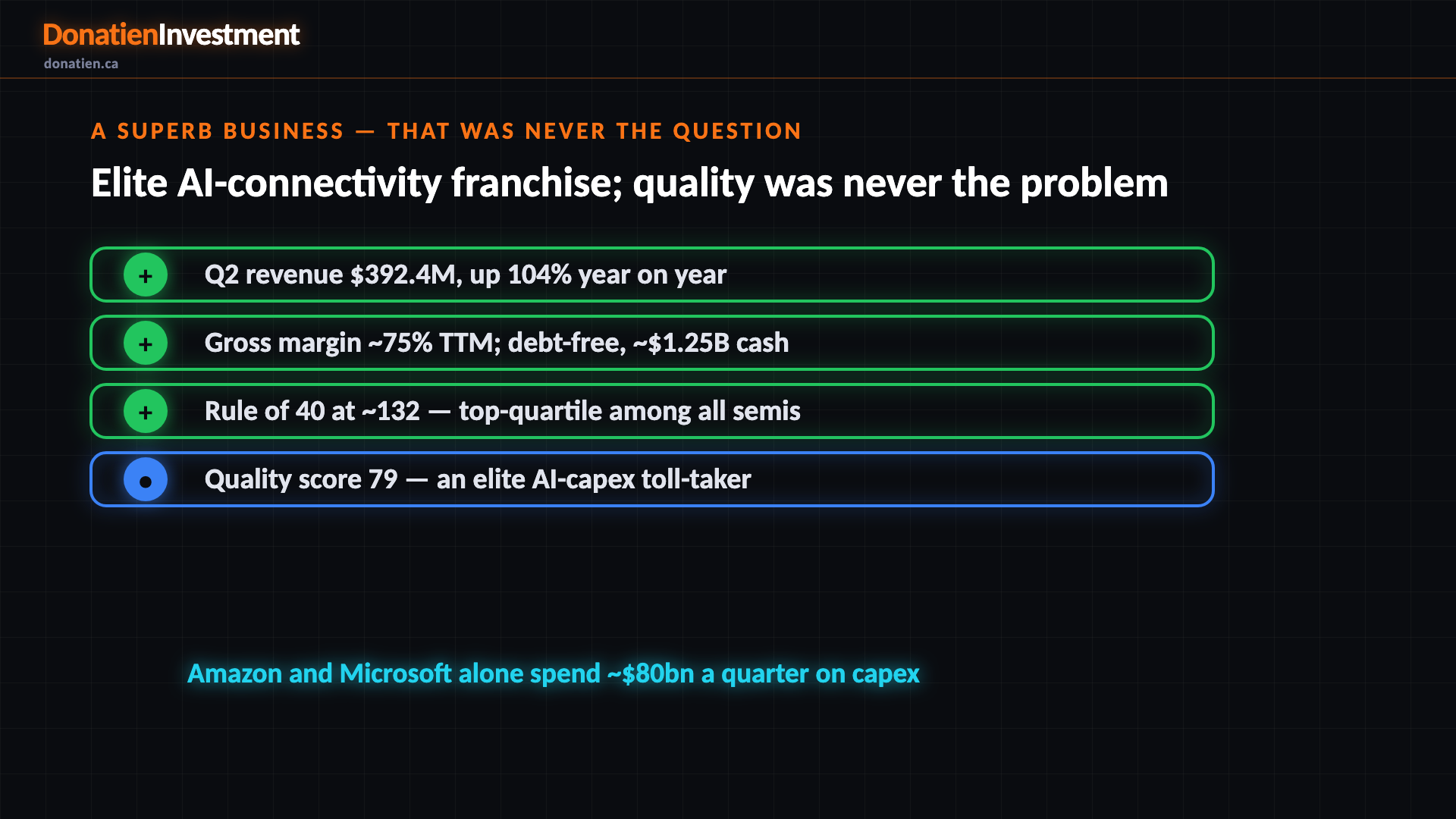
Amazon and Microsoft alone spend ~$80bn a quarter on capex
The price sits deep in the Expensive band
Here is the catch the growth headline hides. Our framework says a business like this — after a disciplined haircut to its growth and a discount rate that reflects a beta of nearly four — warrants about twenty-three times earnings. The shares trade near fifty-two times next year's consensus, which is two-and-a-third times over, and past the thirty-three-times guardrail for its sector on its own. Strip out a one-off tax benefit and interest income and the clean trailing multiple is around two hundred and sixty times; the free-cash-flow yield is barely half a per cent. The valuation score is thirty-three, and fair value anchors near a hundred and forty-six dollars — well below the three-thirty-one you would pay today.
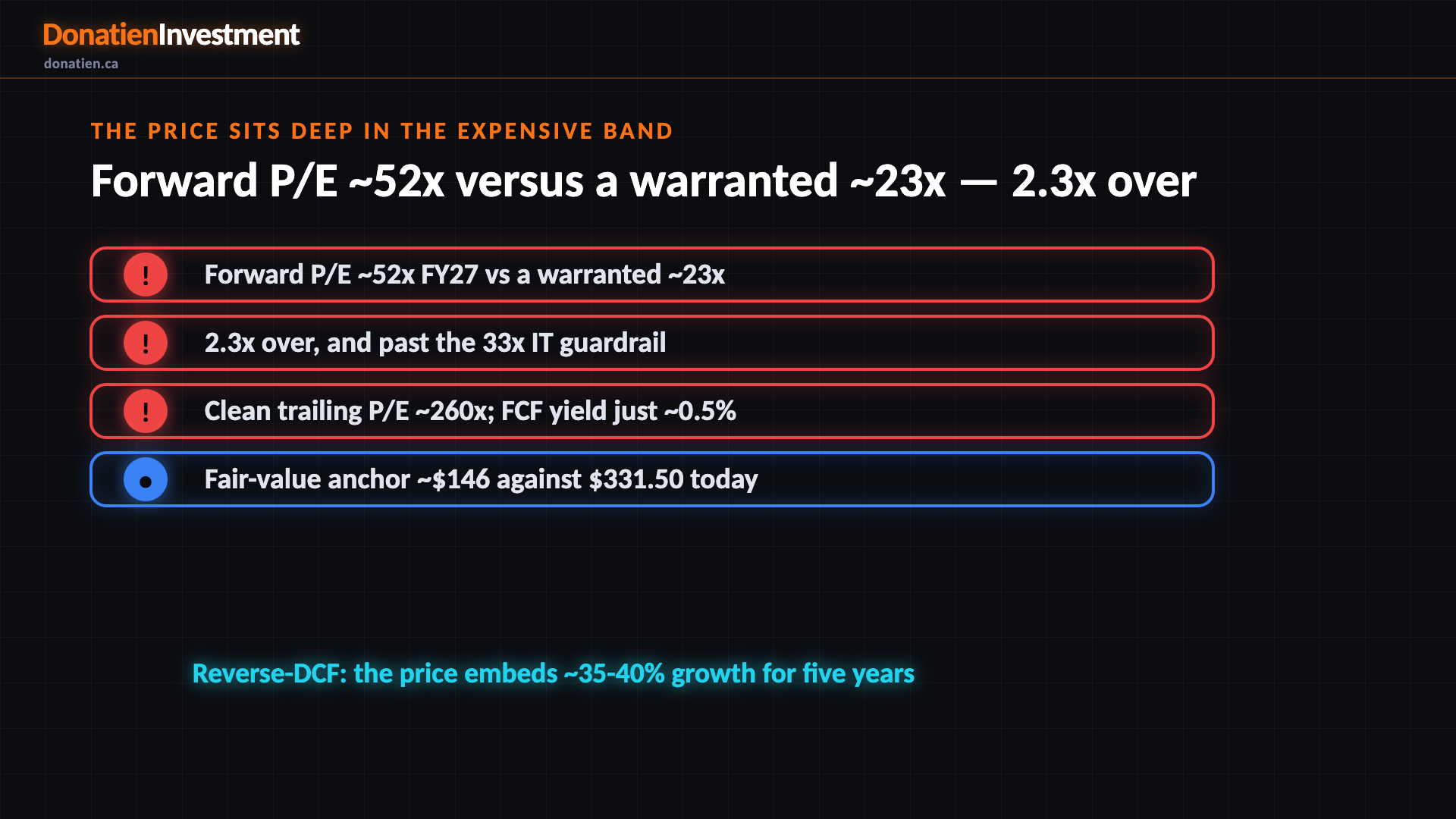
Reverse-DCF: the price embeds ~35-40% growth for five years
A live risk tail, and no entry edge
On its own, expensive would cap this at a hold. What turns it into a Do-Not-Buy is that the risk is live, not theoretical. Our macro read on the thirtieth of July has the AI-concentration tail armed, and the safety valve — market breadth broadening — is absent: the equal-weight index was flat while technology ripped five and a half per cent. That narrowing breadth means the tail is triggering, a live de-rating catalyst, and Astera is a genuine member of exactly that cohort. Notice too that the stock sold its own beat-and-raise, falling twelve per cent on results before recovering. There is no entry edge anyway — conviction reads Wait, with none of the three entry paths open at this price.
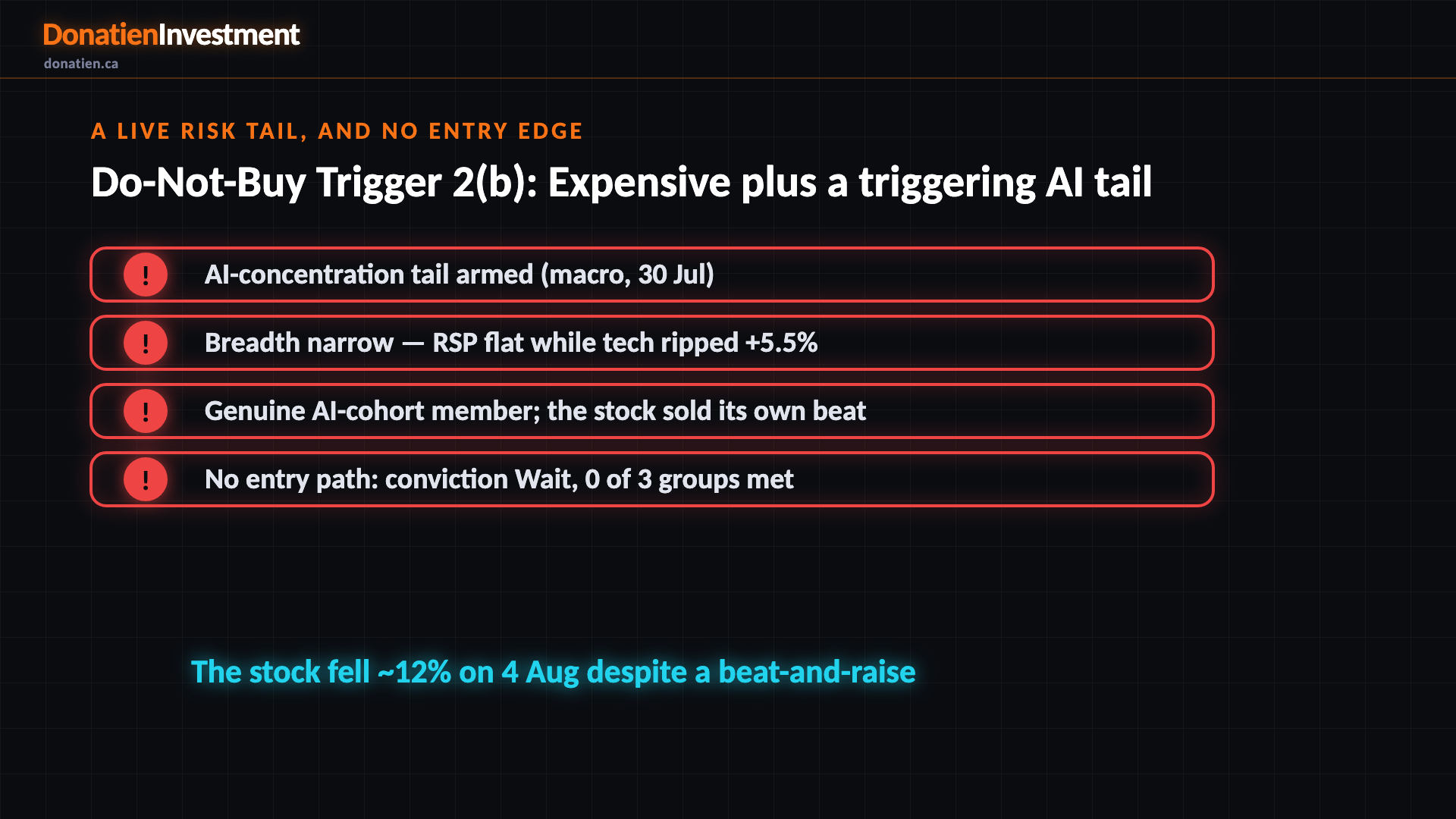
The stock fell ~12% on 4 Aug despite a beat-and-raise
What could go wrong
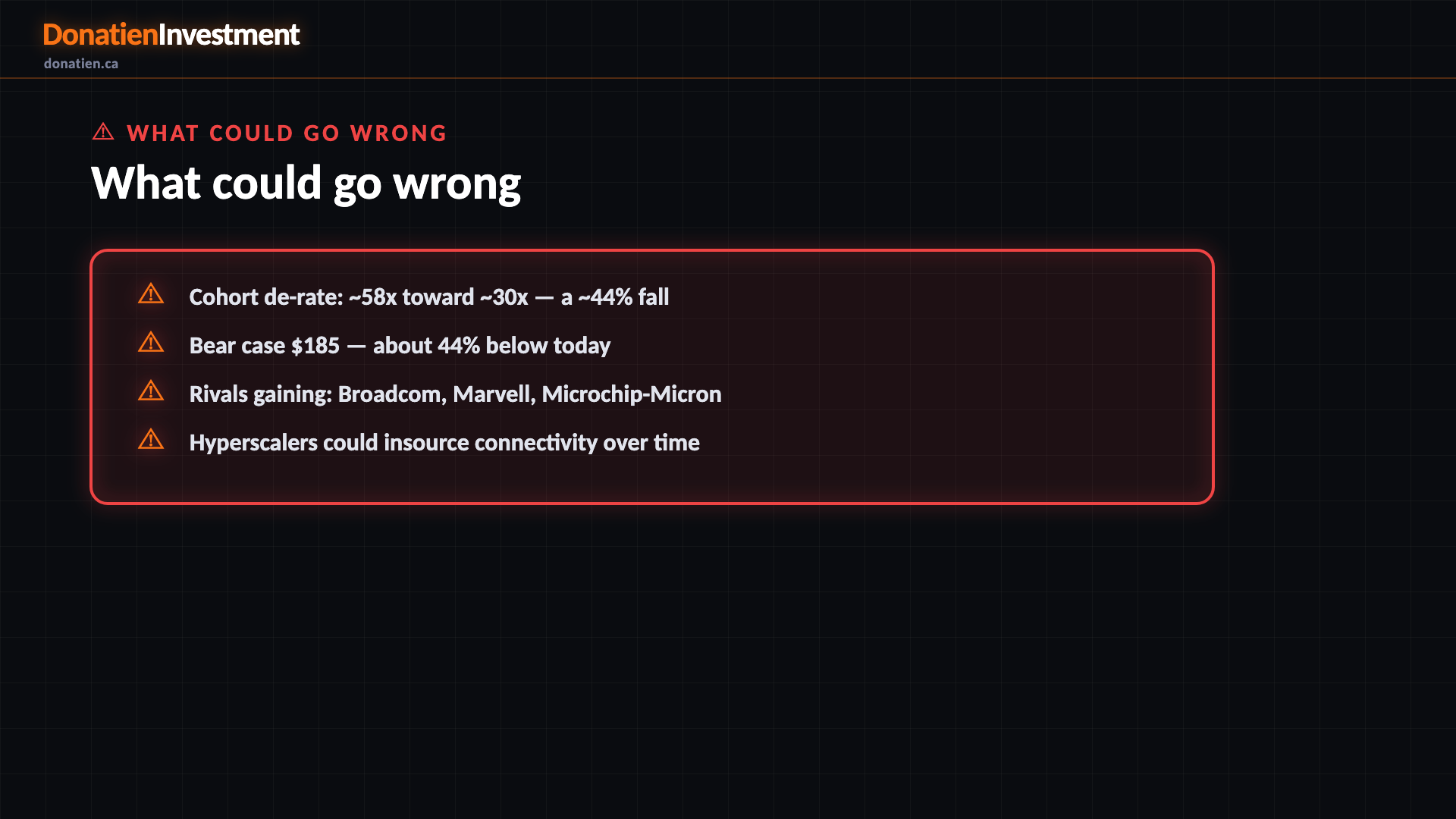
Be honest about the shape of the downside, because it is not gentle. The main risk is not company-specific at all — it is the whole AI cohort's forward multiple compressing from about fifty-eight times toward thirty, a move that would drag Astera to roughly a hundred and eighty-five dollars, forty-four per cent below today, and its beta of three-point-six-seven would amplify every index down-move. On top of that sits a genuine competitive threat: much larger rivals — Broadcom, Marvell, and a new Microchip-and-Micron alliance — pushing into the same Gen-six switch and retimer turf, and hyperscalers that could insource this connectivity over time. That downside dwarfs the base-case upside. It is the risk you would be carrying, unpaid.
Risk vs Reward
Weigh the three paths and the reason for the call becomes plain. The bull case at five hundred dollars — a one-in-four chance — needs the AI-capex boom to sustain, Astera to keep compounding above forty per cent, and breadth to broaden so the tail disarms; that is a fifty-one per cent gain. The base case at three hundred and forty, the most likely at forty-five per cent, has strong revenue growth offset by a modest de-rating, leaving the stock roughly flat over a year. The bear at a hundred and eighty-five, at thirty per cent, carries the cohort unwind. Blend them and the probability-weighted value is about three hundred and thirty-three — essentially today's price. You are being paid almost nothing to carry a deeply asymmetric downside, and that is exactly why the answer is Do-Not-Buy.
The verdict
So, to be clear: this is not a sell of a bad company — it is a refusal to buy a very good one at this price, with this risk live. Do-Not-Buy across every horizon. If the shares fall back toward the hundred-and-forty-six anchor, or breadth broadens and disarms the tail, the picture changes. Until then, the honest call is to wait.
Read the full report on donatien.ca →