Gold HOLD
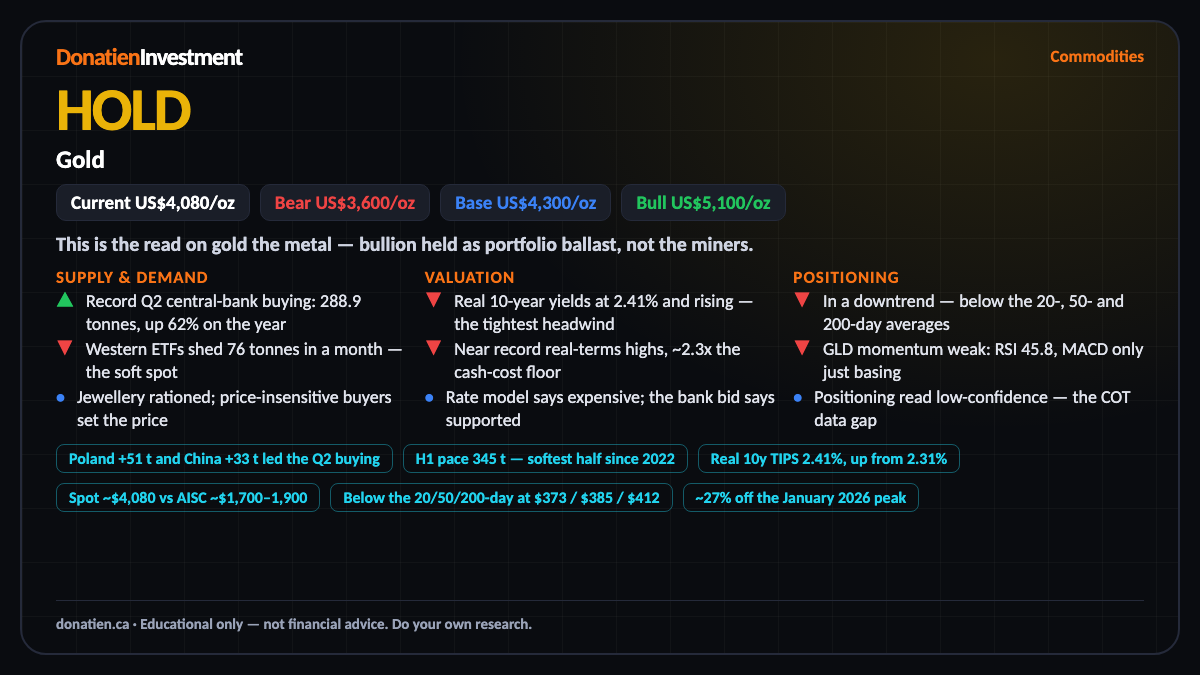
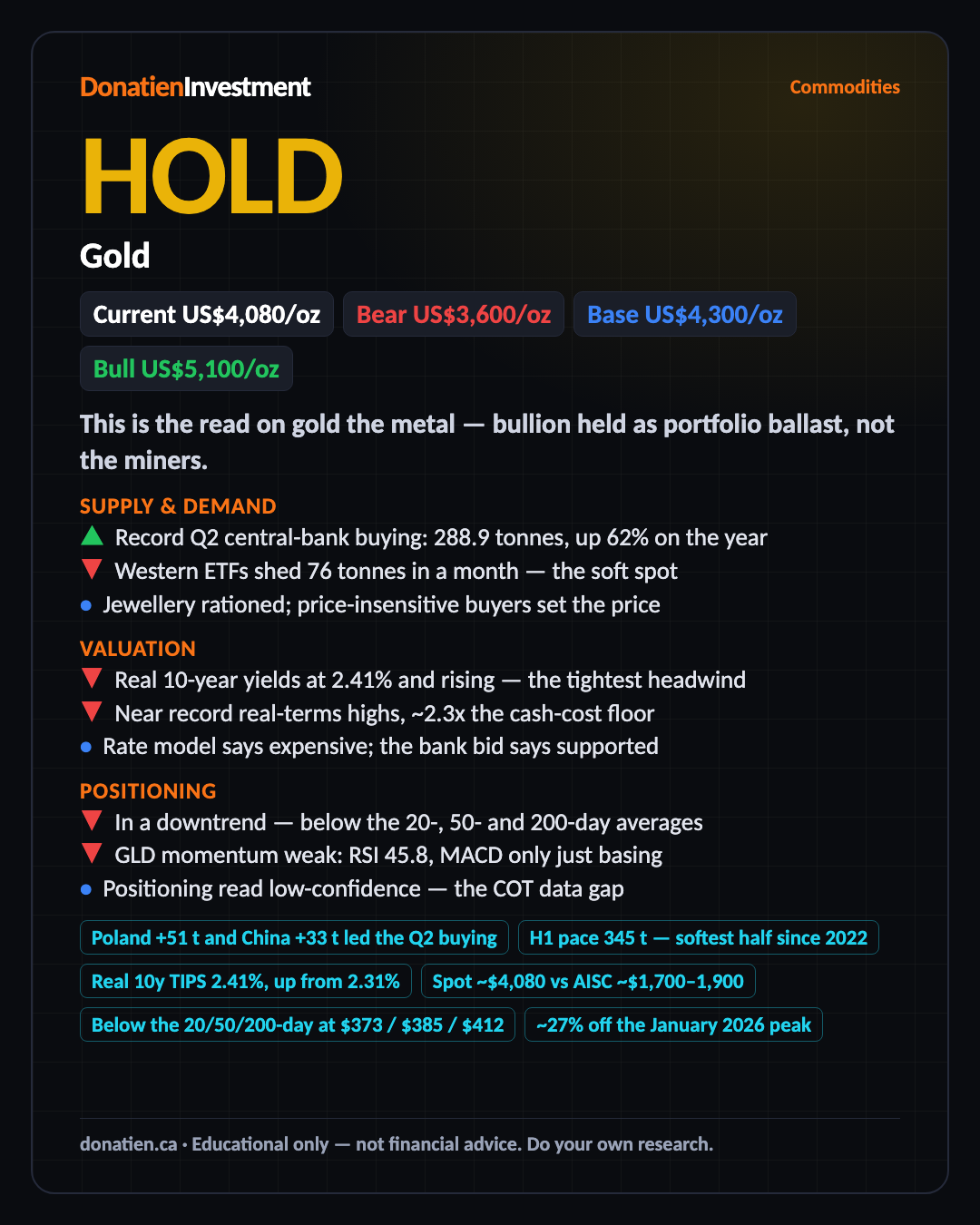
A long-term buy on the record central-bank bid — but rich here, with real yields at a cycle-high 2.41% and the price below every major moving average. Hold it, and accumulate on weakness rather than chase it.
This is the read on gold the metal — bullion held as portfolio ballast, not the miners. What sets the price isn't jewellery; it's two large, price-insensitive buyers, central banks and investors. That bid is the spine of the case, and it's why a fall of about 27% from January's peak reads as a correction, not a top. Drivers and regime only amplify that read — they don't set it.
Supply & Demand
The demand side is the long-term case, and it is strong. Central banks bought a record 288.9 tonnes in the second quarter, up 62% on the year — and they bought into the price drop, which is the tell of a buyer that runs on reserve policy, not price. Poland and China led. The soft spot is Western investors: exchange-traded funds shed about 76 tonnes over the month as a hawkish Fed bit. And the half-year pace, 345 tonnes, was the weakest since 2022. So the structural bid is real, but it is not a stampede.
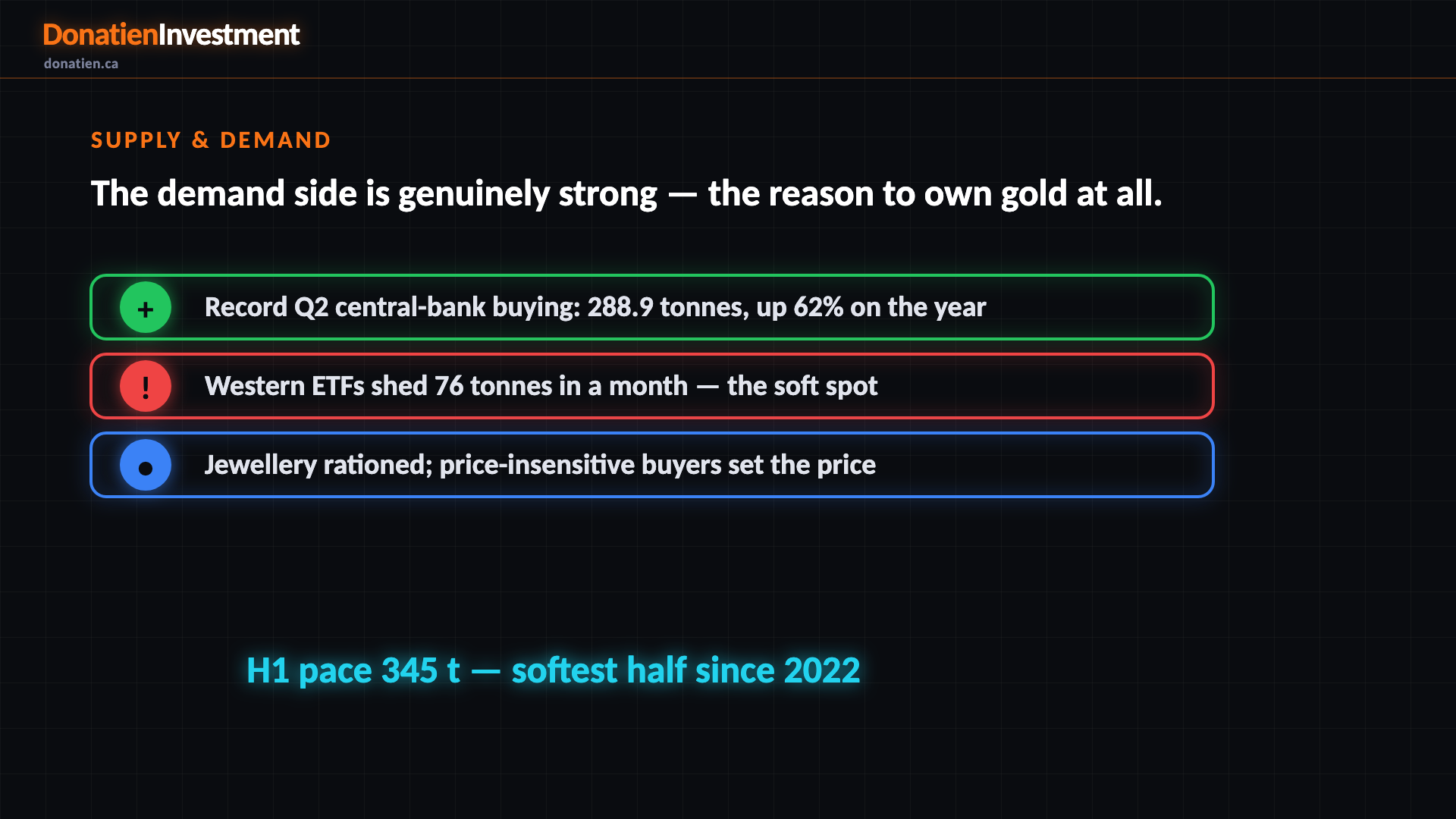
Poland +51 t and China +33 t led the Q2 buying · H1 pace 345 t — softest half since 2022
Valuation
Gold is not cheap, and that is what caps the short term. Real ten-year yields sit at 2.41%, up from 2.31%, and are still rising — the single tightest inverse driver of the price, because a rising real yield raises the opportunity cost of holding a metal that pays nothing. Even after a correction of about 27%, gold is near its record highs in real terms, roughly two-point-three times its cash-cost floor. The rate model says expensive; the central-bank floor says supported. Both are true, which is why the honest call is hold, not buy — you wait for a better entry.
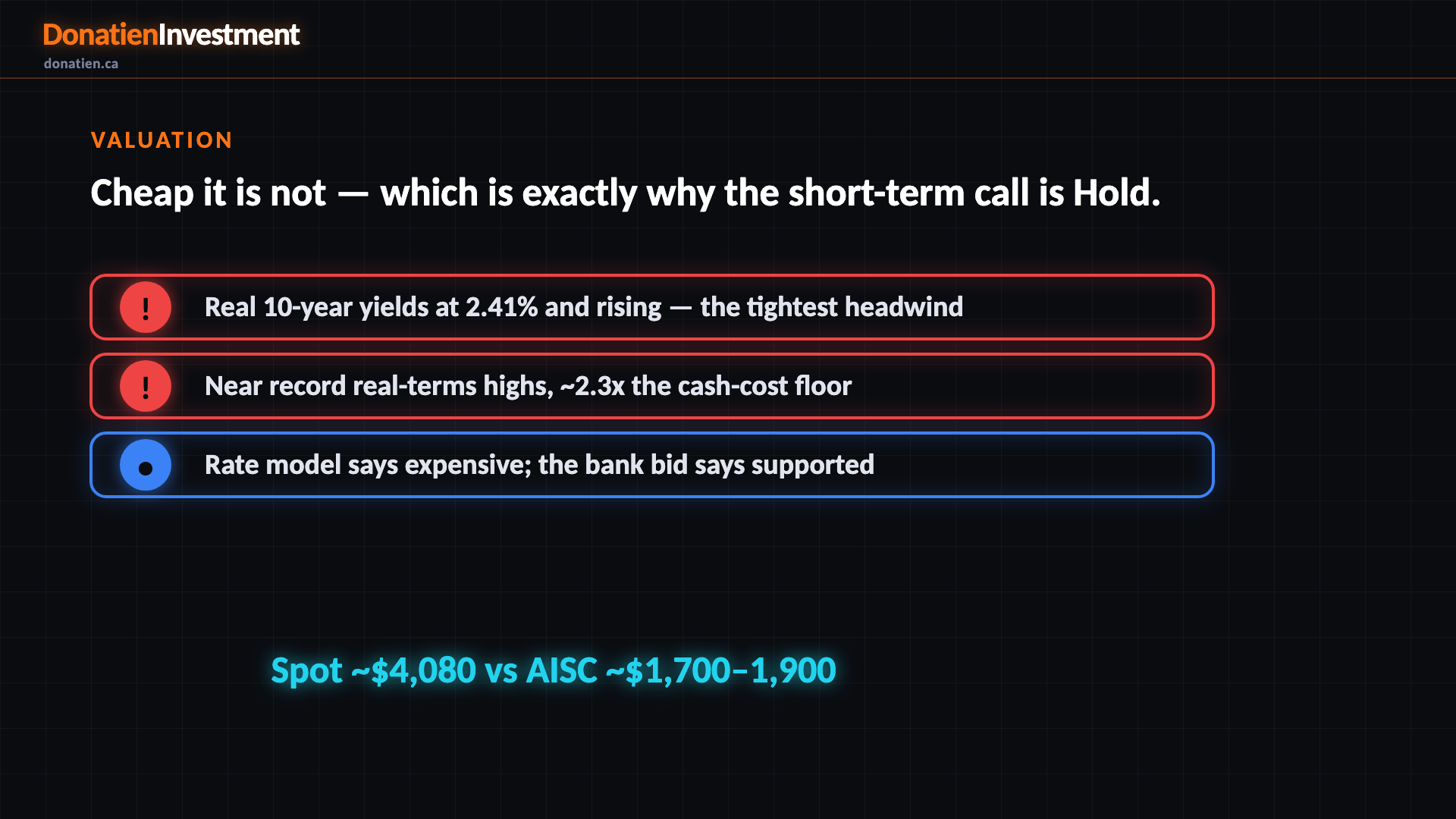
Real 10y TIPS 2.41%, up from 2.31% · Spot ~$4,080 vs AISC ~$1,700–1,900
Positioning
Right now the tape is against gold. The price is below its twenty-, fifty- and two-hundred-day averages, momentum is weak with the relative-strength index in the mid-forties and the MACD only just trying to base, and it sits about 27% below January's peak. We can't read the futures positioning cleanly this run — the commitments data wasn't retrievable, so that gauge is low confidence rather than a signal either way. The long-term trend is still up, just extended. None of this changes the multi-year case; it is why you wait rather than chase.
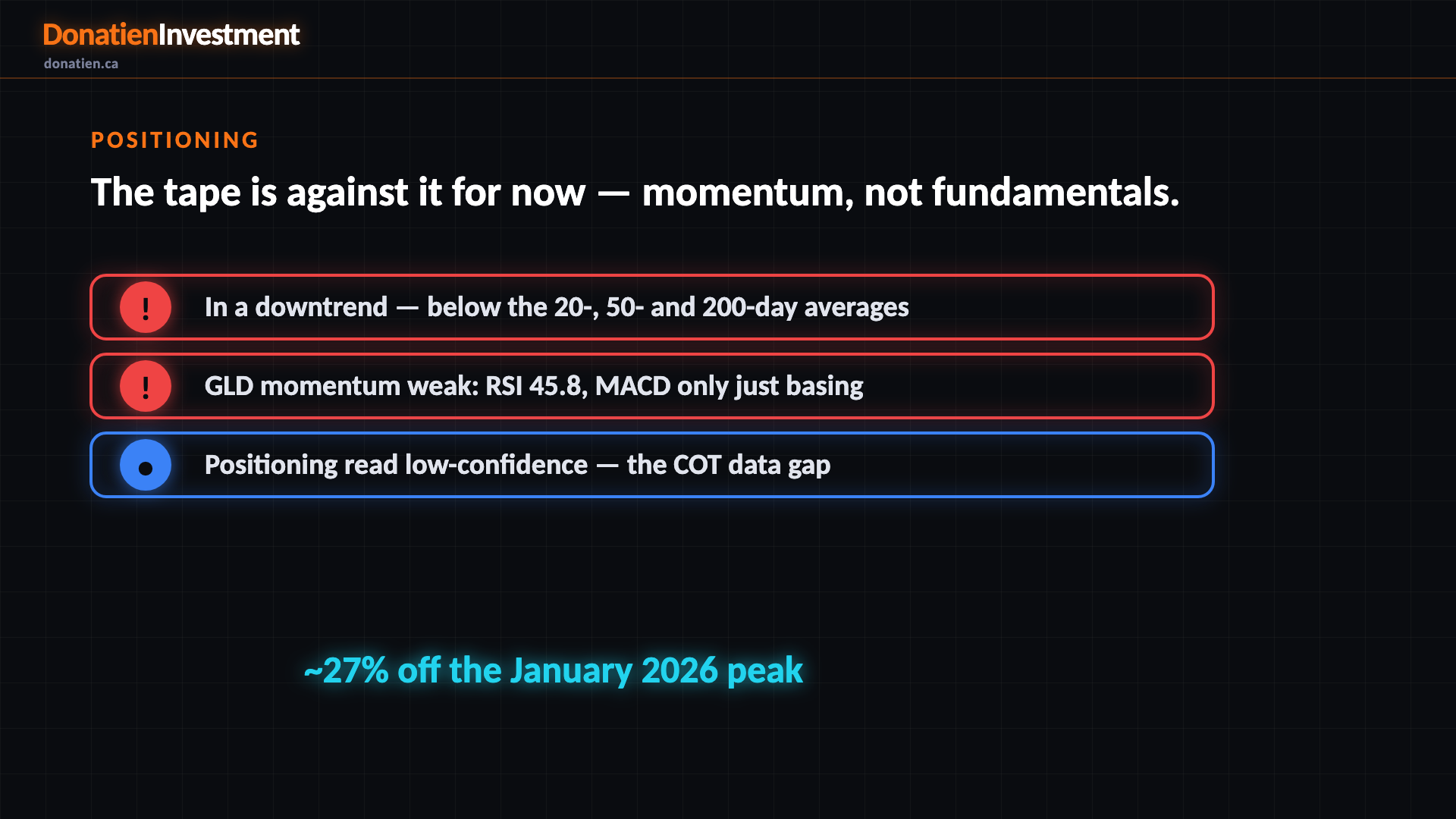
Below the 20/50/200-day at $373 / $385 / $412 · ~27% off the January 2026 peak
Physical flows
The plumbing tells the same story: strong structurally, soft tactically. The long bid is real — the dollar's share of reserves has slipped below 57% for the first time since the mid-nineties, and 89% of central banks say they plan to add gold over the next year. Be honest about the other side, though: the shift is slow and contested — the dollar is still about 57% with no credible rival, and most of the recent slip was currency valuation rather than active selling. But the acute-tightness gauges aren't flashing. Western funds are still selling, about 76 tonnes over the month; Shanghai trades at a subdued five-dollar premium rather than a squeeze; and COMEX vaults are elevated, not draining. China's late-July ban on leveraged retail paper-gold trimmed some froth without touching physical demand. Nothing here is forcing you in — which, again, is the case for patience.
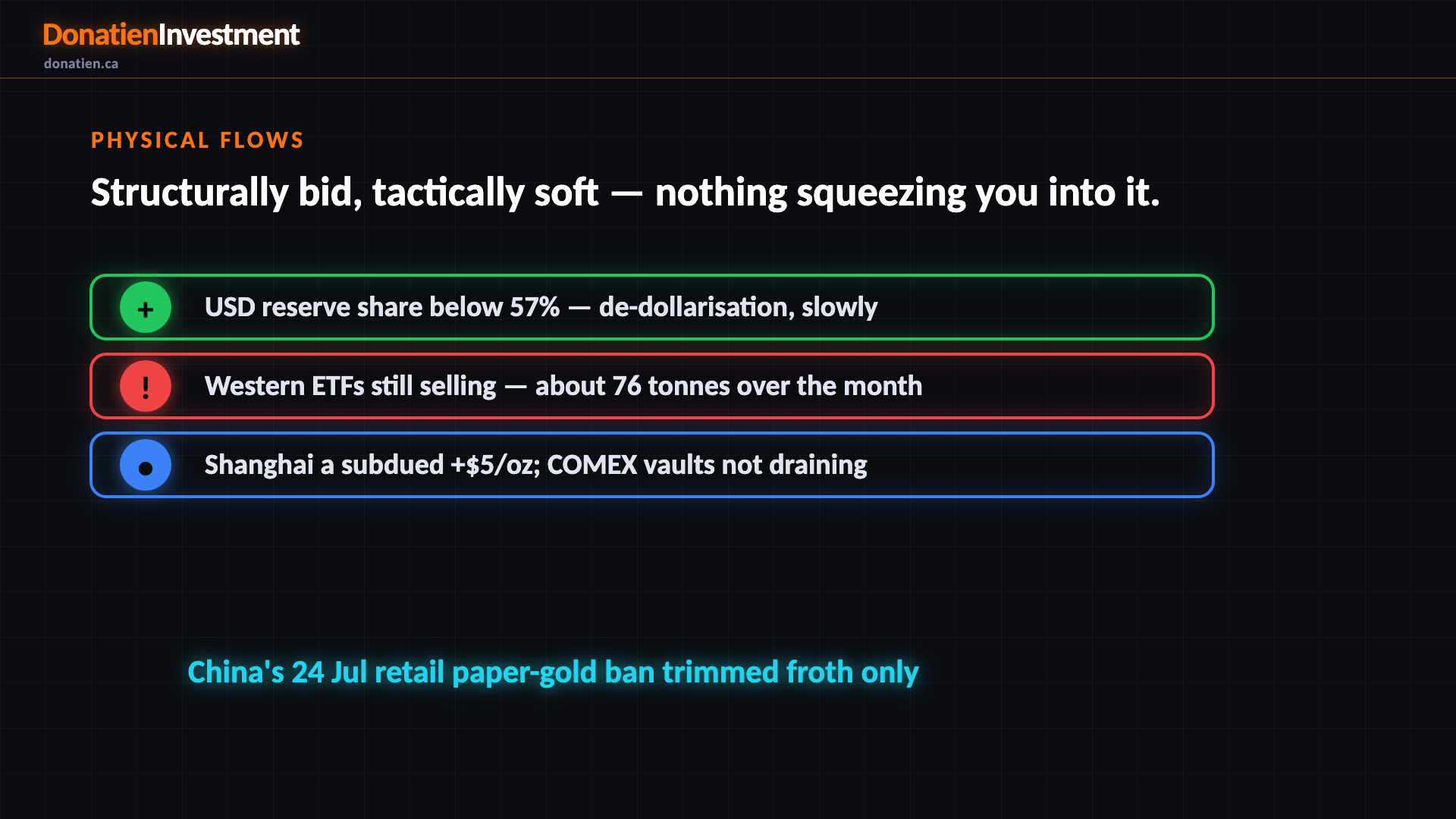
89% of central banks plan to add gold over 12 months · China's 24 Jul retail paper-gold ban trimmed froth only
What could go wrong
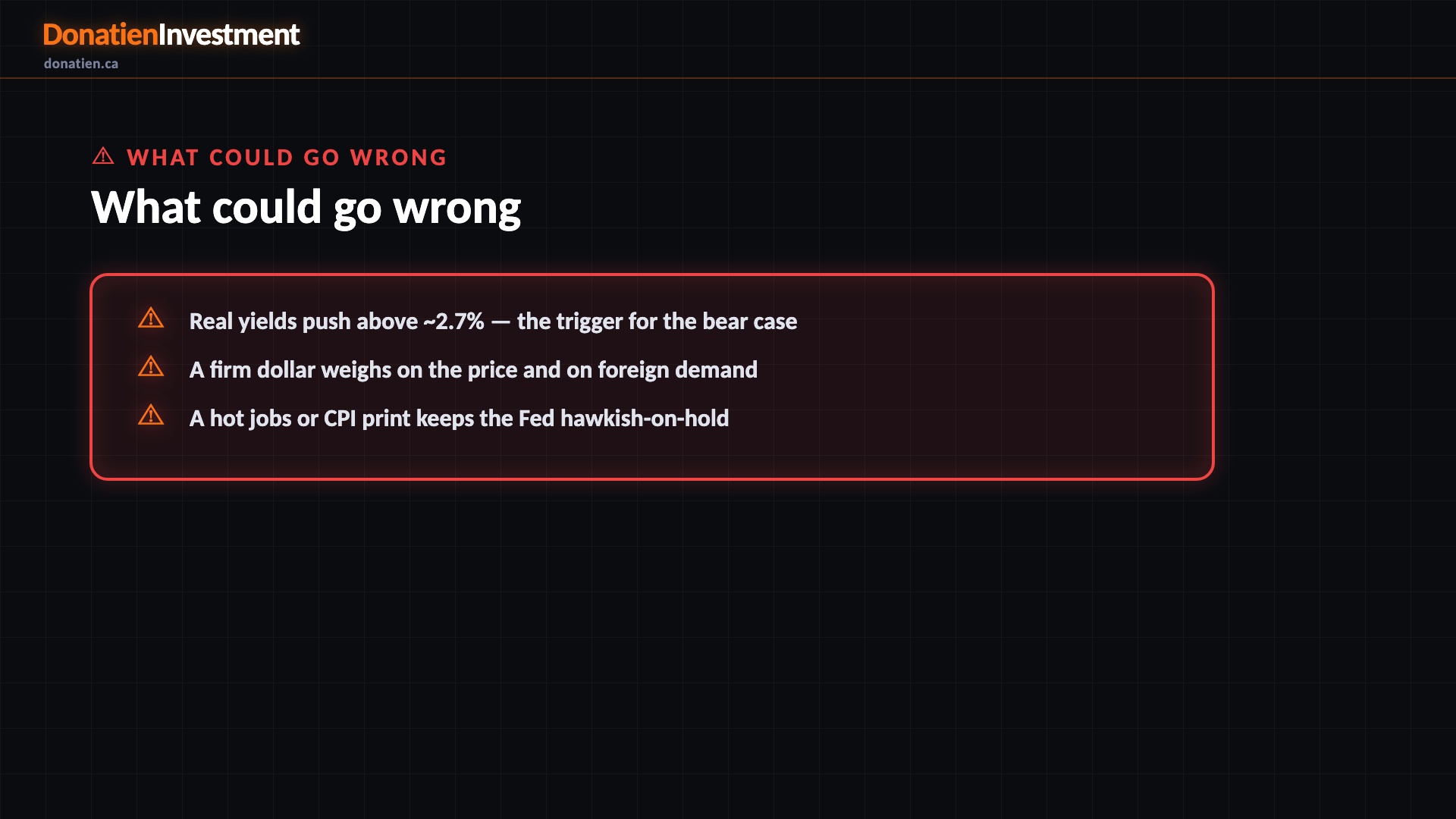
The risks all run through rates and the dollar, and they are live. The Fed held at 3.75% on the 29th of July and signalled patience, and real ten-year yields have climbed to 2.41%. If they push above about 2.7%, that triggers the bear case. A firm broad dollar weighs on the price mechanically and erodes foreign demand. And the near-term swings are the 7th-of-August jobs print and the 12th-of-August inflation report: a hot reading keeps the Fed hawkish-on-hold and the downtrend has further to run. These are exactly why the near-term call is hold, not buy — even as the years-long case stays a buy.
Risk vs Reward
The base case, and the likeliest over six to twelve months, has gold around $4,300 an ounce, up about 5% — digesting the correction in a range with the record central-bank bid as the floor; JPMorgan sees $4,500 by the fourth quarter. The bull case is around $5,100, up 25%, if real yields fall, the Fed pivots, or a stagflation, credit or Hormuz shock hits and Western money comes back. The bear case is around $3,600, down 12%, if a hot inflation print forces rates higher for longer and the dollar firms. Near-term the bear path has the wind; over years the base-to-bull path is favoured.
The verdict
Short term, hold — right asset, wrong moment to chase. Medium term, hold and accumulate on weakness. Long term it's a buy: the record central-bank demand and de-dollarisation dominate over years, and that is what makes gold worth holding as ballast. The bear case owns the next few months; the base-to-bull case owns the next few years. Note how the call is built — the hold comes from rich valuation and a broken tape, gold's own supply, demand and positioning, not from the bullish macro story. Drivers and regime only amplify; they don't set the signal. That circularity guard is the point. Live Iran and Hormuz escalation is the wildcard that can spike the metal regardless of rates.
Read the full report on donatien.ca →