Microsoft Corporation (NASDAQ:MSFT) HOLD
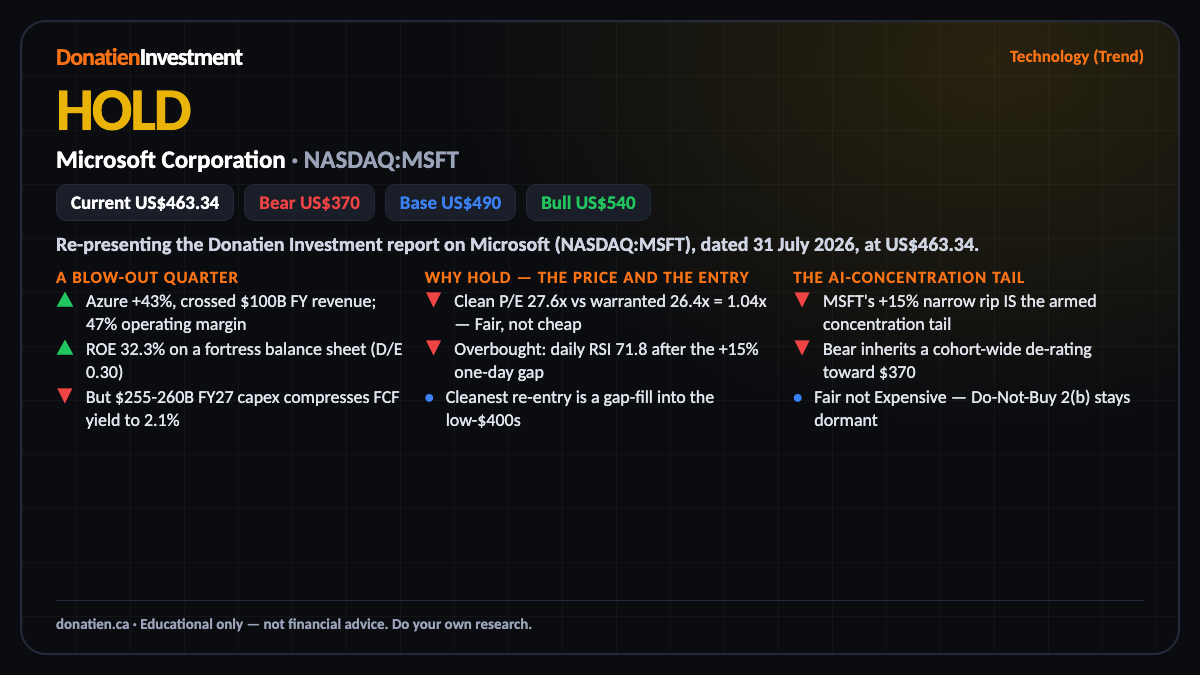
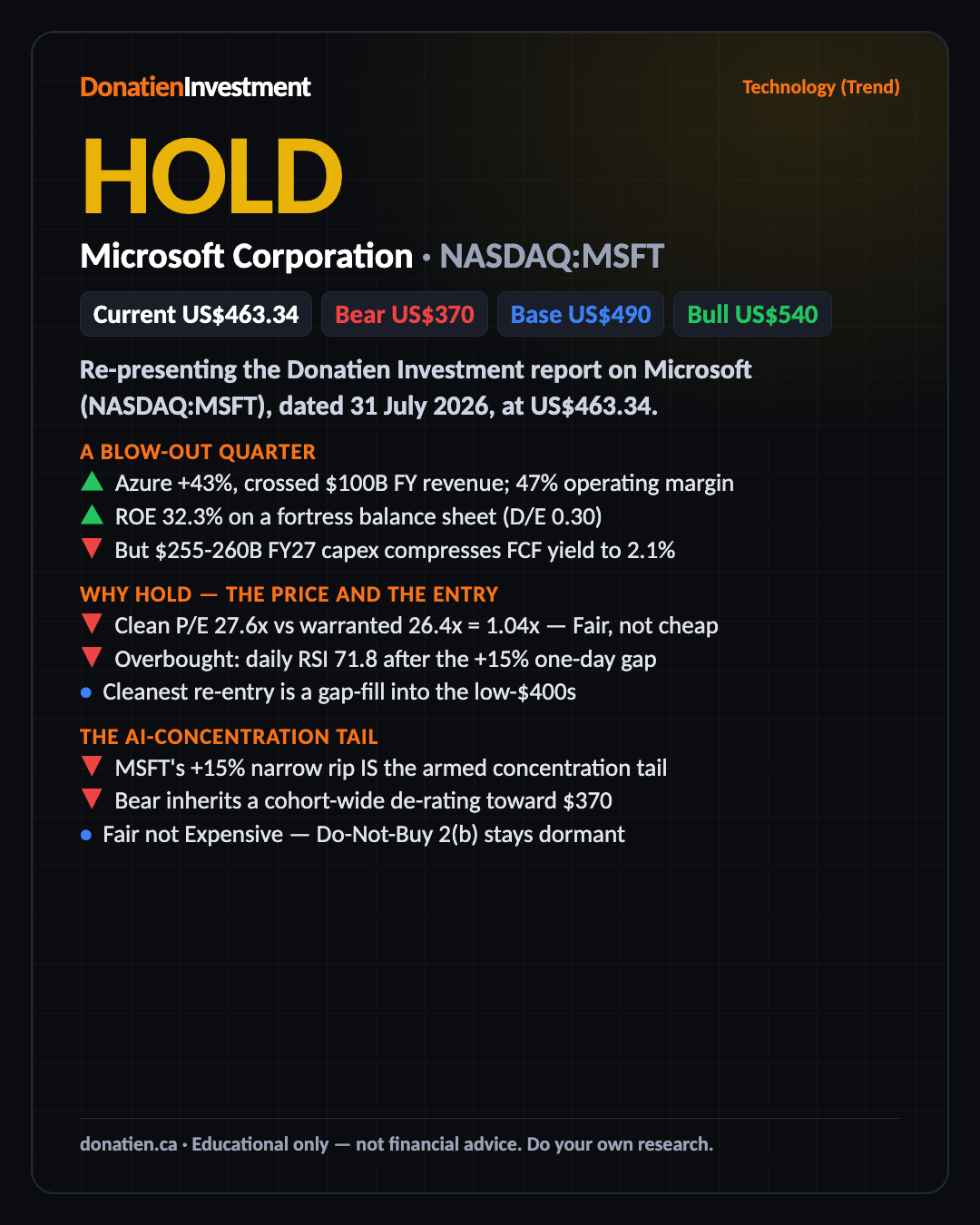
Microsoft's June quarter was a blow-out — Azure up forty-three per cent. But after the fifteen per cent rip, clean earnings sit at twenty-seven point six times: Fair and extended, not cheap. A great business you don't chase after a gap like that. Hold.
Re-presenting the Donatien Investment report on Microsoft (NASDAQ:MSFT), dated 31 July 2026, at US$463.34. HOLD across all three horizons — a don't-chase-the-rip hold, not a defensive one.
A blow-out quarter
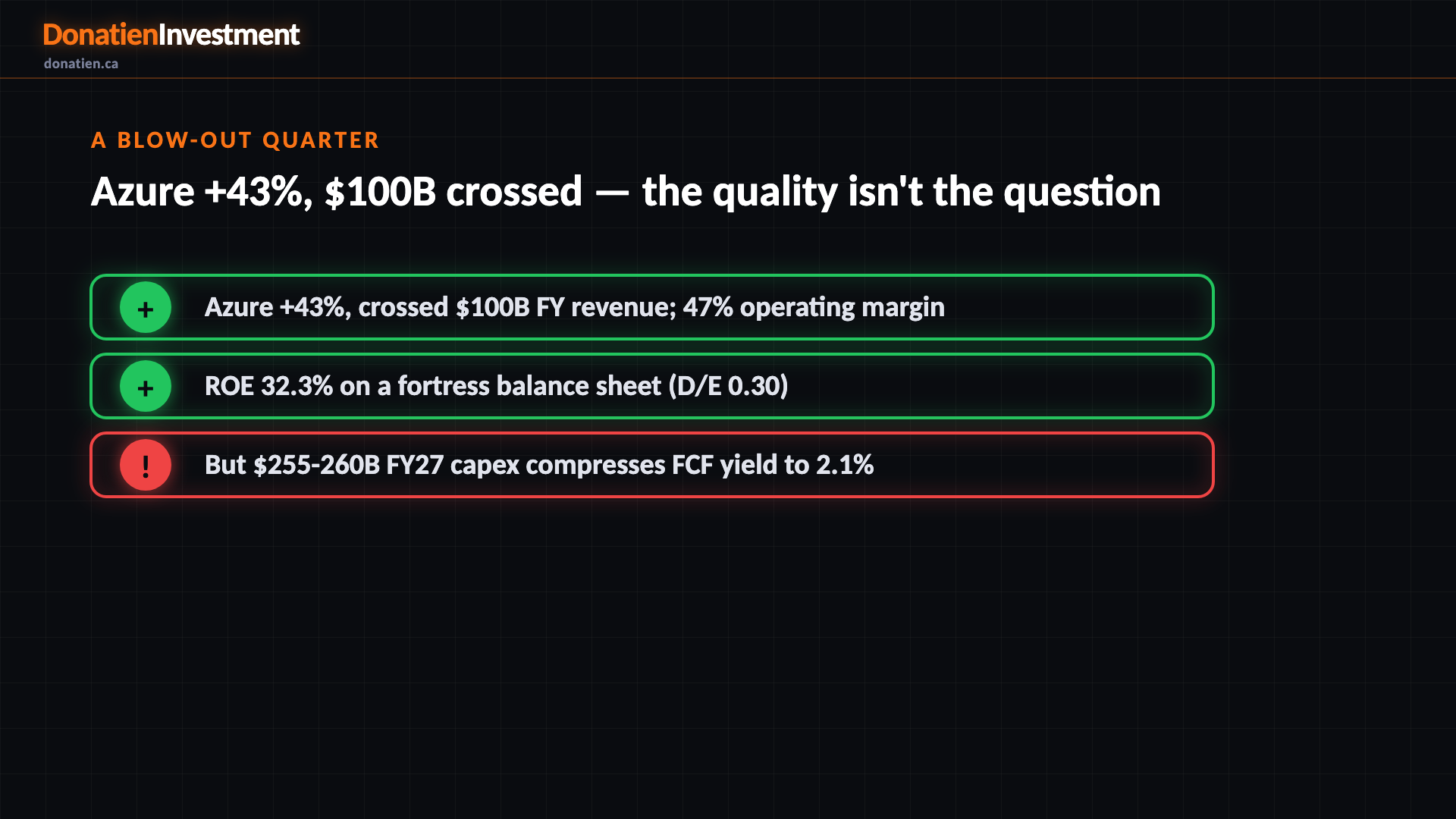
The business is not in doubt. In the June quarter Microsoft did ninety billion dollars of revenue, up eighteen per cent, and Azure grew forty-three per cent — crossing one hundred billion dollars of annual cloud revenue for the first time. Operating margins are near forty-seven per cent, return on equity above thirty-two, all on a fortress balance sheet. This is the capex actually converting into cloud revenue, which is exactly what the bull case needed. The one tension: Microsoft is now spending two hundred and fifty-five to two hundred and sixty billion dollars a year on A-I data centres, and that compresses free cash flow while the return on it is still unproven.
Why hold — the price and the entry
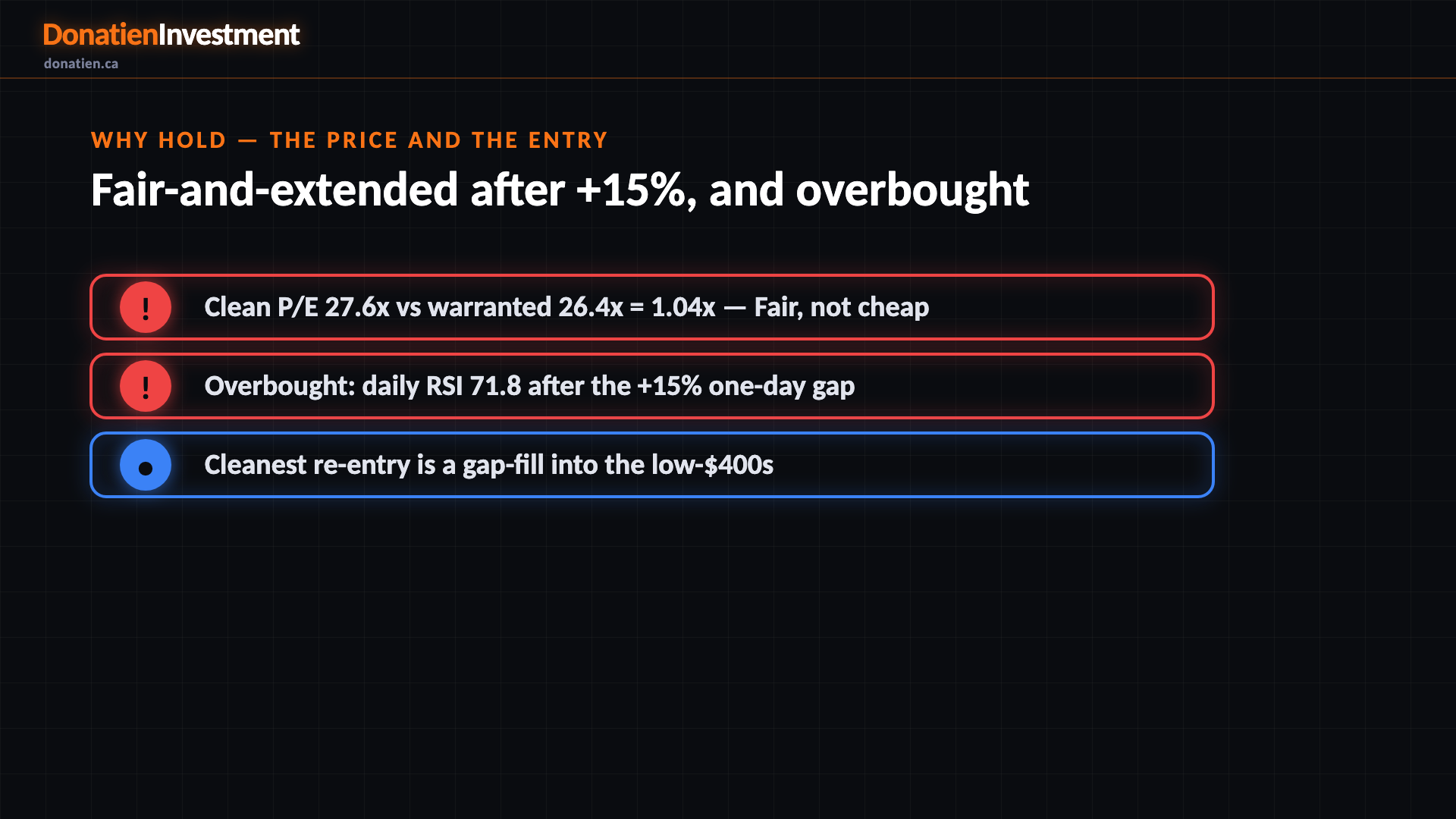
Here is what caps it. Against a warranted multiple of twenty-six point four times — built from a four point six seven per cent ten-year yield and disciplined growth — Microsoft's clean twenty-seven point six is one point zero four times: Fair. Not Expensive, so no valuation gate fires; but no longer Attractive either. And the entry is stretched — the daily relative-strength index is seventy-two after a fifteen-per-cent one-day gap, with no real support until the gap fill near four hundred and forty-nine, and then the pre-earnings base around four hundred. Good tape, poor risk-reward for a fresh position. The cleaner entry is a pullback, not a chase.
The AI-concentration tail
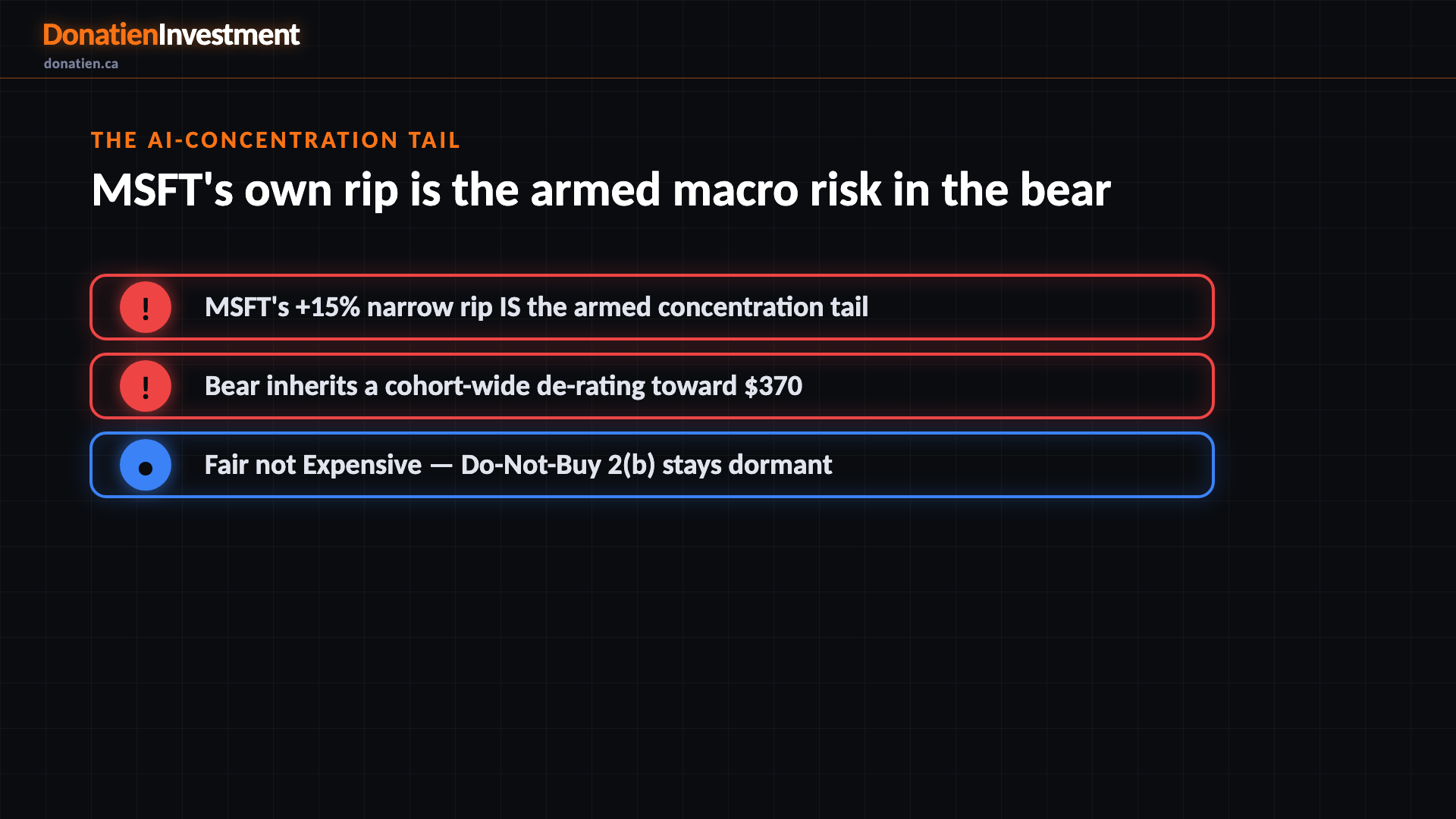
Microsoft also sits at the centre of a market-wide risk. The thirtieth-of-July macro report flags an armed concentration tail — the top ten names are about forty-one per cent of the S&P, and Microsoft's own fifteen-per-cent rip, with the equal-weight index flat, IS the named narrow-breadth event. So its bear case isn't just company fundamentals; it inherits a cohort-wide de-rating, where an A-I capex scare or a private-valuation markdown compresses the whole group together. Because Microsoft is Fair rather than Expensive, the do-not-buy trigger stays dormant — but the bear still has to carry that cohort leg.
What could go wrong
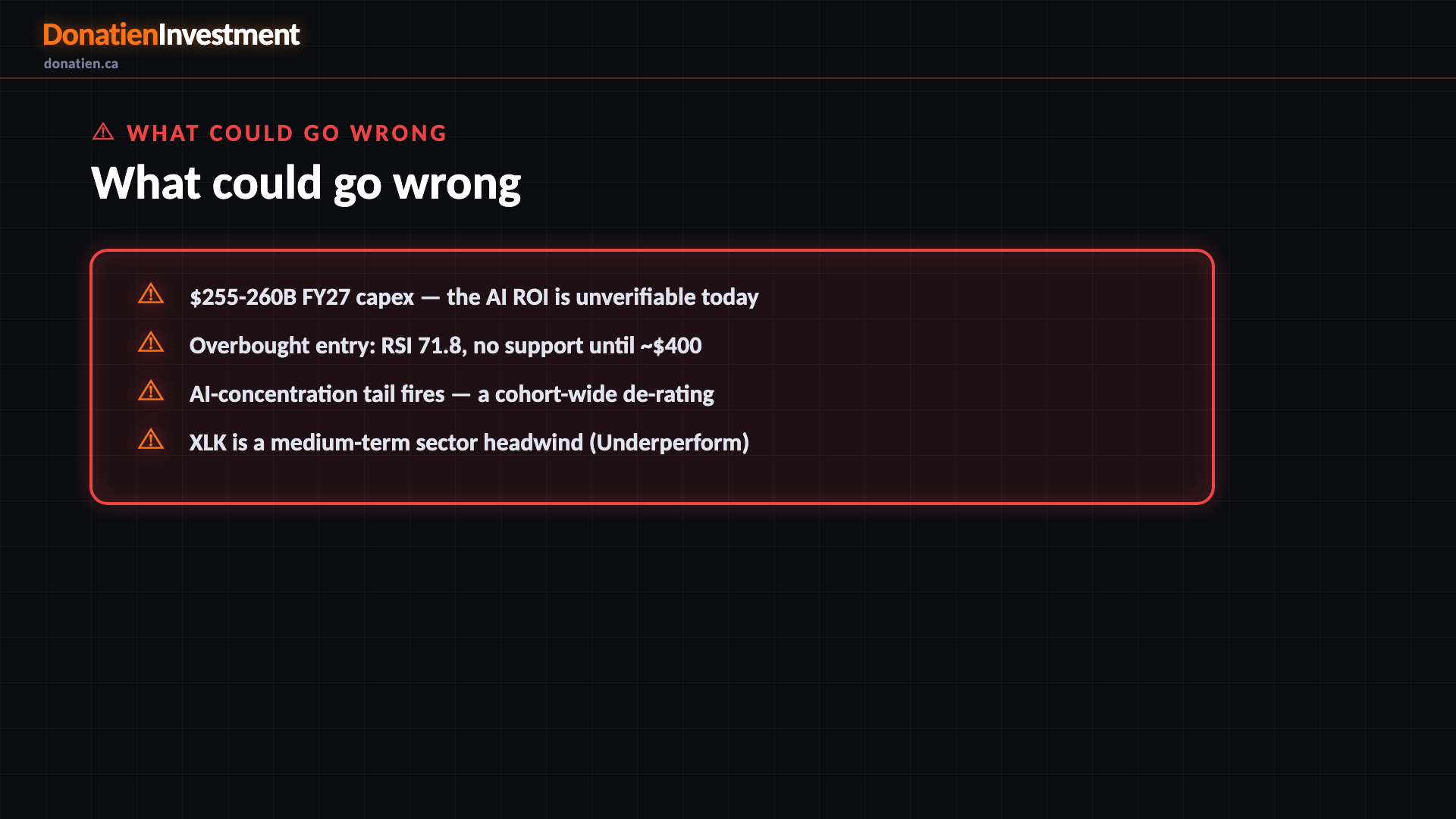
$255-260B FY27 capex — the AI ROI is unverifiable today. Overbought entry: RSI 71.8, no support until ~$400. AI-concentration tail fires — a cohort-wide de-rating. XLK is a medium-term sector headwind (Underperform).
Risk vs Reward
The report weights three twelve-month paths, and the skew is essentially flat. The base case, most likely at fifty per cent, holds Microsoft near four hundred and ninety dollars — about six per cent up — as the blow-out is digested and Azure normalises from forty-three toward the high-thirties. The bull, at twenty-five per cent, reaches five hundred and forty if the capex-to-revenue story keeps compounding, roughly seventeen per cent up. The bear, at twenty per cent, fills the gap to three hundred and seventy — down about twenty per cent — if the concentration tail fires, with a five-per-cent deep-bear tail below three hundred and fifty. Probability-weighted, that's about four hundred and seventy-two dollars, only two per cent above today — flat risk-reward, which is the quantitative case for a hold.
The verdict
The bottom line: the quality isn't the question, the price and the entry are. A superb business, but Fair-and-extended after a fifteen-per-cent gap, bought into an overbought tape with a live cohort-de-rating tail in the bear — the risk-reward here is flat. It's a hold, not an entry. The cleaner path is to let the gap fill toward the low-four-hundreds, which pulls the valuation anchor back to Attractive, rather than chasing four hundred and sixty-three.
Read the full report on donatien.ca →