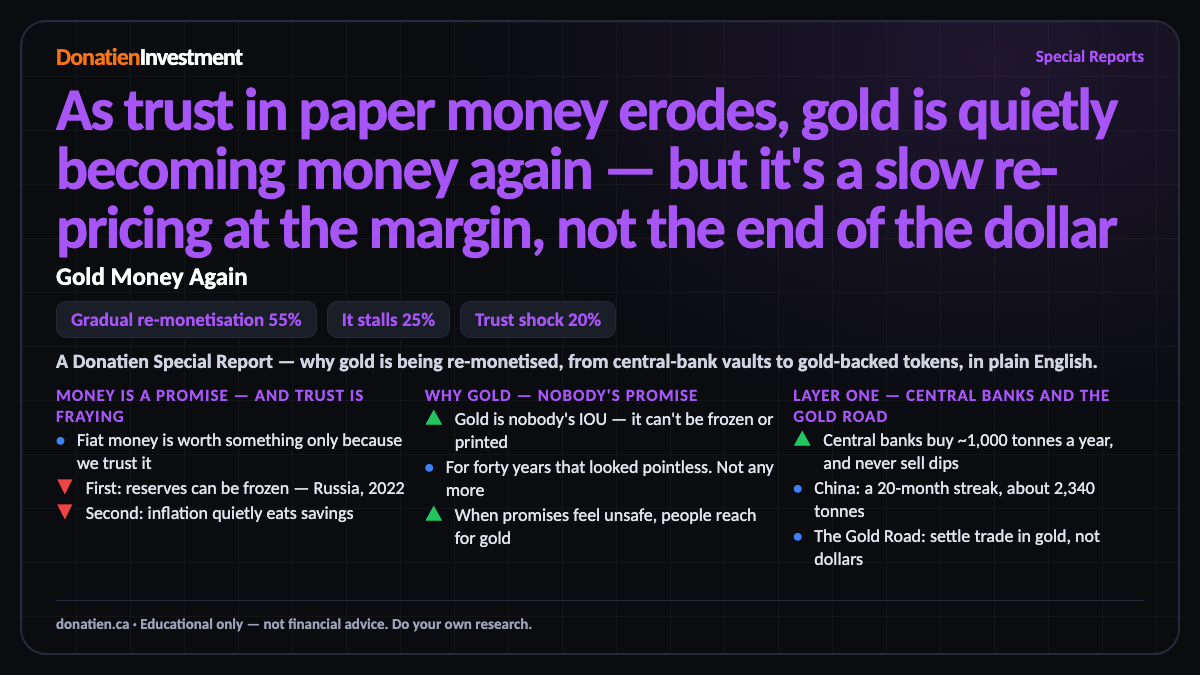
Gold Money Again As trust in paper money erodes, gold is quietly becoming money again — but it's a slow re-pricing at the margin, not the end of the dollar
central banks, savers and now software are all reaching for the one asset no government can print or freeze
A Donatien Special Report — why gold is being re-monetised, from central-bank vaults to gold-backed tokens, in plain English.
Money is a promise — and trust is fraying
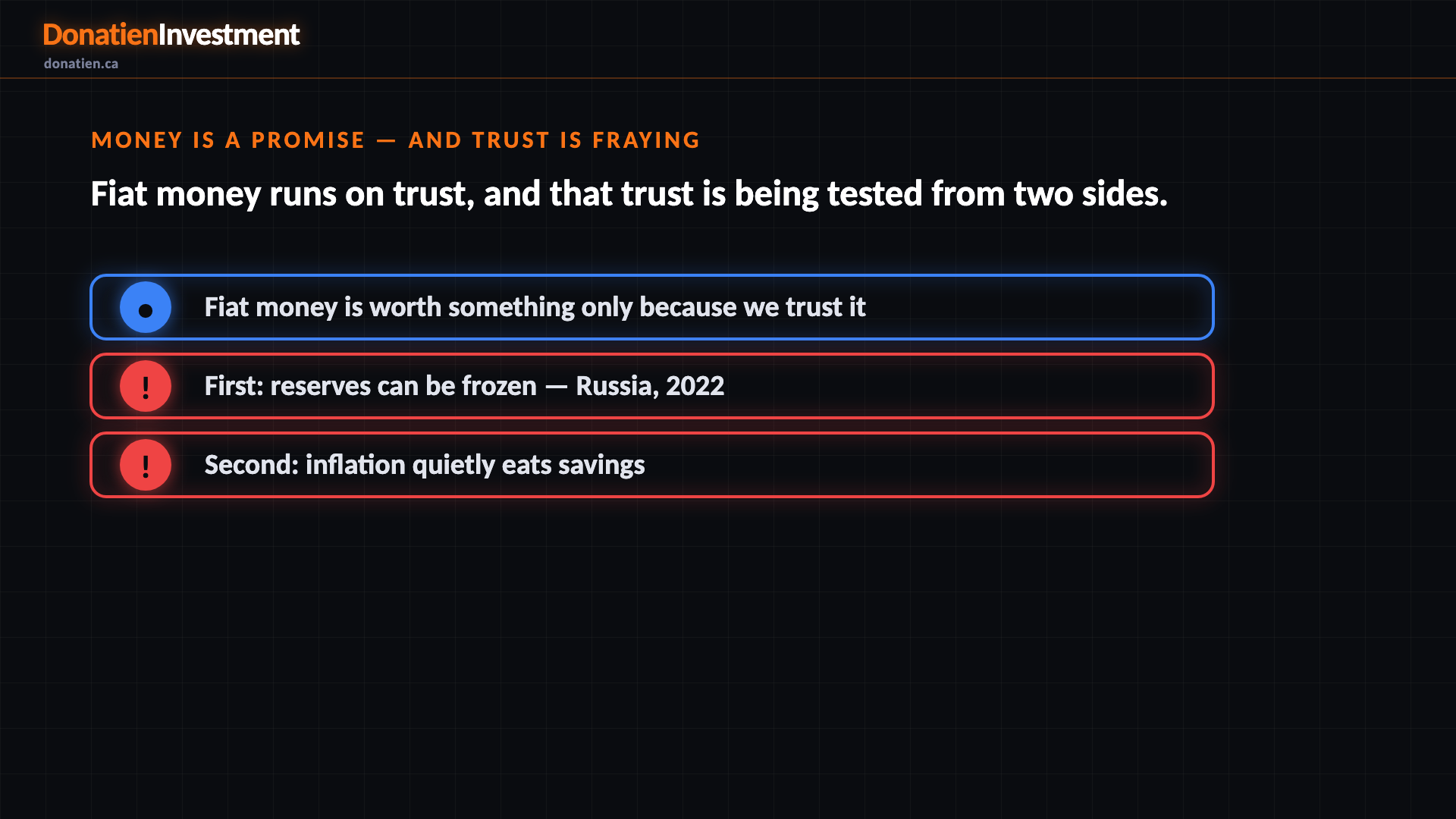
Start with what money actually is. The notes in your pocket aren't backed by gold or by anything you can touch — they're worth something only because a government says so and everyone agrees to accept them. That agreement is trust, and it's the only thing holding the whole system up. Right now that trust is being tested from two directions at once. In twenty twenty-two the West froze roughly three hundred billion dollars of Russia's reserves, and every central bank outside the Western alliance learned that 'safe' dollar reserves are safe only with permission. And ordinary savers have watched years of money-printing quietly eat the value of their cash. Sovereigns and savers rarely agree on anything. They agree on this.
Why gold — nobody's promise
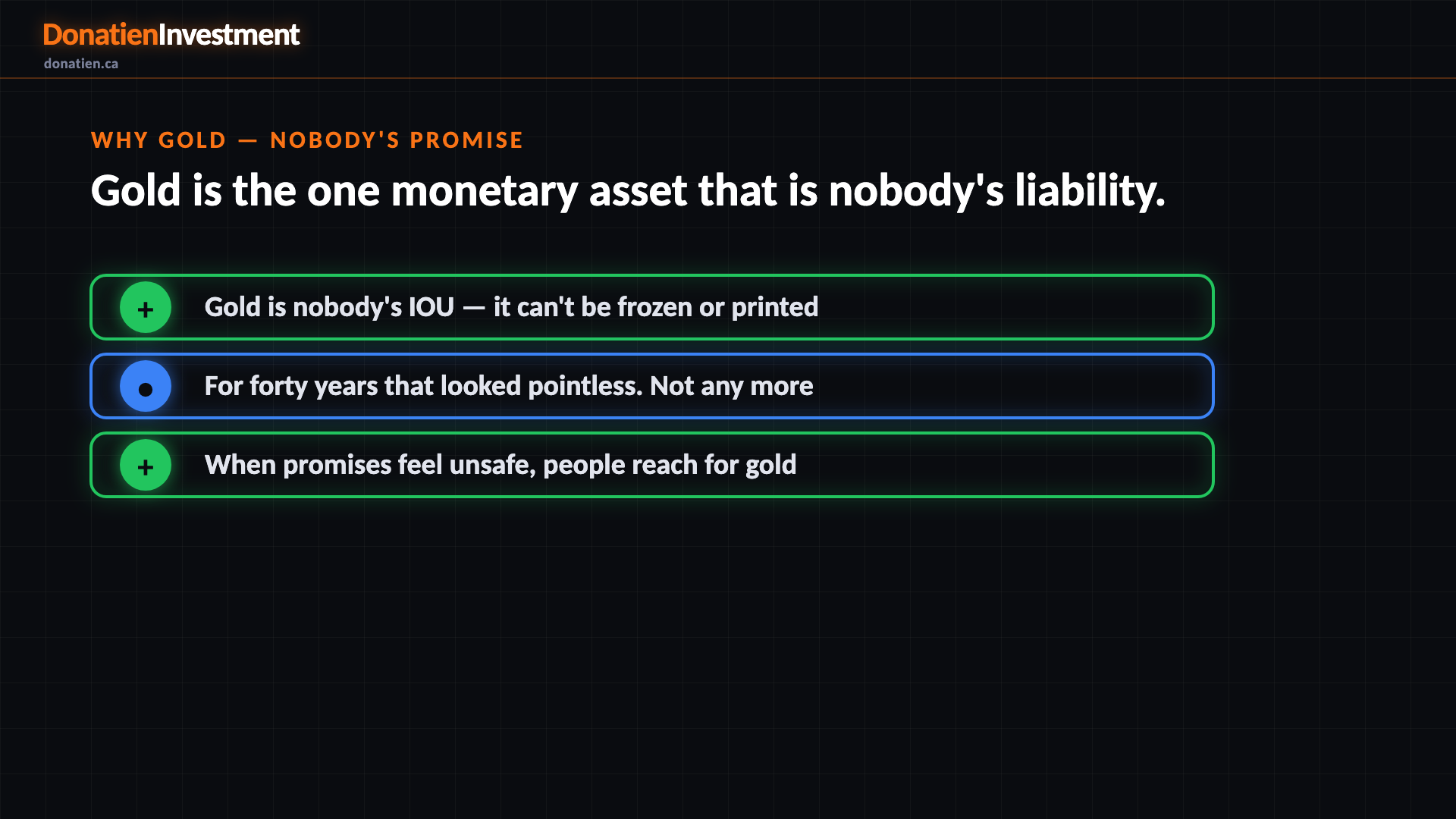
So where do people go when they stop fully trusting a promise? Toward something that isn't a promise. Gold has an ancient, boring advantage that spent decades looking irrelevant and suddenly looks essential. It doesn't depend on anyone. It can't be frozen by a sanctions office, it can't be printed into oblivion by a central bank, and it can't default. For most of the last forty years that didn't matter much — why hold a lump of metal that pays no interest when a government bond pays you and looks just as safe? But a frozen reserve isn't unconditionally safe, and interest that trails inflation isn't really a gain. Strip away those two comforts, and gold owing nothing to anyone stops being a quirk and becomes the entire point.
Layer one — central banks and the Gold Road
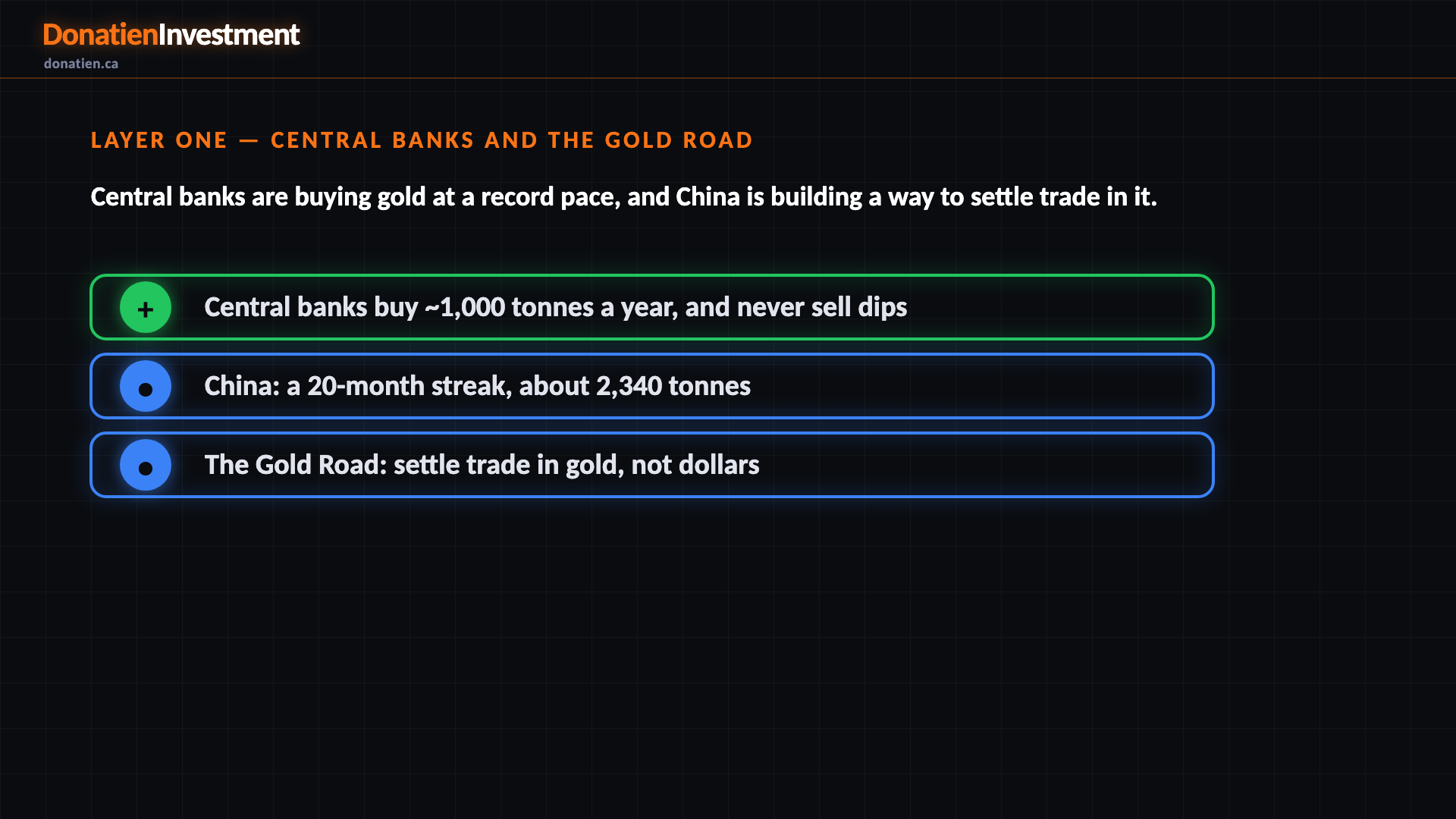
The biggest layer is the official one. Since the freeze, the world's central banks have bought gold on the order of a thousand tonnes a year, and they don't sell on bad days. China's central bank alone has added gold for some twenty months straight, to around two thousand three hundred and forty tonnes. On top of the buying, China is building what's called the Gold Road: its Shanghai exchange trades gold priced in yuan, backed by real metal in offshore vaults, with a new Hong Kong benchmark for gold you can actually take delivery of. Here's the clever part. Nobody really wants to hold yuan, because China won't let money move freely in and out. So the deal is: sell China oil, take yuan, and convert it straight into physical gold at Shanghai. No dollar ever touches the trade. The yuan doesn't have to be trusted — it just has to be a bridge into gold.
Layer two — savers and the hidden tax
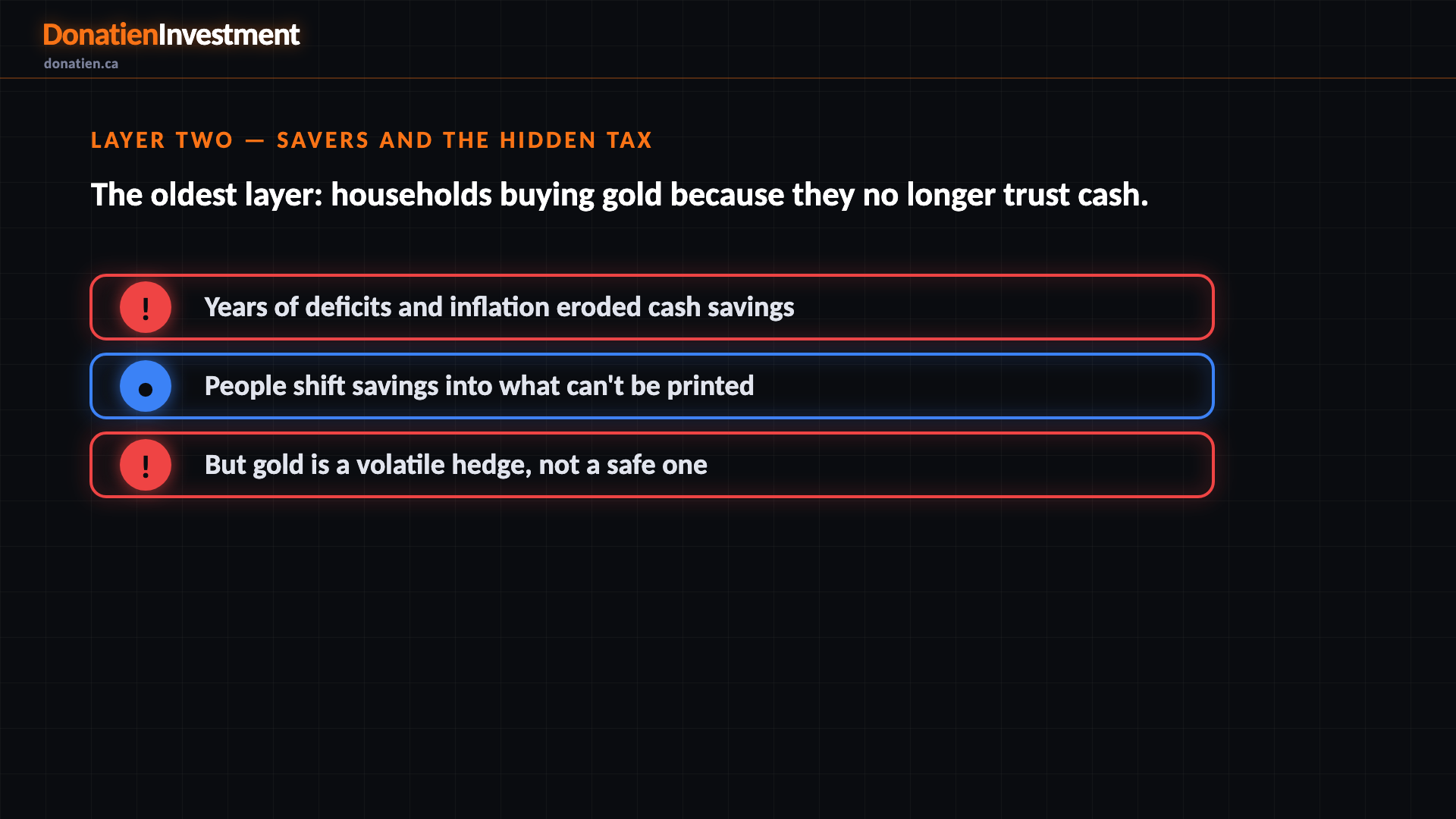
The quietest layer is the oldest one: ordinary people buying gold because they no longer trust cash to hold its value. When you sense your money is losing value faster than a savings account replaces it, you convert a slice of it into something that can't be printed. That's not new — it's the oldest monetary instinct there is. What's new is how visible the reason has become, after years of large deficits and money creation and inflation. Our earlier Debt Machine report explained that hidden tax in full; this report is the practical sequel — gold is one of the things people move toward when they feel it. One honest caveat, said loudly: gold is a volatile hedge, not a safe one. It fell twenty-eight percent in five months this year, so this protection comes with white knuckles.
Layer three — gold on a blockchain
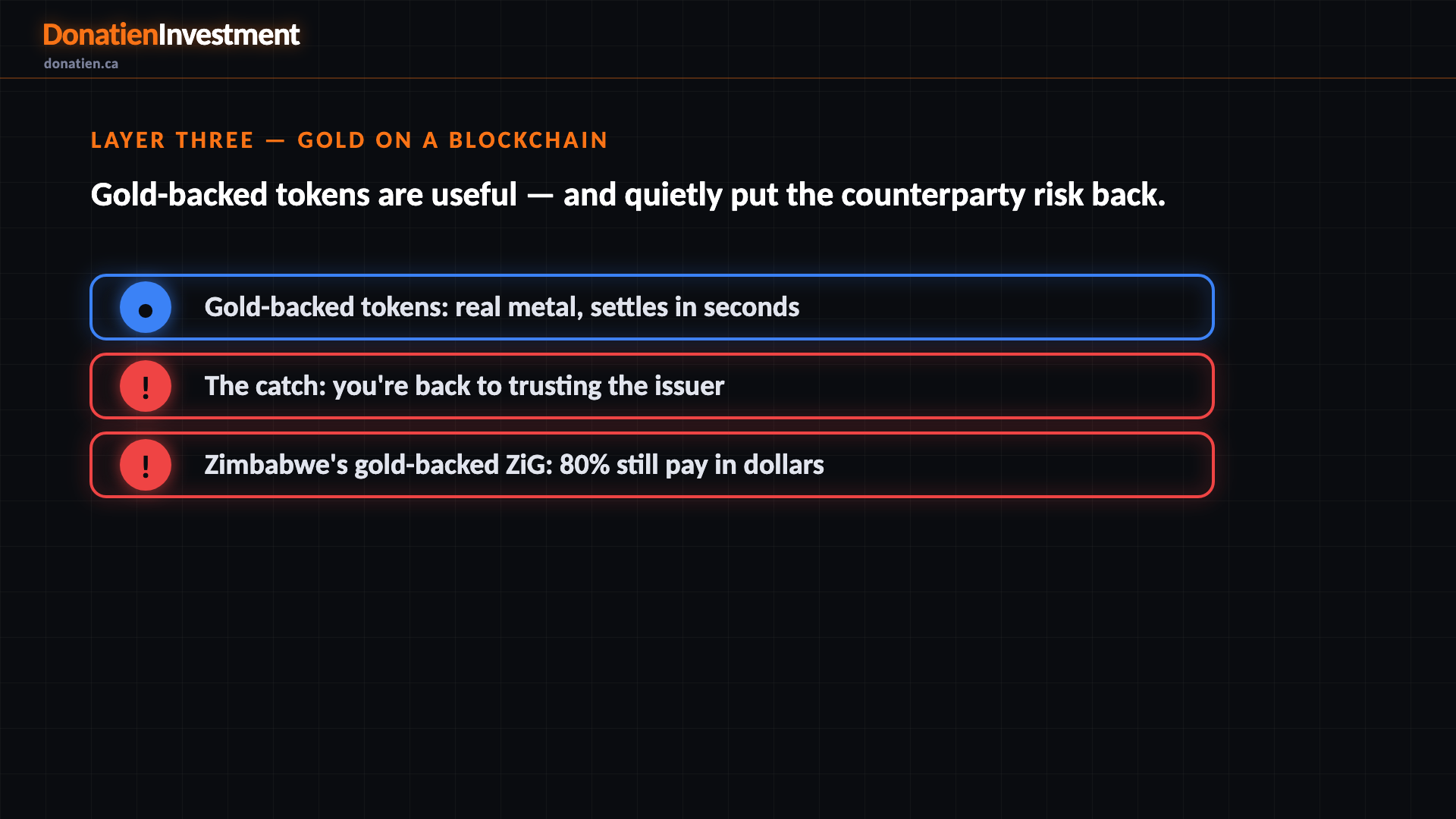
The newest layer puts gold on a blockchain. A gold-backed stablecoin is a digital token, each unit backed by a real ounce in a vault, that you can send like a crypto payment and settle in seconds. It's genuinely useful, and serious banks are exploring it — but the whole category adds up to only about six billion dollars, a rounding error next to the dollar. And here's the irony you must not miss. Physical gold's whole magic is that it's nobody's promise. A gold-backed token quietly puts the promise back: you're no longer trusting a government, you're trusting a company to actually hold the bar, audit it honestly, and honour your redemption. You've swapped one counterparty for another. And when a government tries gold-backing directly — Zimbabwe's ZiG currency — you see the limit: about eighty percent of transactions there still happen in US dollars, because gold backing can't manufacture trust a government hasn't earned.
What it means for gold and the dollar
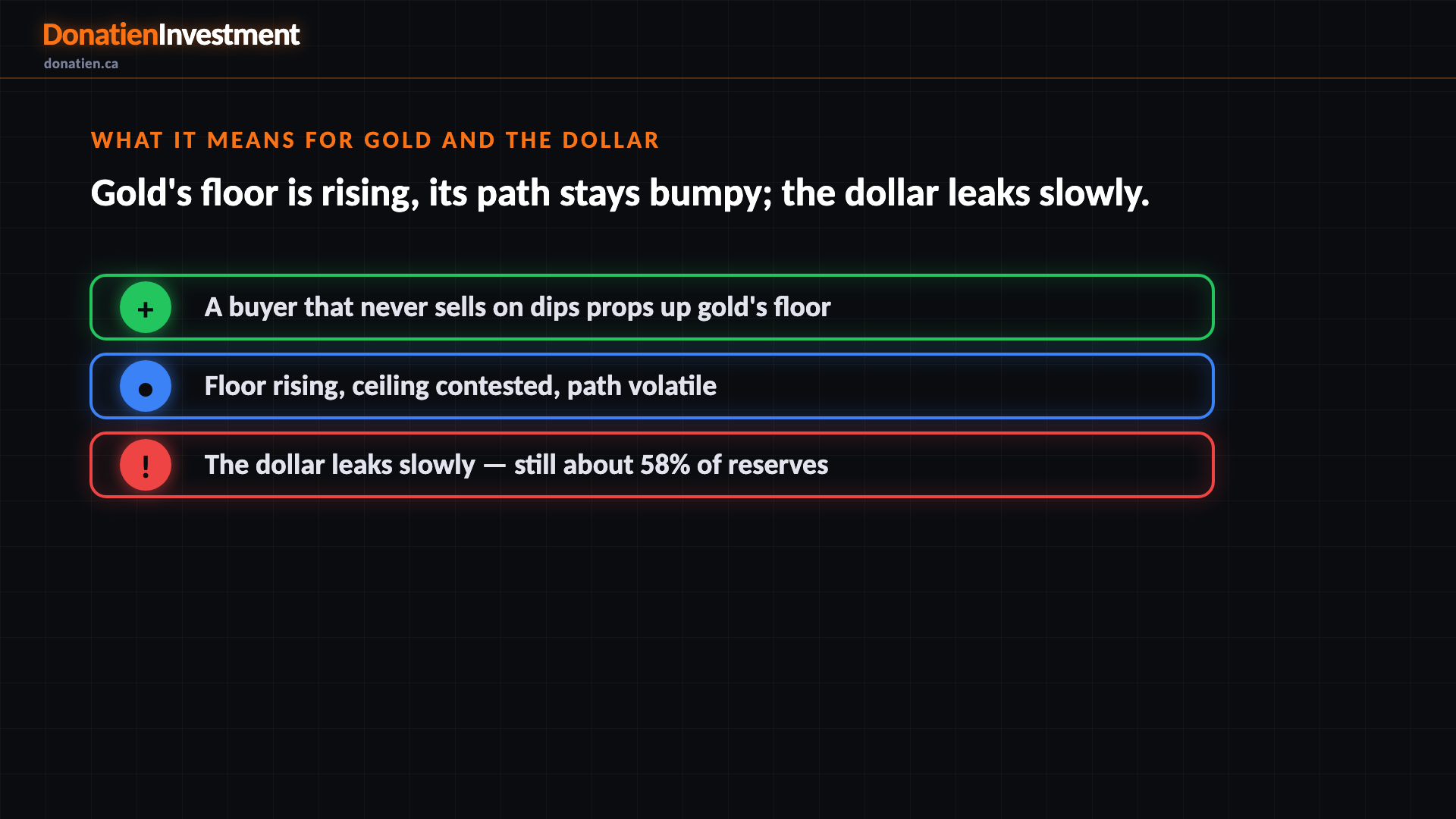
So what does all this do to the price of gold, and to the dollar? For gold, the mechanism leans one way: a persistent buyer that keeps buying even while the price falls, plus metal draining into vaults, plus a physical market loosening the grip of paper trading. Together that lifts the floor under gold over time. But it is not a straight line up — gold just fell twenty-eight percent this year even with every one of these forces already in place, because real interest rates are high and gold pays nothing. Floor rising, path bumpy. For the dollar, every trade settled in gold is a trade that created no demand for dollars, so its privilege thins — slowly, at the margin. But keep the scale honest: the dollar is still about fifty-eight percent of world reserves, and every gold token on earth adds up to around six billion. This is a slow re-pricing, not a collapse.
What breaks this — the honest counter-case
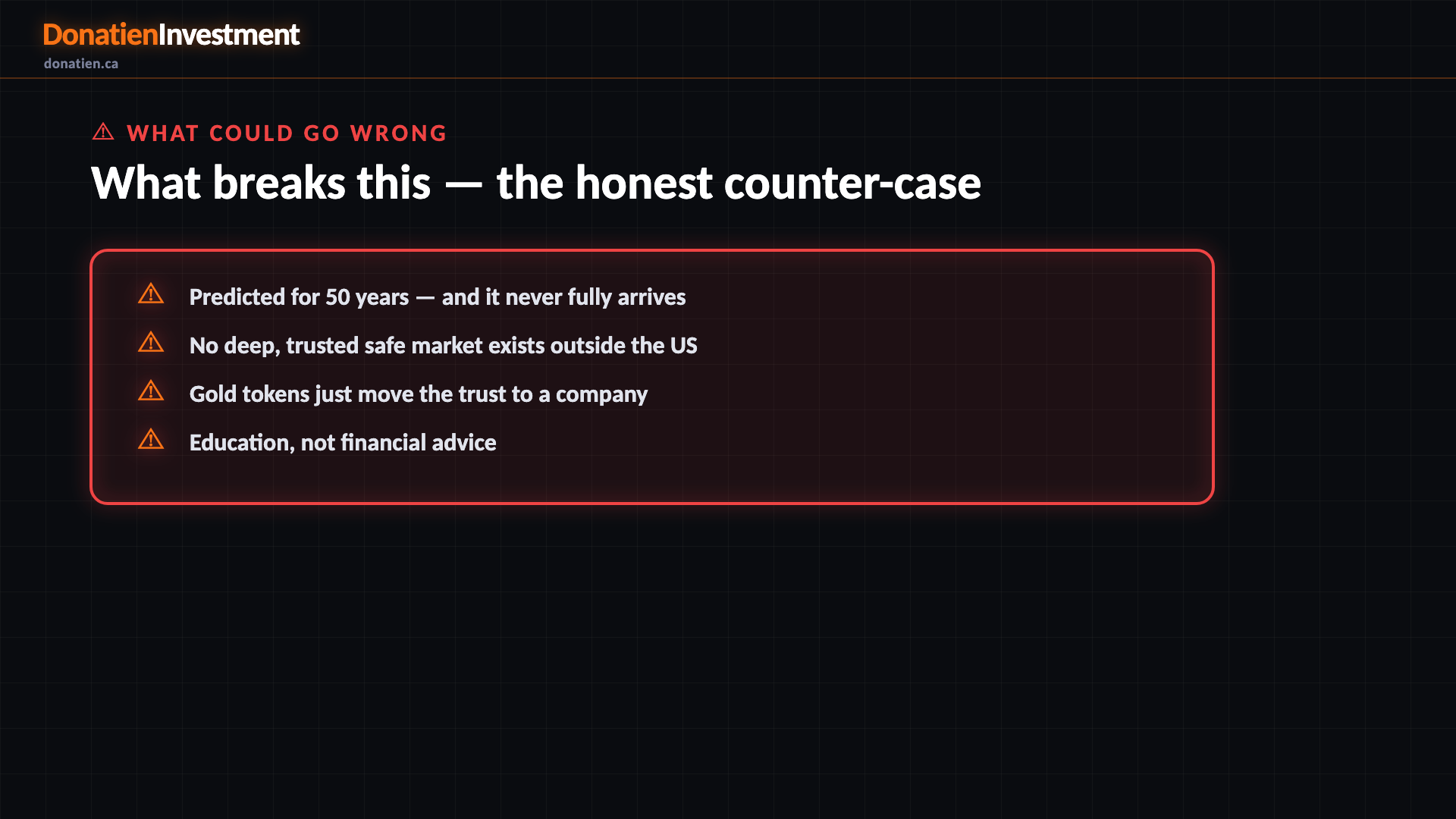
Now the other side, at full volume, because none of this is certain. 'Gold is money again' has been predicted every decade for fifty years and never fully arrives. Gold pays no interest and is clumsy to settle with — you can't wire a bar — and its digital versions just move the trust to a company. There is still no deep, open, trusted market outside the United States big enough to hold the world's savings, and network effects are brutally sticky: everyone uses dollars because everyone else uses dollars. The likeliest outcome is unglamorous — fiat stays dominant while gold grows at the edges. And this is education, not financial advice: it names no investments and makes no promises.
Risk vs Reward
Putting rough numbers on the uncertainty. The base case — gradual re-monetisation, gold growing at the edges while fiat stays dominant — is about fifty-five percent. It stalling, with trust holding and inertia winning, is about twenty-five percent. And a trust shock that speeds the whole thing up is about twenty percent. Most likely a slow drift, a real chance it stalls, a smaller chance a rupture accelerates it.
The verdict
So, the whole thing in one breath. Trust in paper money is fraying at both ends — frozen reserves and eroded savings — and gold is quietly becoming money again in response, across three layers: central banks and China's Gold Road, savers fleeing the inflation tax, and gold-backed digital tokens. It is a real, structural shift. It is also early and small, and it does not spell the end of the dollar. The honest shape is a rising floor and a bumpy path for gold, and a slow leak, not a burst pipe, for the dollar. Financial freedom comes from understanding the plumbing — not from betting the house on a headline.
Read the full report on donatien.ca →